reseña de libro: El oro del desierto, por Cristina Pacheco, narrado por Elka Rodriguez

una colección poderosa, variada, y a veces hasta entretenido sobre la vida en las afueras de la Ciudad de México

Cristina Pacheco inicia esta colección de cuentos con un prólogo autobiográfico que es tanto interesante como poderoso, un recuerdo de la experiencia de la autora en mudarse del campo de México hasta la ciudad por necesidad cuando era joven y las dificultades que pasó su familia (hasta estar pidiendo limosnas) para dar educación a los niños. “Perdimos la tierra y ganamos la escuela.”

“Sería difícil resumir aquí la historia de los marginados, esa multitud anónima que edifica las casas que no habita, que hace productos que no consume, que cultiva alimentos que no come, que paga una deuda que jamás contrajo ni la benefició. Intentaré, en cambio, recoger el testimonio de quienes dentro, en las proximidades del Distrito Federal, se dedican a la agricultura enfrentando diariamente el deterioro causado por las aguas contaminadas, por los mantos agotados, por los avances de la ciudad que asfixian la que antes fueron tierras cultivables.” Yo diría que ella capta una gama de experiencia mucha más amplia.

Sigue una colección de cuentos que se trata de todo aspecto de la vida no tan solo mexicana sino – en muchos aspectos – de la vida de cualquier:

* una familia que experimenta el estigma del SIDA y que tiene que mudarse a un nuevo pueblo y borrar la existencia de su hijo fallecido,
* unos pueblos vacíos porque todos los jóvenes se han mudado a la ciudad para el trabajo,
* la frustración de los profesionales que tienen que buscar trabajos de labor a causa de la situación economía,
* unas parejas frustradas y celosas por mucho tiempo de estar separados a causa de la migración para el trabajo,
* El estrés que se crea entre empleador e empleado en el sector informal cuando haya un accidente en el trabajo,
* y mucho más.

No cada cuento es obra de arte, pero todos son cortitos y may muchos más buenos de lo que hay de los menos interesantes. Aunque el tema es de pérdida, de frustración, de desesperación, Pacheco tiene una forma de meter un tono no totalmente desesperado. Nos hace sentir que algunos de estos cuentos podrían ser de nosotros.

Comparando esta colección con su colección anterior El corazón de la noche, recomendaría los dos libros sin reservación pero éste me cayó mejor por el prólogo autobiográfico. Una nota con respecto al contenido: Al describir la vida de los desesperados, hay unas palabrotas y unas alusiones (no tan gráficos, según me acuerdo) al sexo. Con éste libro y el anterior por Pacheco, escuché el audiolibro de Recorded Books Audiolibros (cada libro era 4 discos). Esta narradora – Elka Rodriguez – tiene la voz más alta así que a veces me confundió cuando el hablante en el libro era hombre. Pero es una crítica pequeña: en general, Rodriguez lee bien.

book review: Murder on the Links, by Agatha Christie

In my capricious quest to read all of Christie’s Poirot books, I read and enjoyed Poirot’s second outing.

murder, passion, deceit, and true love, served with ample red herrings

In this, Agatha Christie’s third novel and Hercule Poirot’s second appearance (after The Mysterious Affair at Styles), the author and her detective continue to delight and dizzy. Poirot and Hastings travel to France to investigate a murder and we think we’ve reached the bottom of it…about five times. I’d never have guessed the actual solution, but watching Poirot at work and Hastings being wowed by the ladies and not as quick on the case (he’s the reader – i.e., me or you – in the novel, the one we can relate to!) was the real pleasure anyway.

I thoroughly enjoyed the ride.

just dumping computers in schools might not help

In The Use and Misuse of Computers in Education: Evidence from a Randomized Experiment in Colombia, by Felipe Barrera-Osorio and Leigh L. Linden, the authors examine a program that

aims to integrate computers, donated by the private sector, into the teaching of language in public schools. The authors conduct a two-year randomized evaluation of the program using a sample of 97 schools and 5,201 children. Overall, the program seems to have had little effect on students’ test scores and other outcomes. These results are consistent across grade levels, subjects, and gender. The main reason for these results seems to be the failure to incorporate the computers into the educational process. Although the program increased the number of computers in the treatment schools and provided training to the teachers on how to use the computers in their classrooms, surveys of both teachers and students suggest that teachers did not incorporate the computers into their curriculum.

Two thoughts on this:

  1. This reminds us – and I’d say “as if we needed reminding” except that we do – that you cannot just dump inputs into schools and expect changes.  If inputs don’t get used well, they don’t matter.  Even though this seems like a no-brainer, many development programs are very narrow: build a school or give some books or ….  Same problem, I’m afraid.
  2. That said, a quick look at the tables suggests to me that the authors may be confusing a noisy result with a narrowly bound zero result.  In other words, there seem to be differences in outcomes between kids who got computers and those who didn’t, but there is so much variation in both groups that we cannot be sure.  What this really means is that we don’t know if there is an effect, that there might be a heterogeneous effect, or there might not.  (Either way, clearly this program wasn’t a raging success.)

There is also some evidence from India (I haven’t evaluated the quality) that if you just let kids play with the computers, they’ll learn some stuff.  (One question is, Do they learn things that will help them?)

resenha de filme – Noel: Poeta Da Vila

I continue my effort to gain comprehension of Portuguese through films.  In this film, I learned about a monument in Brazilian musical history: Noel Rosa.  The film is a better-than-average biopic, the people are attractive, and the music is awesome! 

bom filme biográfico sobre um músico excepcional: a música do filme é – como se esperaría – excepcional!

Este filme conta a vida de Noel Rosa, o carioca «filósofo da samba».  Embora Noel morreu aos 26 anhos, logrou muito.  Para os não brasileiros como eu, esta historia é uma introdução bem-vinda a vida de um músico increívelmente influente.  A trama do filme não é excepcional: como qualquer filme biográfico, sigue nosso músico por quasi tuda a sua corta vida.  Mas os valores de produção são altos, os atores e as atrices são bonitos pra olhar, e a musica é ótima.  Começa com seus estudos da medicina até seu primero êxito musical (“Com que roupa?”), seu casamento por obligação, suas aventuras amorosas (incluso com sua musa Ceci), sua luta contra a tuberculose, e – de mais interesse – sua carreira musical.  E a música faz o filme enteiro um prazer para ver!  Que música!  O filme me faz querer sair e comprar tuda a música de Noel e me faz discípulo da samba.


Uma note sobre o conteúdo:  Esta filme não tem clasificação nos EUA mas tería clasificação «R» a causa de algumas cenas com a desnudez femenina e um pouco de violencia.


Blockbuster vs Netflix: Round Brazil

In Brazzil magazine in October 1998, a list of Brazil’s top 50 films was published, compiled by a group of local movie experts. 

I did a quick check to see how many of the top 10 films were available on Blockbuster and Netflix.  (Netflix has the reputation of having more hard-to-find films: Let’s see!)

The verdict:  They each had two available and one more listed in the catalog.

  • B = available on Blockbuster
  • N = available on Netflix
  • b = listed but not available on Blockbuster
  • n = listed but not available on Netflix
  1. Ganga Bruta (Rough Gangue) by Humberto Mauro (1933)
  2. B N Vidas Secas (Barren Lives) by Nélson Pereira dos Santos (1963)
  3. n O Pagador de Promessas (The Promise Keeper) by Anselmo Duarte (1962)
  4. Amei um Bicheiro (I Loved a Numbers Game Runner) by Jorge Ileli (1953)
  5. b Assalto ao Trem Pagador (The Pay-Train Robbery) by Roberto Farias (1962)
  6. B N Central do Brasil (Central Station) by Walter Salles Jr. (1998)
  7. Deus e o Diabo na Terra do Sol (God and the Devil on the Land of the Sun) by Gláuber Rocha (1963)
  8. Todas as Mulheres do Mundo (All the Women in the World) by Domingos Oliveira (1966)
  9. O Cangaceiro (The Bandit) by Lima Barreto (1953)
  10. A Ostra e o Vento (The Oyster and the Wind) by Walter Lima Júnior (1997)

the rules for Variety Boggle

I’ve just spend the weekend with my sister in Kansas, and we – big Boggle players as are most in my family – refined and piloted a new version of playing Boggle that introduces some fun variations.  (We tried a few variations and this worked best for us.)

If you have the 5×5 Boggle board (sold as Boggle Deluxe or Big Boggle), here is the way to play.  Get a die, take turns rolling the die.  The number on the die determines the rules for the round:

1.  Standard Boggle rules, 4 letters or more

2.  Standard Boggle rules, 5 letters or more

3.  Nouns only (pronouns okay, proper nouns not okay), 3 letters or more

4.  Verbs only (adverbs not okay), 3 letters or more

5.  First person to write down a six letter (or more) word* and then say Got It wins the round.  Winner earns 8 points, everyone else gets Zero.  [If the claimed six-letter word is proved to not be a word, the pretended winner loses 15 points and round ends.]

6.  Roller chooses any of the above games.

Point scheme is as follows: 3 letter word=1 point, 4 letters=1 point, 5 letters=2 points, 6 letters=3 points, 7 letters=5 points, 8+ letters=11 points.

* We tried the first person with a seven letter word, but my sister is one of the best Boggle players I know and even with her, I think this would lead to a lot of dry rounds.  Sometimes 6-letters goes fast, but that’s okay.

Continue reading “the rules for Variety Boggle”

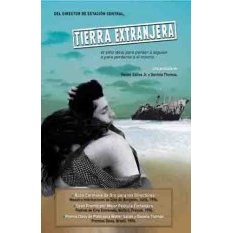
resenha de filme: Terra Estrangeira

tierraMy first review in Portuguese!  I’m watching Brazilian movies to try and improve my Portuguese comprehension.  I really enjoyed this gritty, noir Brazilian flick about the loss of identity for immigrants in Portugal, an early film by the director of Central StationThe version I watched had non-optional Spanish subtitles, which meant I actually knew what was going on.  A version with English subtitles – Foreign Land – also exists.

[Note on content: Not rated in the USA, but would be R for one sex scene plus adult themes.]

Um filme «noir» de suspense sobre a desesperança e a perda

Neste filme, do mesmo diretor que fez Central do Brasil, a mãe de um jovem Paco de São Paulo morre de repente e o jovem, sem saber o que fazer, se encontra metido com comerciante que o envia a Portugal para entregar um violino. Entretanto, a mulher Alex – garçonete brasileira em Lisboa – tem o namorado assassinado por comerciantes do mercado negro. As suas vidas se cruzam, os dois perdidos tanto fora (na cidade estrangeira) como dentro (sem saber como sobreviver).

É um filme «noir» (escuro), filmado a branco e preto. É um filme de desesperança e da perda. Gostei muito e o recomendo.

O ruim desta versão é que tem legenda em español que não se pode apagar. Mas o diálogo está no português. Também existe uma edição com legenda em inglês chamado Foreign Land.

[Uma nota sobre o conteúdo: Não tem classificação nos EUA, mas teria classificação de «R» por uma cena de sexo, algo de violência, e também por ter temas adultos.]

reseña del libro (ok, audiolibro): El corazón de la noche, por Cristina Pacheco

corazonMe gustó bastante este libro pero he comenzado con su próximo libro – El oro del desierto, también en audiolibro – y comienza con un prólogo que me impresionó mucho.

cuentos cortitos que captan una gran diversidad de experiencia

La autora de esta conjunto de cuentos busca explorar cada aspecto de la vida mexicana. Casi no se pueden llamar cuentos sino cuentitos; cada uno es cortito pero se trata de algo completamente distinto. Desde lo político [la policía corrupta en la capital, la tortura a parte de los militares] hasta lo doméstico [el patriarca de un gran familia se da cuenta de que sus hijos sólo quieren su pensión; una señora lamenta haber quedado una noche con un hombre que ahora la llama esposa pero nunca su amor] hasta los asuntos del medio ambiente [una señora busca los restos de su esposo después de un gran terremoto; varios personajes buscan manera de sobrevivir a pesar de la falta constante de agua].

Sé que suena deprimido, y de verdad no es el asistir el circo, pero Pacheco de vez en cuando alivia la tensión con un humor irónico o una situación absurda.

En verdad, me encantaban muchos de los cuentitos y recomendaría el libro a cualquier. Creí sentir el tono de la vida mexicana, especialmente para los de la capital y las partes cercanas. También me dio perspicacia a la simple vida humana.

Nota con respeto a contenido: Este libro tiene unas palabrotas y unas referencias (no muy explícitas) al sexo. Escuché el audiolibro narrado por Mariana Carreño y publicado por Recorded Books y la narración fue muy buena.

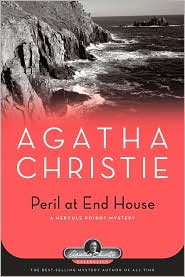
book review: Peril at End House, by Agatha Christie

Another fun entry in the Poirot series…

a lovely diversion with an ending not to be guessed

Captain Hastings and Hercule Poirot are on holiday when they learn that several attempts have been made on a local girl’s life. Poirot seeks to stop a future murder, with mixed success.

This is the 8th published work featuring Poirot (6th novel), and while not the finest (The Murder of Roger Ackroyd, perhaps? I have not read them all…yet), it made for a pleasurable travel diversion while waiting in Brazilian airports. As the New York Times Book Review said of this novel in 1932, “With Agatha Christie as the author and Hercule Poirot as the central figure, one is always assured of an entertaining story with a real mystery to it” [1].

[The previous Poirot works are – in order – The Mysterious Affair at Styles, Murder on the Links, Poirot Investigates, The Murder of Roger Ackroyd, The Big Four, The Mystery of the Blue Train, and Black Coffee (a play later adapted as a novel).]

Note on potentially objectionable content: Sexist protagonists (Women, they are impatient!) and murder as entertainment.

[1] Isaac Anderson, March 6, 1932, p20. Quoted in the wikipedia entry for this book.