gracefully impersonating Einstein

In 1951, while he [Albert Schweitzer] was traveling by train in America, two ladies approached his compartment and diffidently asked, “Have we the honor of speaking to Professor Einstein?”  “No, unfortunately not,” he replied.  “However, he is a very old friend of mine – would you like me to give you his autograph?”  And he wrote, “Albert Einstein, by way of his friend Albert Schweitzer.”

The next year Schweitzer won the Nobel Peace Prize.  From Human Goodness, by Yi-Fu Tuan, p51.

reseña de libro: El oro del desierto, por Cristina Pacheco, narrado por Elka Rodriguez

una colección poderosa, variada, y a veces hasta entretenido sobre la vida en las afueras de la Ciudad de México

Cristina Pacheco inicia esta colección de cuentos con un prólogo autobiográfico que es tanto interesante como poderoso, un recuerdo de la experiencia de la autora en mudarse del campo de México hasta la ciudad por necesidad cuando era joven y las dificultades que pasó su familia (hasta estar pidiendo limosnas) para dar educación a los niños. “Perdimos la tierra y ganamos la escuela.”

“Sería difícil resumir aquí la historia de los marginados, esa multitud anónima que edifica las casas que no habita, que hace productos que no consume, que cultiva alimentos que no come, que paga una deuda que jamás contrajo ni la benefició. Intentaré, en cambio, recoger el testimonio de quienes dentro, en las proximidades del Distrito Federal, se dedican a la agricultura enfrentando diariamente el deterioro causado por las aguas contaminadas, por los mantos agotados, por los avances de la ciudad que asfixian la que antes fueron tierras cultivables.” Yo diría que ella capta una gama de experiencia mucha más amplia.

Sigue una colección de cuentos que se trata de todo aspecto de la vida no tan solo mexicana sino – en muchos aspectos – de la vida de cualquier:

* una familia que experimenta el estigma del SIDA y que tiene que mudarse a un nuevo pueblo y borrar la existencia de su hijo fallecido,
* unos pueblos vacíos porque todos los jóvenes se han mudado a la ciudad para el trabajo,
* la frustración de los profesionales que tienen que buscar trabajos de labor a causa de la situación economía,
* unas parejas frustradas y celosas por mucho tiempo de estar separados a causa de la migración para el trabajo,
* El estrés que se crea entre empleador e empleado en el sector informal cuando haya un accidente en el trabajo,
* y mucho más.

No cada cuento es obra de arte, pero todos son cortitos y may muchos más buenos de lo que hay de los menos interesantes. Aunque el tema es de pérdida, de frustración, de desesperación, Pacheco tiene una forma de meter un tono no totalmente desesperado. Nos hace sentir que algunos de estos cuentos podrían ser de nosotros.

Comparando esta colección con su colección anterior El corazón de la noche, recomendaría los dos libros sin reservación pero éste me cayó mejor por el prólogo autobiográfico. Una nota con respecto al contenido: Al describir la vida de los desesperados, hay unas palabrotas y unas alusiones (no tan gráficos, según me acuerdo) al sexo. Con éste libro y el anterior por Pacheco, escuché el audiolibro de Recorded Books Audiolibros (cada libro era 4 discos). Esta narradora – Elka Rodriguez – tiene la voz más alta así que a veces me confundió cuando el hablante en el libro era hombre. Pero es una crítica pequeña: en general, Rodriguez lee bien.

book review: Murder on the Links, by Agatha Christie

In my capricious quest to read all of Christie’s Poirot books, I read and enjoyed Poirot’s second outing.

murder, passion, deceit, and true love, served with ample red herrings

In this, Agatha Christie’s third novel and Hercule Poirot’s second appearance (after The Mysterious Affair at Styles), the author and her detective continue to delight and dizzy. Poirot and Hastings travel to France to investigate a murder and we think we’ve reached the bottom of it…about five times. I’d never have guessed the actual solution, but watching Poirot at work and Hastings being wowed by the ladies and not as quick on the case (he’s the reader – i.e., me or you – in the novel, the one we can relate to!) was the real pleasure anyway.

I thoroughly enjoyed the ride.

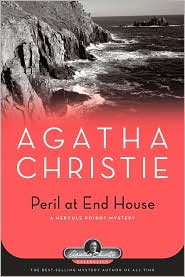
book review: Peril at End House, by Agatha Christie

Another fun entry in the Poirot series…

a lovely diversion with an ending not to be guessed

Captain Hastings and Hercule Poirot are on holiday when they learn that several attempts have been made on a local girl’s life. Poirot seeks to stop a future murder, with mixed success.

This is the 8th published work featuring Poirot (6th novel), and while not the finest (The Murder of Roger Ackroyd, perhaps? I have not read them all…yet), it made for a pleasurable travel diversion while waiting in Brazilian airports. As the New York Times Book Review said of this novel in 1932, “With Agatha Christie as the author and Hercule Poirot as the central figure, one is always assured of an entertaining story with a real mystery to it” [1].

[The previous Poirot works are – in order – The Mysterious Affair at Styles, Murder on the Links, Poirot Investigates, The Murder of Roger Ackroyd, The Big Four, The Mystery of the Blue Train, and Black Coffee (a play later adapted as a novel).]

Note on potentially objectionable content: Sexist protagonists (Women, they are impatient!) and murder as entertainment.

[1] Isaac Anderson, March 6, 1932, p20. Quoted in the wikipedia entry for this book.

audiobook review: Invasion of the Body Snatchers, by Jack Finney

This was AWESOME.

brilliant, fast paced 1950s science fiction thriller

Dr Miles Bennell, a general practitioner in a quiet California town, notices a strange psychological epidemic. People begin believing that their loved ones aren’t really their loved ones. And then he finds the seed pods…

This is a brilliant suspense thriller from the 1950s. I listened to the audiobook performed by Kristoffer Tabori, published by Blackstone Audio [and available here under the “Audio CD” edition]. Tabori was the perfect narrator: he really made the story come alive. I couldn’t put my mp3 player down! And to boot, Tabori’s father directed the original film and the audiobook includes an interesting interview at the end with Tabori about his father’s film.

I listened to this during a business trip to Brazil and it was perfect escape listening. Only at one point did the characters make a ludicrous decision (like when people split up in horror movies); incidentally that part was cut from the original movie. And in this “updated” version, the date of the action is moved to the 1970s, even though it seems little else is updated, including the gender roles which feel very 1950s. The ending was a little quick; I had to listen to it twice to catch all that happened, and even so I have a couple of questions. But if you can handle that, What a ride! I loved this and immediately sent off for the 1950s movie. Highly recommended: the funnest audiobook I’ve listened to in months!

Note on potentially objectionable content: a smattering of “light” profanity, 1950s gender roles, and it’s Very Scary.

audiobook review: Martian Time-Slip and the Golden Man, by Philip K Dick

Dick is always a total trip, and this is no exception.  Great human drama.

what is reality? take a look inside a troubled mind

At one point in this book, I said to myself, If anyone was in doubt as to whether Philip K. Dick took drugs, here is confirmation. But I was just mixed up in the time slips.

It is the future. Humans have colonized Mars but life is hard on the colony with little water and scant employment. The native Martians are a low class. Jack is a repairman whose path crosses that of Arnie Cott, a corrupt local power broker. There are time warps and visions of the future, schizophrenics who live in a different time realm, and Martians with special powers.

But really this book is about people dealing with fear and with suffering, about power and its misuses. And it asks the question, What is reality? What do we really know about it?

Not much.

I enjoyed it. I listened to the audiobook narrated by Grover Gardner and published by Blackstone Audiobooks. Good reading. [Note on content: one character uses profanity regularly, and there are one or two brief, not-particularly-graphic sex scenes.]

The audiobook includes an additional CD with the story The Golden Man, ostensibly the basis for the Nicholas Cage movie Next. In fact, the two have nothing in common except the idea that a person can see the future, but I enjoyed both.

book review: The Mysterious Affair at Styles, by Agatha Christie

I have taken to reading very light fiction when I travel.  And I’m on an Agatha Christie jag right now.  This is her first published book ever!  My thoughts:

wonderful travel reading, a great start to an incredible career (for both Christie and Poirot)

It’s exciting to read the first published novel of the world’s best selling author of all time. After reading The Murder of Roger Ackroyd, I decided to read all of the Hercule Poirot mysteries, and this is a natural beginning. We meet the detective Poirot, a Belgian refugee in England, and his future traveling companion, Arthur Hastings.

The powerful matron of a wealthy family is poisoned in her sleep! Whodunnit?

I felt the book started a wee bit slow (as always with the first in a series, no?), but once the poisoning happened, it was difficult to put down. Perfect reading for a long flight to Brazil.

Highly recommended as travel reading (or whenever else you may need a diversion). For the rest of my trip, I’ve brought Murder on the Orient Express and Hallowe’en Party. Poirot to the rescue!

[Note on content: No objectionable content, unless you count poisoning an elderly woman or the general idea of murder as entertainment.]

book review: Predictably Irrational, by Dan Ariely

fun writing, fascinating experiments, lots of learning; not enough introspection

Dan Ariely was a victim of serious burns as a youth which left his body covered with serious burns. After surviving the burns and the consequent treatments, he designed some experiments to see how to make treatments less painful, then went back to his hospital and shared the findings with the staff.

In this book, Ariely shares a host of experiments that he has carried out in behavioral economics (the branch of economics that looks at how people deviate from the standard economic assumption of people being logical, calculating, and rational). The experiments are fun, fascinating, and insightful. He shows us our irrational obsession with free things using experiments with Hershey kisses and truffles; he shows the oft unnoticed power of “anchoring” prices in an experiment with random numbers and an auction. He and his colleagues do experiments in bars, malls, and classrooms. This is a great introduction to behavioral economics.

One minor weakness is that – like most popular empirical economics books – Ariely is trapped by the work that he himself has done, with minor supplements by others, and so the book jumps around a bit. That said, he has done enough interesting stuff that this isn’t a major flaw.

My main gripe was the lack of introspection as to how much these experiments apply to non-experimental settings. In the introduction, he tells us, “I would like you to think about experiments as an illustration of a general principle, providing insight…not only in the context of a particular experiment but, by extrapolation, in many contexts of life” (p. xxi). Why? Should we just take Dan’s word for it? Beyond the question of extrapolation from the experimental setting, the vast majority of experiments are on undergraduate or graduate students, with little meditation on whether results might vary for different demographics.

That said, I thoroughly enjoyed the read. Read it, enjoy it, share stories with your friends, and take a few minutes to think through the questions that Ariely didn’t.

And would someone – please – design a better-looking cover for the second edition?!

reseña del libro: El salón de ámbar, por Matilde Asensi

puro escapismo, no tan original, pero entretiene bastante de todos modos

Una señora, parte de un grupo internacional de ladrones de arte, roba una pintura para un cliente. Pero debajo de la pintura, ¡encuentra otra pintura misteriosa! Esta le lleva a ella y a unos compañeros a una búsqueda para el legendario «salón de ámbar», un premio valeroso en la historia de Rusia. De allí en adelante hay acción, tecnología, amor, traición, pasión, y todos los otros ingredientes que te gustarían en un cuento de este tipo.

No es un libro que voy a comprar y leer vez tras vez, pero en cuanto lo leía, no me fue fácil dejarlo para otras actividades.

Escuché el audiolibro, narrado por Adriana Sananes. Fue bien narrado.

[Este libro no tiene nada de ofensivo menos la glorificación del robo: ni la violencia ni la pasión son explícitas, ni hay palabrotas.]

my dubious popularity among African students

In March of 2008, I published a short review of the Senegalese classic novel, The Beggars’ Strike, by Aminata Sow Fall.  A number of the comments on that post have suggested that the book is assigned reading somewhere:

  • i am a student i realy realy enjoy the play (feb 2009)
  • Hi, please i need urgent help on my project topic IRONY OF FATE IN AMINATA SOWE FALL “BEGGAR’S STRIKE”. Will be very happy if anyone can help me with relevant materials to aid me in writing my final year project. Thanks alot!!!!!!!!. (may 2009)
  • please i urgently need help on writing on discussing the general setting of the beggar’s strike in relation to the writer’s handling of the theme. thanks (july 2009)
  • can i please know how dose the setting of the book relates to its theme? (july 2009)
  • hi, i need the summery of the novel the beggars strike please kindly send it to my mail box which is –. thanks in anticipation. (july 2009)
  • sir the book has really tells us africa background, however sir i want to know the theme of oppression in the novel (july 2009)
  • I love this novel but i need to know if it is totaly a satire (nov 2009)
  • pls can u summarize the entire book (dec 2009)

and much more!  I only wish I could be of more use.  Maybe I could post a couple of sample term papers based on the book?  Alas, mine is a paltry little review…