My books are bathed in blood and water. Because I love them.

I’ve been listening to the delightful podcast “Witch, Please,” in which two professors lovingly and critically dissect the Harry Potter books and films. In Episode 3 (The Chamber of Spoilers), Hannah McGregor treats us with this image of a true bibliophile:

I’m very hard on my books, and I really like reading in the bath. So most books that I have enjoyed in my life are in really bad condition. They also often have blood on them, ’cause I… Never mind.

I am reminded of Anne Fadiman’s wonderful essay “Never do that to a book,” in which she distinguishes between two types of bibliophiles — those who feel courtly love toward books, and those who feel carnal love. I think we know what kind of book-lover Professor McGregor is. Me too!

The image is from the Witch, Please podcast, which I strongly recommend. 

Is it depressing when the characters you relate to in The Little Prince are the sad adults?

I just revisited Le Petit Prince, by Antoine de Saint Exupéry. I listened to the lovely audiobook in French — narrated by Bernard Giraudeau (available on Audible and also on Youtube) — while reading along in the French paperback. If you haven’t read this beautiful story — in whatever language — I recommend it.

At one point in the book, the little prince visits a range of planets, each with a single inhabitant: a king, a drunk, a lamplighter, a geographer… Each demonstrates the folly of some aspect of adulthood. Perhaps sadly, I found myself relating to some aspect of each of the adults. The lamplighter and his obsession with fulfilling his duties without thinking of meaning. The geographer and his obsession with the permanent. The businessman and his counting, counting, counting. Thankfully, a fox shows up to remind us of what is good and true.
adults
Time to get back to recognizing a picture of a boa consuming an elephant.

(I read it in French once before and reviewed it here.)

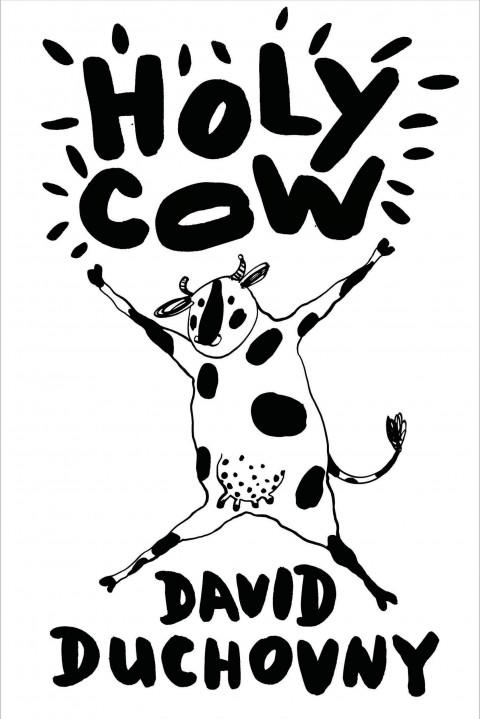
a cow, a pig, and a turkey board an international flight – a review of David Duchovny’s Holy Cow

If that sounds like the opening of a joke, that’s because it is! David Duchovny’s first novel, Holy Cow, is a fun, silly romp. I laughed aloud more than once, but not continuously.

In short, a farm cow looks into the family room of the farmer’s home and sees a TV program showing her bloody fate. But she also sees that there’s a land where cows are revered: India. She seeks to get there, along with a pig who wants to go to Israel and a turkey who wants to get to Turkey. As you can imagine, mayhem ensues.

Who is this book aimed at? No idea. If it were a movie, it would be a PG-13 for language, and despite the anthropomorphized animals, most of the humor is over the heads of smaller children. But I enjoyed it.

A few tidbits:

On global warming: “Stop blaming me and my gas for global warming. I can’t drive a car.”

On selfies: “Selfies they call ’em, and that makes sense ’cause even though they’re sending these pictures to others, it still smells like selfish to me. Is that why they call it an ‘I phone’?”

On TV: “I realized that the Box God is not just one god, but many gods in one box. … It seemed that everyone in the family wanted to worship different gods. The youngest girl wanted to worship the Nickelodeon God, the dad wanted to worship the ESPN God…while the mom was happy with this Discovery God. Mom won out. Everybody else…left the room grumbling, and I realized that all humans must have a Box God in their own rooms. … What a strange god that instead of bringing people together, divides them.”

On plane behavior: “None of the flight attendants gave us any trouble, ’cause everyone acts like an animal on a plane.”

It was light and entertaining and occasionally a little bit thoughtful.

POSITIVE
Kirkus – “a charming fable about dignity and tolerance, complete with anthropomorphized animals and replete with puns, double-entendres, and sophisticated humor” https://www.kirkusreviews.com/book-reviews/david-duchovny/holy-cow-duchovny/

Denver Post – “a seriously entertaining fable that doesn’t take itself too seriously.” http://www.denverpost.com/2015/02/12/book-review-holy-cow-by-david-duchovny/

The Guardian – “although Elsie’s “memoir” feels slight, and reads too often like a funny first draft of something more substantial, it does what all good animal novels do – it makes us think about our relationship with the other species we share the planet with.” https://www.theguardian.com/books/2015/feb/04/holy-cow-david-duchovny-review

MIXED
HuffPost – “the book seems to have no real idea who its audience is or what it’s actually about…The sheer absurdity of this roller coaster of a book makes for some knee-slapping moments, however.” http://m.huffpost.com/us/entry/6598702.html

NEGATIVE
“Holy Cow is one of the most half-baked, phoned-in books I’ve ever read, and it’s hard to look at it as anything but a vanity project.” http://www.npr.org/2015/02/07/383875612/dont-have-a-cow-man

How to design conference name badges

If you’re lucky, you’ve never had to think about this. But I’ve been involved in enough conference organizing to wonder what’s best: the string or lanyard around your neck? the clip? the safety pin?

So I asked, and 51 people on Twitter answered.

how to design a conference name tag

So the lanyard or string takes the day. But Alix explained why this is particularly true for women.

If you have the kind of lanyard that swivels, it’s better to have the name printed on both sides.

What else? Alice and Emilia both suggested having the first name BIG with the last name and the institution small, so the emphasis is on the individuals rather than the hierarchy.

So in case you’re the kind of person who has to think about this, maybe this data will be sufficient for you never to have to think about it again.

Oh, and I did receive three alternative suggestions for alternative name tags, only at the most innovative conferences: neck tattoos, magnets, and piercings.

an alien invasion story in a time when people aren’t expecting them – a review of H.G. Wells’s The War of the Worlds

Many people will know The War of the Worlds from the story of its 1938 radio broadcast — directed and narrated by Orson Welles — which apparently was so realistic that some listeners believed a Martian invasion was actually taking place. But 40 years earlier, H.G. Wells published the novel that the radio broadcast was based on. As one of the earliest examples of an alien invasion novel (albeit not the earliest), I found this tale intriguing, despite knowing how it ends. (I saw the Steven Spielberg / Tom Cruise movie a few years ago.)

Here’s the basic premise: A philosopher in England is witness when cylinders start landing on earth. From them emerge squid-like aliens who construct giant walking machines and can kill with lasers and poison gas. Mayhem ensues. Over the course of his journey, the philosopher falls in with a man of faith, a curate, who doesn’t come across well: “He was one of those weak creatures, void of pride, timorous, anaemic, hateful souls, full of shifty cunning, who face neither God nor man, who face not even themselves.”

Nowadays, people have an idea of alien invasions, due to books and films and stories. But it was fascinating to see the invasion take place against a backdrop where people didn’t have a preconceived notion of it. Furthermore, it was intriguing to see how slowly — and inaccurately — information traveled from place to place.

As I read this, I saw its influence in many subsequent science fiction tales. This was part of my “read a book mentioned in a book.” I read David Mitchell’s Slade House, which mentioned John Wyndham’s The Kraken Wakes, which in turn mentioned this. The Kraken Wakes, which I found moderately enjoyable, takes the concept of apparently weak aliens who construct great machines to attack the humans and simply shifts the landing spot from the land to the ocean. The concept of squid-like aliens comes back in Independence Day and in Galaxy Quest.

This was a great introduction to the science fiction of yesteryear. I listened to the unabridged audiobook narrated by Simon Vance. The entire text is available free on-line on Project Gutenberg. If you want an extra treat, check out the wide variety of visual representations of the aliens in this book.

A few tidbits:

  • On police brutality in the face of chaos: “The policemen who had been sent to direct the traffic, exhausted and infuriated, were breaking the heads of the people they were called out to protect.”
  • On pity for creatures less powerful than us: “I, who had talked with God, crept out of the house like a rat leaving its hiding place–a creature scarcely larger, an inferior animal, a thing that for any passing whim of our masters might be hunted and killed. Perhaps they also prayed confidently to God. Surely, if we have learned nothing else, this war has taught us pity–pity for those witless souls that suffer our dominion.”
  • On hope as a habit: “I had still held a vague hope; rather, I had kept a lifelong habit of mind.”
  • On serious books: “We must make great safe places down deep, and get all the books we can; not novels and poetry swipes, but ideas, science books.”

do you think living on under $2 a day is only a problem of developing countries? think again.

a review of Kathryn J. Edin and H. Luke Shaefer’s $2.00 a Day: Living on Almost Nothing in America

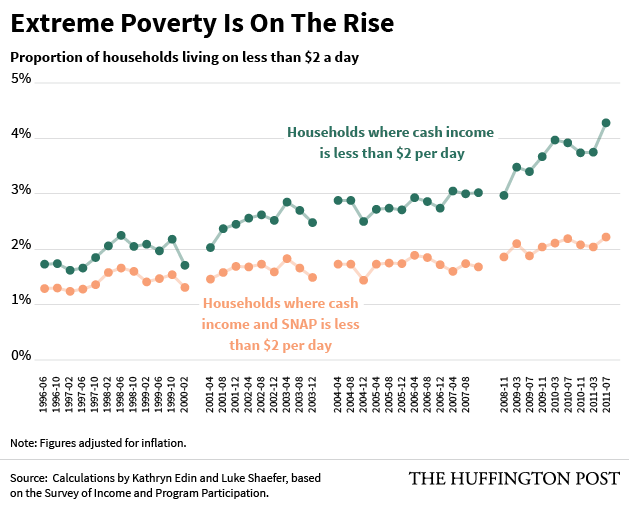
“1.5 million households with roughly 3 million children were surviving on cash incomes of no more than $2 per person, per day in any given month” as of 2011. In $2.00 a Day: Living on Almost Nothing in America, Kathryn Edin and Luke Shaefer compellingly demonstrate how families in extreme poverty in the U.S. survive. They use survey data to characterize the magnitude of the problem, then they follow a wide range of families over time to see how they got where they are and how they are getting by. They provide a quick review of the policies that brought us here (with the extreme poor increasing 4 percent over 15 years), as well as ideas for policies to give families a hand up.

One truth comes through in each family’s story: Every parent here would far prefer a steady job over a welfare payment. But guess what? There aren’t enough jobs at the bottom of the ladder, and the jobs that exist are terrible. As Jared Bernstein writes in his review of the book, “I cannot overemphasize the importance of this fundamental flaw in poverty policy, i.e., the assumption that there is an ample supply of perfectly good jobs out there that poor people could tap if they just wanted to do so.” One woman applied for over 100 jobs before getting a terrible one with irregular hours that ultimately caused enough health problems (from working in unheated spaces in Chicago winters) that she lost almost all of her hours. She is not the exception; story after story confirms her experience. (Anecdote plus anecdote plus anecdote eventually add up to data.)

Even when you include various non-cash benefit programs, the number of extremely poor is far too high, as the Huffington Post figure below shows. And part of what Edin and Shaefer demonstrate in the lives of the families they profile is how difficult it is to survive in the United States without cash: How do you ride the bus for a job interview? How do you obtain appropriate clothing to apply for jobs?

two dollars a day

This book is eye-opening and important. As Bernstein writes, “Doing nothing should not be an option.” And Edin and Shaefer don’t recommend a return to cash welfare. Every person they interview wants a job, so they want the government to help create those, via workfare and public-private partnerships. Regardless of whether you agree with that solution, read this book. I hope that it becomes part of our national conversation. Every other review I’ve encountered agrees, from the New York Times and the Los Angeles Times to the Boston Globe, Kirkus, and Publishers Weekly. Jonathan Cohn has an insightful interview with one of the authors in the Huffington Post.

I listened to the unabridged audiobook. It was well narrated by Allyson Johnson.

Excerpts from other reviews

William Julius Wilson, New York Times: “This essential book is a call to action, and one hopes it will [arouse] both the nation’s consciousness and conscience about the plight of a growing number of invisible citizens. The rise of such absolute poverty since the passage of welfare reform belies all the categorical talk about opportunity and the American dream.”

Stephanie Mencimer, Mother Jones: “$2.00 a Day is an intimate chronicle of the ‘cashless economy'”.

Julia Klein, Los Angeles Times: “History and analysis aside, what will likely remain with readers of ‘$2.00 a Day’ are its indelible pseudonymous portraits of families struggling to survive.”

Nick Romeo, Boston Globe: “Edin and Shaefer’s book is an important exposé on what they describe as ‘a poverty so deep that most Americans don’t believe it even exists.'”

Kirkus Reviews: “The authors share deeply human stories of the regular people trapped in poverty, typically through no fault of their own. Some are victims of abuse, others are forced to quit their low-paying jobs due to health concerns, and some simply cannot catch a break despite playing by the rules. An eye-opening account of the lives ensnared in the new poverty cycle.”

Jared Bernstein, Atlantic Monthly: “Given the lives to which Edin and Shaefer have introduced us, doing nothing should not be an option.”

Publishers Weekly: “This slim, searing look at extreme poverty deftly mixes policy research and heartrending narratives from a swath of the 1.5 million American households eking out an existence on cash incomes of $2 per person per day.”

this protest novel takes you to the heart of the action but doesn’t compel

Remember the World Trade Organization protests in Seattle in 1999? In Sunil Yapa’s debut novel, he takes us back to those protests from a wide range of viewpoints: a peaceful protester with a dark history, a pot dealer who gets caught up in the protests, a peace loving chief of police, another cop itching to take somebody down, a cop who wants to play by the rules, and a government minister from Sri Lanka. If that sounds like a lot of different viewpoints, you’re right. One of my critiques is that I ultimately never felt invested in any of the characters, perhaps because there were so many.

Two major themes come through: The first is that the moderates sell out their principles while the extremists don’t. One deeply committed peacekeeper remains that way throughout, and one violent cop stays that way. But the moderate cops are the ones who go crazy, and the more moderate protester likewise leaps into retaliation.

The second is that people’s pain is caused by a failure to communicate. A protester son does not have the words to explain to his police chief father what he was doing during the protest. The cops fail to listen. These characters are contrasted with the Sri Lankan minister who, mistakenly apprehended with a bus full of protesters, invites each protester to explain their case to him.

Yapa effectively captured the chaos of the clash. “The rules had changed and the cops appeared to have gone temporarily insane.” Even the most apparently reasonable cops lose it in this story, in this situation. There are no unambiguous good guys on that side.

Still, the book often felt overwritten, as people “misplaced their lives like it was something you could lose among the folds of a newspaper” and the like.

I don’t regret listening to this audiobook, but I’m not going to race out and recommend it to anyone else.

I went through 13 professional reviews, excerpted below. Most reviewers agree that Yapa is excellent at capturing the feel and the chaos of the protests themselves, and most agree that he tends toward overwriting. With — by my categorization — 6 positive, 5 mixed, and 2 negative reviews, they disagree on the value of the sum of the parts.

Bits and pieces

  • On a man who has negotiated multiple loans from the IMF on behalf of his low-income nation: “He had the eyes of a man who has just been told his house burned down with his wife and children inside.”
  • On much of my empirical experience: “The more he saw, the less he understood.”
  • Ironically, towards the end, a government minister from a low-income country decides he will organize other low-income countries to demand that environmental regulations and labor laws be included in the trade negotiations. My sense is that in fact, low-income governments would prefer fewer regulations than rich countries want to impose.
  • There’s one rich exchange where a protestor realizes that the man he is blocking from getting to the WTO meetings is in fact a representative from a low-income country. “We’re out here to protect countries like yours.”

Books mentioned in this book
  • Manufacturing Consent, by Noam Chomsky
  • If They Come In The Morning, by Angela Davis

Excerpts from professional reviews

POSITIVE

Truth Dig: “The new year explodes with a fantastic debut novel.” http://m.truthdig.com/arts_culture/item/your_heart_is_a_muscle_the_size_of_your_fist_20160115

Rumpus: “Yapa does a heroic job of journeying into the heart of this complex set of events.” http://therumpus.net/2016/01/your-heart-is-a-muscle-the-size-of-a-fist-by-sunil-yapa/

Independent: “Yapa demonstrates admirable pace and control over what could easily have become an unwieldy mess.” http://www.independent.co.uk/arts-entertainment/books/reviews/your-heart-is-a-muscle-the-size-of-a-fist-by-sunil-yapa-book-review-streetwise-tale-set-in-seattles-a6861611.html

Miami Herald: “Marred only slightly by uneven character development, this furiously paced and contrapuntal literary tour-de-force.” http://www.miamiherald.com/entertainment/books/article54846500.html#storylink=cpy

Publishers Weekly: “A memorable, pulse-pounding literary experience.” http://www.publishersweekly.com/978-0-316-38653-1

Christian Science Monitor: “Nobody would compare a Seattle protest to a Napoleonic war; but that does not diminish the feat that Yapa achieves with this remarkable, engrossing novel, subjecting history’s police log to the higher law of the writer’s vision.” http://m.csmonitor.com/Books/Book-Reviews/2016/0202/Your-Heart-Is-a-Muscle-the-Size-of-a-Fist-turns-recent-history-into-literature

MIXED

New York Times: “Yapa does well with activism’s breathless rush… But the novel’s indisputably good heart is weakened by a tendency toward overwriting.” http://mobile.nytimes.com/2016/01/17/books/review/your-heart-is-a-muscle-the-size-of-a-fist-by-sunil-yapa.html?referer=

The Guardian: “Vibrantly told and jumping from consciousness to consciousness with each chapter, the novel is a crowd scene in 302 pages. … [The] director general of the WTO…monologues on the secret logic of global capitalism with all the subtlety of a cartoon supervillain.” http://www.theguardian.com/books/2016/mar/03/your-heart-is-a-muscle-the-size-of-a-fist-sunil-yapa-review

Star Tribune: “‘Your Heart Is a Muscle the Size of a Fist’ goes long on theme and language while coming up short on story and characterization, but Sunil Yapa’s voice and ambition leap off the page.” http://m.startribune.com/review-your-heart-is-a-muscle-the-size-of-a-fist-by-sunil-yapa/364577481/

Sydney Morning Herald: “There are moments of breath-catching prose: blood smelling like “a handful of pennies on a sweaty summer’s day”, a “slat-ribbed stray” but much is muddled as well as Yapa jumps from voice to voice, as the glass shatters and crowbars connect with flesh.” http://m.smh.com.au/entertainment/books/your-heart-is-a-muscle-the-size-of-a-fist-review-a-social-novel-like-a-protest-20160122-gmboow.html

Irish Times: “Fragmented and fraught as the story it’s trying to tell, Your Heart Is a Muscle the Size of a Fist is at its best when asking questions about the effectiveness of public protest. It is the beating heart of the book, the life force that keeps the fiction flowing.” http://www.irishtimes.com/culture/books/your-heart-is-a-muscle-the-size-of-a-fist-by-sunil-yapa-review-fragmented-and-fraught-1.2548599

NEGATIVE

NPR: “The concept…is a good one, but the execution is, at best, amateurish.” http://www.npr.org/2016/01/12/462263265/your-heart-is-a-muscle-is-a-florid-ambitious-tale-of-protest

Kirkus: “American novels about protest have been thin on the ground since the days of Ken Kesey and Edward Abbey. The genre deserves a better revival effort than this.” https://www.kirkusreviews.com/book-reviews/sunil-yapa/your-heart-is-a-muscle-the-size-of-a-fist/

an entertaining, insightful view into three generations of dysfunctional family

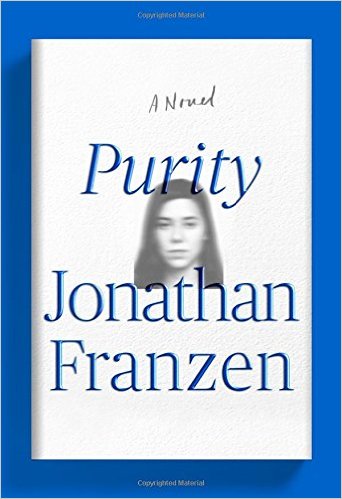
Pip is lost. She’s in a dead-end job, buried under a mountain of student debt, squatting in a Bay Area house, and hoping — at some point — to learn who her father is. Then she gets the opportunity to intern with Andreas Wolf, a competitor to Julian Assange in leaking a wide range of documents. Connections begin to be made… The narration jumps to Andreas’s childhood, to the stories of her father and her grandmother in turn. It took me a while to get into it, but I laughed aloud many times while consuming the audiobook.

Here are a few tidbits I noted:

  • “From her mother she’d learned the importance of leading a morally purposeful life, and from college she’d learned to feel worried and guilty about the country’s unsustainable consumption patterns. Her problem at Renewable Solutions was that she could never quite figure out what she was selling, even when she was finding people to buy it.”
  • “Nowadays there is only one habit of highly effective people: Don’t fall behind with your email.”
  • “In technology we trust. We need to put that on the new hundred dollar bill.”
  • “Who could resist the temptation of believing one’s own press?”
  • “It was like beholding my addiction to a substance that had long since ceased to give me the slightest kick of pleasure.”

OTHER REVIEWS

HIGHLY POSITIVE
  • Laura Miller, Slate: “Of all the things people expect from a new Franzen novel, who’d have anticipated that more than anything else it would be so much fun?” http://www.slate.com/articles/arts/books/2015/08/jonathan_franzen_s_purity_reviewed.html

POSITIVE
  • Colm Toibin, New York Times: ““Purity” is a novel of plenitude and panorama. Sometimes, there is too much sprawl, but it can suggest a sort of openness and can have a strange, insistent way of pulling us in, holding our attention.” http://mobile.nytimes.com/2015/08/30/books/review/jonathan-franzen-purity-review.html?referer=
  • Caleb Crain, The Atlantic: “The ride is exhilarating. All the way down.” http://www.theatlantic.com/magazine/archive/2015/09/jonathan-franzen-strikes-again/399329/
  • Tim Adams, Guardian: “baggy plot and big heart and seductive intelligence” http://www.theguardian.com/books/2015/sep/06/purity-jonathan-franzen-review-piercingly-brilliant
  • Curtis Sittenfeld, Guardian: “rich scenes and crackling dialogue, its delicious observations about contemporary life, the breathtaking scope of its ambition.” http://www.theguardian.com/books/2015/aug/26/purity-by-jonathan-franzen-review

MIXED
  • Roxane Gay, NPR: “But, for every wonderful piece of prose, for every masterful stroke in this novel, there is the stuff that was simply distracting, if not alienating and infuriating. For all its extravagant ambition, the book is full of self-indulgent nonsense.” http://www.npr.org/2015/09/01/435543843/book-review-purity-jonathan-franzen

NEGATIVE
  • CML, Gawker: “It is obvious from its first page that Purity is a worthless novel and its author, Jonathan Franzen, a worthless writer.” http://review.gawker.com/jonathan-franzens-purity-is-an-irrelevant-piece-of-shit-1729287392

Books and authors mentioned
  1. Philip K. Dick
  2. Iris Murdoch
  3. Michiko Kakutani
  4. Proust
  5. Philipa Gregory
  6. Candida Lawrence: Reeling and Writhing
  7. Jonathan Safron Foer, Eating Animals
  8. Zadie Smith
  9. Barbara Kingsolver
  10. And many others

Everything you ever wanted to know about cotton, and maybe much, much more

Sven Beckert provides a history of the cotton industry from its earliest mentions in historical records to modern cultivation and processing. He shows both the shifts in the cotton industry across the world, from the American South to Pakistan, and how the industry has changed over time, from slavery through the modern labor movement.

Seeing these big trends was interesting, as how the American Civil War drove up cotton prices in Egypt, benefitting Egyptian farmers. Individual anecdotes were also interesting, as when German industrialists could not convince West African farmers to exclusively plant cotton because — shocker! — the farmers could saw that it was “much more labor intensive and not necessarily more profitable.” Likewise, I was intrigued by the fact that “although it is often imagined that the [West African] slave trade was animated by simple exchanges of guns and gewgaws for human export, slaves were more frequently traded for a far more banal commodity: cotton textiles.”

At the same time, I had two gripes with the book. First, it felt to me that Beckert was largely fighting against the straw man that capitalism works without any state intervention. The people naive enough to believe that probably aren’t going to wade through this tome. This leads to my second gripe, that at 400 pages of text, the book feels — as Adam Hochschild, author of the wonderful narrative history King Leopold’s Ghost, wrote in the New York Times — “crowded with many more details and statistics (a few of them repeated) than the nonspecialist needs.”

My take away? Interesting, not entirely convincing (on the capitalism narrative), but perhaps only the most committed will read to the very end.

Below are excerpts from a handful of professional reviews.

Highly Positive

Publishers Weekly: “a hefty, informative, and engaging study of cotton” … “Beckert’s narrative skills keep the story of capitalism fresh and interesting for all readers”

Daniel Walker Howe, Washington Post: “‘Empire of Cotton’ proves Sven Beckert one of the new elite of genuinely global historians. Too little present-day academic history is written for the general public. “Empire of Cotton” transcends this barrier and should be devoured eagerly, not only by scholars and students but also by the intelligent reading public. The book is rich and diverse in the treatment of its subject. The writing is elegant, and the use of both primary and secondary sources is impressive and varied. Overviews on international trends alternate with illuminating, memorable anecdotes.”

Karen Long, Newsday: “Be forewarned, as this momentous and brilliant book illustrates, those ubiquitous cotton fibers we take for granted are soaked in history, money and blood.” http://www.newsday.com/entertainment/books/empire-of-cotton-review-the-fiber-that-remade-history-1.9700322

V. Krishna Ananth, The Hindu: “Sven Beckert’s Empire of Cotton: A Global History is certainly a must-read for specialists as well as the lay reader. The lucid style and the wide canvas, both in time and space, make the book riveting.” http://m.thehindu.com/books/literary-review/drvkrishna-ananth-reviews-empire-of-cotton/article7485199.ece

Charles Post, The Journal of the Civil War Era: “His new book, Empire of Cotton, promises to be a classic.” https://muse.jhu.edu/article/601686

Wendy Smith, Boston Globe: “Beckert’s brilliant case study makes it clear how valuable this broader perspective is.” https://www.bostonglobe.com/arts/books/2014/12/18/book-review-empire-cotton-global-history-sven-beckert/ADRXIA2qU7DTFUqP7eA2uJ/story.html

Positive

Giorgio Riello, History Today: “an engrossing narrative” “Beckert is at his best when considering slavery and cotton plantations, places of violent domination where, even more than in the dark satanic mills of England, the rhythm of ceaseless exploitation was imposed by ruthless plantation owners.” “One might think that this is a narrative of unredeemed Eurocentric triumphalism, if it were not for the fact that Beckert shows the unbalances, weaknesses and utter failures of the cotton empire. … What once was the backbone of western capitalism is now a sclerotic sector whose survival, at least in the US, relies on state subsidies.”
 

The Economist: “Mr Beckert’s story is both inspirational and utterly depressing, a reflection of the white-knuckle ride that has been the characteristic of globalisation through the centuries.”

Andrew McKie, Wall Street Journal: “That this journey is seldom dull is to Mr. Beckert’s great credit. He is a deft and admirably clear writer with a story that is not only sweeping but, in the strict sense, terrific.” http://www.wsj.com/articles/book-review-empire-of-cotton-by-sven-beckert-1421443202

Eric Herschthal, Slate: “Beckert’s version will not be the final word in this new history of capitalism, but it is an exceptional start.” http://www.slate.com/articles/arts/books/2014/12/empire_of_cotton_a_global_history_by_sven_beckert_is_a_great_history_of.html

Mixed

Adam Hochschild, New York Times: “‘Empire of Cotton’ is not casual airplane reading. Heavy going at times, it is crowded with many more details and statistics (a few of them repeated) than the nonspecialist needs. But it is a major work of scholarship” … “Empire of Cotton” is laced with compassion for the millions of miserably treated slaves, sharecroppers and mill workers whose labors, over hundreds of years, have gone into the clothes we wear and the surprising variety of other products containing cotton, from coffee filters to gunpowder.” “This makes “Empire of Cotton” read a bit like two books combined [a history of cotton and a history of capitalism], with one of them [the latter] incomplete.”

a haunted house for the new millenium


a review of David Mitchell’s Slade House

Slade House is the latest offering by David Mitchell, who is most famous for his novel Cloud Atlas. It is set in the same universe as his subsequent book, The Bone Clocks, although I haven’t read that one.


The book opens with a boy named Nathan who goes with his mother to a musical recital at an aristocratic home called Slade House. Nathan is an odd boy. “Mum says I need to blend in more, but there aren’t any classes for blending in, not even on the town message board.” Throughout the book, Mitchell is wonderfully specific with Nathan and all his characters.


But once Nathan arrives at Slade House, not all turns out as it seems.


I don’t want to give too much away, but I would characterize this as supernatural horror, but a type of horror that is more reminiscent of Jane Eyre (gothic!) or modern efforts along related lines (like Carlos Ruiz Zafón) than Steven King. In short, it’s a haunted house story.


The book is structured as a series of case studies, as different people encounter Slade House and what goes on there. Therein is my one quibble, that the book feels a little repetitive in structure. But again, the specificity of this host of characters and the playful language makes it enjoyable nonetheless. One character effectively sums up the book: “Tonight feels like a board game designed by MC Escher on a bender and Steven King in a fever.”


Interestingly, the novel grew out of a story that Mitchell published entirely on Twitter, which you can read here:


Here are clips from a couple of professional reviews:


Liz Jensen, the Guardian: “Vending-machine horror tropes, believable characters, wild farce, existential jeopardy, meta-fictional jokes: into the cauldron they go.”


John L. Murphy, PopMatters: “There remains a steady delight in letting Mitchell’s imagination carry one along over hundreds of pages without us even noticing the time.”


Books mentioned within the book:
  • The Diving Bell and the Butterfly, by Jean-Dominque Bauby
  • The Lord of the Rings, by JRR Tolkien
  • The Kraken Wakes, by John Wyndham


256 pages


First line: “Whatever Mum’s saying drowned out by the grimy roar of the bus pulling away, revealing a pub called The Fox and Hounds.”


Last line: Spoilers!