Category: Economics
the economist and the anthropologist
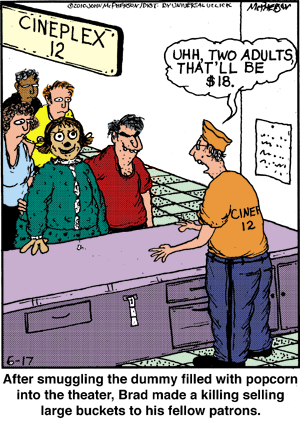
There is a story about an economist and an anthropologist which goes something like that: The economist asks the anthropologist, ‘I see you know everyone in this village closely, but do you know anyone outside this village?’ ‘But explain to me,’ replies the anthropologist, ‘you know a little bit about everyone in the world, but do you know anyone at all?’
Economist Amartya Sen, in the foreword to anthropolist Devi Sridhar’s The Battle Against Hunger: Choice, Circumstance, and the World Bank (2008)
professional reviews of Super Freakonomics
The Telegraph (UK) MIXED: Essentially, Superfreakonomics consists of more of the same. This might get wearying were it not for the fact that Levitt and Dubner’s zeal for statistical anomalies is as undimmed as their eye for a good story. … Sex, as you will have gathered, looms quite large in this book, at least at the start; Levitt and Dubner know the importance of softening up their readers with a bit of smut before hitting them with the heavier stuff. Their research into Chicago prostitution reveal that prostitutes’ wages have plummeted in real terms in the last 60 years. … What, you may wonder, has this got to do with people responding to incentives? Unless I’m missing something, the answer is absolutely nothing. Yet perhaps this is the wrong way to read Superfreakonomics. Perhaps it’s best to forget any ideas of cohesion and just lie back and let Levitt and Dubner’s bouncy prose style carry you along from one peculiarity to the next.
WSJ blog POSITIVE: “SuperFreakonomics,” by the economist Steven Levitt and writer Stephen Dubner, is not only a book with mind-blowing ideas, innovative research and quality investigative journalism, it’s also a story about creativity and what it takes to get the mindset to turn conventional concepts upside down. The authors have found their stride with “SuperFreakonomics.” As good as the first “Freakonomics” was, I found this read much more enjoyable and interesting.
The Guardian (UK) NEGATIVE: The genius of the original book lay in its ability to turn hard data into stories as interesting as the best anecdotes. This book treats mildly interesting anecdotes as though they were substitutes for hard data. … The real problem is that there is too much of people like Allie [one of the anecdotes] and too little of Levitt. We hear something of his latest research – about how drink-walking is more dangerous than drink-driving, or why children’s car seats may be no safer than seatbelts. But we don’t hear nearly enough and too many questions are left unanswered; for instance, whether more people die walking home drunk because they are simply so much drunker than people who still think they can drive. … Superfreakonomics is not a bad book, but it’s not a patch on the first – it has very little of the charm or the originality. Yet in their rather smug preface, the authors say that they believe the second book “is easily better than the first”. Can they really think this?
Financial Times (Tim Harford) POSITIVE: This book is a lot like Freakonomics, but better. … In the end, a book such as SuperFreakonomics stands or falls on its entertainment value. And on that count, there’s no doubt: it’s a page-turner. … More revealing, though, was that I’d folded over at least a dozen pages, resolving to go back, follow up the references, and find out more. This is a book with plenty of style; underneath the dazzle, there is substance too.
The Independent (UK) POSITIVE: Levitt and Dubner, in this “freakquel” to their wildly successful 2005 book Freakonomics, offer another collection of “things you always thought you knew but didn’t; and things you never knew you wanted to know but do”.” Such as, why it’s more likely that you’ll die as a drunk pedestrian than a drunk driver, and how monkeys can be taught to use money. So it’s great fun. … Would I recommend this book to an economics teacher? Yes, provided they were comfortable discussing with their students what might be described as “adult themes”. Some of us were brought up to understand the laws of supply and demand in terms of how they affected the market for apples, cups of tea, or cars. Not our freakonomists, who instead turn to the market for paid sex in Chicago, then and now, to stimulate the reader.
LA Times POSITIVE: Thank goodness they are back — with wisdom, wit and, most of all, powerful economic insight. … The examples the authors use in “Super Freakonomics” won’t disappoint, though these are now more concentrated on edgier topics. Prostitution, terrorism and the altruistic indeterminacy of just about everything form much of the landscape in this book. Topics are simultaneously interesting and profoundly disturbing — in other words, freaky. … Surprisingly, the book left me hopeful that we can tackle seemingly intractable social problems. Human ingenuity is clearly in no short supply in “Super Freakonomics,” and we can thank Steve and Steve for making Le Freak still chic.
Washington Post (blog – Ezra Klein) NEGATIVE: Super Freakonomics is getting a lot of flak for its flip contrarianism on climate change, most of which seems based on incorrectly believing solar panels are black (they’re blue, and this has surprisingly large energy implications) and misquoting important climate scientists. But before people begin believing that the problem with Super Freakonomics is that it annoys environmentalists, let’s be clear: The problem with Super Freakonomics is it prefers an interesting story to an accurate one. … It’s terrifically shoddy statistical work. You’d get dinged for this in a college class. But it’s in a book written by a celebrated economist and a leading journalist. Moreover, the topic isn’t whether people prefer chocolate or vanilla, but whether people should drive drunk. It is shoddy statistical work, in other words, that allows people to conclude that respected authorities believe it is safer for them to drive home drunk than walk home drunk. It’s shoddy statistical work that could literally kill somebody. That makes it more than bad statistics. It makes it irresponsible. But hey, it makes for a fun and unexpected opener.
And don’t miss The Guardian’s parody: Some decisions are very easy. Like the one to cash-in on an unexpected bestseller. But some are very hard. Would you rather drive home pissed from a party or walk? Sayonara if you choose to walk, because you’re far more likely to be run over by all the other people driving back from the party pissed! … Does it seem odd that so many top sports stars are born at the same time of year? Almost certainly not, because Malcolm Gladwell already covered this in Outliers earlier this year and it wasn’t interesting then, as it was just a spin on educational year cohorts that most people already know. But here’s the twist: a study by Captain Nemo from the Nautilus Institute shows that 99.9% of all readers won’t remember where they read it first, so we can claim this factoid as our own. [And much, much more…]
UK attempts to follow Larry Summers’ advice to ship waste to poor countries and fails (try a poorer country next time!)
Brazil returns hazardous UK waste
Around 1,500 tons of hazardous waste which arrived in Brazil from the UK labelled as recyclable plastic is on its way back, authorities have said.
The Brazilian Institute of Environment and Renewable Natural Resources said the cargo included used syringes, condoms and dirty nappies.
And you’re supposed to pay the poor country!
(And here is the Summers advice to which I refer.)
Brazil returns hazardous UK wasteBrazil returns hazardous UK wasteBrazil returns hazardous UK waste
what we don’t know may make us fatter, depending on whether we’re in a sandwich shop or a hamburger restaurant
As of July 2007, many restaurants in New York had to post caloric information for their food. From a study by Julie Downs et al in the American Economic Review 2009:
To test whether this information would affect food choices, we collected data at three locations (a coffee shop in Manhattan and two hamburger restaurant outlets of the same chain, one in Manhattan and the other in Brooklyn), both before and after implementation of the legislation. Researchers stood outside each restaurant during lunch hours. As customers approached, they were informed that they could get paid for turning in their receipt and completing a short survey when they exited. …
At the coffee shop, there was no impact of the legislation. … For the Manhattan hamburger restaurant, there was again no significant effect of the legislation …
At the hamburger restaurant in Brooklyn, however, fewer calories were consumed after the legislation went into effect …. Furthermore, at the Brooklyn location, in contrast to the sandwich study, there was a marginal interaction between dieting status and legislation…such that dieters tended to be helped more than nondieters by the information.
The sandwich study they refer to is an experimental trial (described in the same paper) in which caloric information was provided to some people, and the researchers found “some evidence of a perverse, calorie-increasing effect of providing this information to dieters.” (Apparently the dieters were overestimating the calories in the sandwiches, so giving the information made them eat more!)
Hat tip to Andrew Leigh’s summary piece on the economics of obesity.
development in dangerous places: more military intervention?
Given my own (past, all in the past) propensity to find danger in developing places, I was drawn to this Boston Review Forum on Development in Dangerous Places, in which
- Paul Collier proposes the rich countries do more military interventions to guarantee the legitimacy of elections in poor countries
- Ted Miguel pushes back and offers some optimism on African growth
- Bill Easterly tries to tear Collier’s work to shreds
- Nancy Birdsall brings out the very best in Collier’s premise and offers some reasonable alternatives to his military recommendations
- Other people whom I haven’t met write stuff
- Collier defends himself to Easterly
I completely recommend it all, and especially Nancy Birdsall’s comments.
classic selection problem in Jorge Amado
Jorge Amado is one of Brazil’s great writers. (It’s not just Machado de Assis – and I’ll hit you if you start talking about Paulo Coelho.)
I’m in the midst of his 1943 novel about rural poverty in Brazil’s northeast, As Terras do Sem-Fim. As one character, Antônio Vítor, decides whether to migrate to the northeast or not, he observes those who have gone before:
Almost all the men went, and they rarely returned. But those that did return – and they always returned for just a quick visit – were unrecognizable after years of absence. They came wealthy, with rings on their fingers, gold watches, pearls and ties. And they threw their money away, with expensive presents for relatives, donations for churches and for patron saints, and hosting end-of-year celebrations. “He got rich” was all that that was heard around town. (p20, my own bad translation from the Portuguese)
Antônio, what about the guys that didn’t come back?
heather graham has a causal inference problem
The star admits to dabbling with witchcraft. … She says, “I have this group of friends and we get together and we call ourselves The Goddesses and we wish for things and then a lot of amazing things have happened to all of us. …
“We did this thing where we were calling on the wind and the air and this whole storm started on my roof… It was amazing… It’s empowering.
“One of my friends, she didn’t have a lot of money and she was like, ‘I want a better apartment,’ and we were doing these spells for her and then her dad just bought her an apartment.”
And Graham feels U.S. President Barack Obama owes her and her friends a huge debt of gratitude for helping him win last year’s election. … She adds, “My friends really wanted Obama to be elected so we all did a spell… and then he got elected… It worked out good.”
from imdb.com
bikinis and beer: two interesting studies
- Men actually see women in bikinis as objects: “New research shows that, in men, the brain areas associated with handling tools and the intention to perform actions light up when viewing images of women in bikinis.” I couldn’t tell from the article how men view women who are wearing more clothing. (from Princeton Psychologist Susan Fiske, by way of SixteenSmallStones)
teaching like the world’s favorite father figure
Last week I was in Peru for a workshop, and I taught two sessions in Spanish, one on “sampling and power calculations” and another on “data collection.” we had participants from around the continent.
Today I saw the teacher evaluations. My favorite positive comment: In response to “What did you like most?”, one participant wrote
que a veces hable como Homer Simpson [sometimes he talks like Homer Simpson]
And – as to be expected – the main “what suggestions to improve the session?” was “menos rápido [slower]”. Story of my life.
 David Evans' personal blog