ARC book review: Emma’s War, by Deborah Scroggins

I read this because I came across the audiobook and essentially read every audiobook I encounter about Africa.  I enjoy these journalist and aid worker memoirs less and less relative to voices of actual African writers.  But, my thoughts…

a look at the West’s myriad and whimsical motives for interventions in Africa

Scroggins uses the life of aid worker cum rebel-wife Emma McCune to characterize the Sudanese north-south civil war. The author folds a series of stories into one volume: the life of McCune (from aristocratic British child with pony and all to adventurer to aid worker to wife of a Sudanese rebel leader), the experience of the Scroggins herself (who spent many years as a journalist in Africa), and the history of Sudan (from colonial times to the present).

[If you’re going to read one readable (i.e., not terribly dense) book about Sudan, I recommend Dave Eggers’ What Is the What, the fictionalized account of a Sudanese refugee boy in which Eggers discusses both the north-south civil war and the mass killings in Darfur.]

This book’s greatest value – and Scroggins recognizes this – is not so much in its insight into Sudan but rather in its insight into the West. We see Emma leaping into aid work as an escape from boredom, we see some aid workers water skiing back and forth in front of refugee camps while others work around the clock in feeding centers, and we see how Emma’s marriage to a Sudanese rebel affects the politics of local aid provision.** Scroggins also gives a larger history of Western intervention in Sudan. Her exploration of the manifold and whimsical motivations of Western involvement is insightful and worthwhile.

That said, I found the pre-Sudan life history of McCune (a chunk of the beginning of the book) tiresome, and occasionally Scroggins’ judgment jumps the gun on her analysis.* But in general she seeks to apply an even hand. Scroggins’ own observations from her time as a journalist provide a compelling illustration of the situation in southern Sudan (25 years ago, anyway). I also learned where anthropologists can get jobs (the UN, apparently).

I wouldn’t rush out to buy this book, but I’m not sorry I read it.

I listened to the unabridged audiobook read by Kate Reading (an appropriate name for a narrator), published by Blackstone Audio. It comes in a bit long at 12 CDs, but Reading gives a fine…well, Reading.

* For example, she comments that “the New World Order [i.e., peace in Africa] was desirable only if it could be achieved without cost to American lives” (326). Of course, this presumes that the West is capable of achieving this at some higher cost, which presumption is not obviously true.

** When I read of Emma going as an aid worker and marrying a local person, I was reminded of the wildly different story of Kenneth Goode, the anthropologist who married a Yanamamo woman.
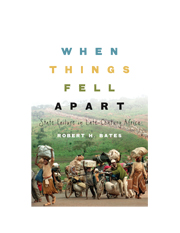
book review – When Things Fell Apart: State Failure in Late-Century Africa, by Robert Bates

I wasn’t a big fan.  For a more positive perspective (from someone who knows much more about African political economy than I do), see Mr Blattman’s comments.  Disagreement is – as always – welcome.

My thoughts:

an interesting model with a hodgepodge of evidence

In this short book (174 pages of text; 139 if you skip the quantitative appendix), Bates argues that state failure stems from predation on the part of the central government. His model, to put it briefly (and inadequately), is that governments can either take revenues from the people (1) in the form of taxes while providing services (such as security) or (2) in the form of predation. As long as the benefits of the former outweigh the latter (for example, when a government is assured of staying in power for a long time), the government will maintain security. However, if the long run is less certain, the government may sacrifice steady long-term gains in favor of larger short-term gains from predation.

Bates starts with an extended, insightful exposition of this metaphor (Chapter Two). Then he characterizes the conditions that prevailed prior to collapse in many African countries in chapters three (political trends), four (bad economic policies), and five (tensions between groups in the countries). In Chapter Six he describes the state failures. The conclusion sums it up, and the appendix gives some statistical evidence (the rest of the evidence is anecdotal or – Bates’s preferred term – narrative).

Overall I found the book slow reading (despite its brevity) and not as coherent as I’d have liked. The basic model is useful but I often found it unclear in the succeeding chapters how the many pieces of narrative evidence fit into the model. The clearest example of this was in Chapter Five, where three models of subnational tensions were presented followed by several examples that did not clearly fit the models.

Further, the form of narrative evidence (lots of different examples from various countries) felt less effective to me than either a detailed case study of one example or systematic statistical evidence. (If I had pre-existing intimate familiarity with the national histories, this would have been less of an issue) The statistical annex provides the latter but deserved more space: some integration of statistical findings with narrative evidence might have worked better. (As it was, the statistical annex left me with a number of clarifying questions.) Bates argues that he distinguishes himself from other work in the area by deriving his hypothesis from a theory rather than highlighting empirical “findings” (p8-9).* And yet Bates – in his empirical appendix – reports atheoretical findings such as the increasing likelihood of disorder over time (despite controlling for changes that should drive the changing likelihood) – p171-173. Finally, Bates doesn’t devote any time to states that didn’t experience state failure and why or how they differed, nor to rival theories and how they fare in light of the national narratives.

As a novice considering whether to read a book like this, the ideal would be to read at least two reviews: one from an expert (who can opine as to how this fits – or doesn’t – with existing knowledge) and one from a novice (who can tell how this may read to another novice). I fall in the latter category. In the former, Chris Blattman (an economics professor in Yale’s political science department) blogged, “It’s short, it’s readable, and it’s intelligent. Normally if I get just two of the three, I’m thrilled” [1]. A political scientist I know called it an “excellent primer.” And Nicholas Van De Walle (author of the highly esteemed African Economies and the Politics of Permanent Crisis, 1979-1999) wrote a brief review for Foreign Affairs, summarizing and concluding that “Bates paints in broad brushes and ignores the states in the region, such as Botswana, Cape Verde, and Mauritius, that have not followed this script but actually enjoyed stability, economic growth, and reasonably democratic politics” [2].

Perhaps this volume is most readable to the already initiated. But it is short and imparts a significant amount of valuable information; I recommend Chapters 2 and 6.

[1] Chris Blattman’s blog [easily searchable on-line], “When things fell apart,” 19 July 2008.

[2] Nicholas Van De Walle, “Africa,” Foreign Affairs, May/June 2008.

* I assume by this he means an explicit, chapter-long theory. Other work I’ve read in this area, by Collier or by Miguel, clearly has a theoretical basis even if not as formally stated as Bates’s.

malaria & education

+ (at the end) one hypothesis for why published randomized trials could disagree more than non-experimental studies

This week’s Lancet has a paper about the effect of treating schoolchildren for malaria in Kenya, by Sian Clarke, Matthew Jukes, and several other people. The study seems to have been very well done. Children in some schools received malaria treatment and children in other schools received placebos: Which were which was “revealed to the investigators only after completion of the statistical analysis.”

Children in treatment schools were healthier and had longer attention spans, but “no effect was shown for inattentive or hyperactive-compulsive behaviours or on educational achievement.”

This study is interesting because the intervention doesn’t just treat kids with malaria: it treats all kids. Apparently (from the article and the associated podcast), children who grow up in areas with lots of malaria develop a degree of immunity to malaria flare-ups (with the fevers and other symptoms with which I am intimately familiar) but still can have malaria in their system which has other negative effects like anemia.

The authors conclude “Effective malaria interventions could be a valuable addition to school health programmes.” In the podcast (July 12), the always charismatic World Bank researcher Don Bundy explains that the study is being replicated in Senegal and in a different part of Kenya.

The lack of effects on school performance stands in contrast to a recent study in Sri Lanka that found significant impacts of malaria treatment on children’s school performance. This reminds me of Worrall’s paper (which I blogged about earlier) which pointed to a greater tendency among randomized trials to see disparate results than among non-experimental trials. One plausible explanation for this is that non-experimental trials are subject to greater publication bias: A non-experimental trial has to meet a higher bar to publish a dissenting result than a randomized trial. This could lead to more variance in published experimental trial results.

I don’t find it particularly surprising that we have lots of variation across randomized trials. Contexts are different. Heartening? No. Surprising? No.

ARC: 50 readers and 60 reviews!

Wow!  When I posted the Africa Reading Challenge back in December 2007, I didn’t imagine so much interest.  50 people have now posted reading lists, and 60 reviews have been posted: here are the most recent ten, from Egypt to South Africa, from Congo to Kenya.  It’s great to see familiar works (Things Fall Apart) and unfamiliar (the Akpan book, which I’ll be getting thanks to Amani’s awesome quote – see No 8 below).

  1. Challenge of the Barons, by Lekan Are / Nigeria (Magic Man)
  2. The Wizard of the Nile: The Hunt for Africa’s Most Wanted, by Matthew Green / Uganda (Rob Crilly)
  3. Paradise, by Mike Resnick / Kenya (sort of) (La Lucuma)
  4. Heart of Darkness, by Joseph Conrad / Congo (elgoose)
  5. Chameleon Days, by Tim Bascom / Ethiopia (Kate)
  6. Things Fall Apart, by Chinua Achebe / Nigeria (elgoose)
  7. Mine Boy, by Peter Abraham / South Africa (Angela)
  8. Say You’re One of Them, by Uwem Akpan / Nigeria, Gabon, Rwanda, Ethiopia, Kenya (Amani): “If you are looking for a super depressing book to read, then look no further… It’s obvious that Mr. Akpan is a tremendous talent.”
  9. The No. 1 Ladies’ Detective Agency, by Alexander McCall Smith / Botswana (Alisia)
  10. The Yacoubian Building, by Alaa Al Aswany (tr. Humphrey Davies) / Egypt (Alisia)

reseña de libro: La Lectora, por Sergio Álvarez

Para dos reseñas más amplias, puedes buscar acá y allá.

Mis pensamientos:

dos cuentos de acción: el cuento principal comienza mejor que acaba


Laura es estudiante universitaria en Colombia que sale a caminar un día cuando un hombre le secuestra y le obliga a … leer un libro sobre una prostituta (Karen) y un taxista quienes se enredan en unos asesinatos del narcotráfico, varios mafiosos, y un maletín lleno de dólares (¡claro!).  El [premise] es creativo e interesante y la acción no deja.


«La lectora» cuenta dos tramas paralelas: la primera es de Laura y sus captores, y la segunda es la trama del libro que Laura lee.  (Además hay dos narrativas menores: un monólogo contado a la prostituta de un examante que parece ocurrir después de los eventos del libro y un diálogo breve entre dos comentadores.)


Las dos tramas invitan la atención: no son nada extremamente original (además de la estructura narrativa con sus tres o cuatro tramas – depende de cómo cuentas), pero tanto la trama de Laura y la de Karen se mueven rápidamente.


A pesar de eso, sentí algo decepcionado al acercarme al final.  La velocidad pareció más despacio a pesar de que la acción llega a su clímax.  No lamento haberlo leído, pero no voy a andar recomendándolo a otros.  (Si quieres una recomendación, lee La sombra del viento o El hombre, la hembra, y el hambre.)


Escuché el audiolibro completo, narrado por Adriana Sananes y publicado por Recorded Books Audiolibros [6 CDs].  Sananes narra bien.


Una nota sobre contenido: Este libro tiene algo de sexo y de violencia. 

deception … in social science!

A recent paper by Martinelli & Parker – “Deception and Misreporting in a Social Program” – shows just how much people lie in self-report questionnaires (using data from Mexico).  The Freakonomics blog has a catchy write-up of it; we’d expect nothing less from those guys!  What’s interesting (and problematic) is that people both underreport and overreport.  (You expect people to underreport in a social program: if you look poorer, you might get more help.)  This, from the Freakonomics summary:

Below is a list of household items that were overreported — i.e., which applicants said they had but in fact did not (again, followed by percentages):

Toilet (39.07 percent)
Tap water (31.76)
Gas stove (28.56)
Concrete floor (25.41)
Refrigerator (12.05)

So 4 out of 10 applicants without a toilet said they had one.

This reminds me of a favorite story.  A good friend was with a survey enumerator who was gathering household data in rural Kenya.  The enumerator asked the household head how many kettles they had.  The head said, None!  We don’t have even one kettle!  And my friend asked, What about that kettle? [pointing to the one on the stove]  Oh, that one!  We borrowed it from the neighbor!

Nice.  This illustrious tradition takes us back to Margaret Meade and her (self-admitted) lying informants in Samoa in the 1920s.  Which makes me even more confident in most social science conclusions.  (I say most, because my research is clearly different.  Who would lie to me?  I’m the Magic Man.)

Abstract of the academic paper below Continue reading “deception … in social science!”

see john worrall (2002) on why randomized clinical trials are not a gold standard

The above footnote in Nancy Cartwright’s Hunting Causes and Using Them: Approaches in Philosophy and Economics* piqued my interest.  She refers to John Worrall’s paper “What evidence in evidence-based medicine?”**  Much of my work involves randomized trials of international development projects, so the argument interested me.


Ultimately, Worrall makes some very good points (yes, other evidence has validity as well) but I don’t find his critiques as convincing as he does.


Greatest hits below the fold…

Continue reading “see john worrall (2002) on why randomized clinical trials are not a gold standard”

Africa Reading Challenge review: Challenge of the Barons, by Lekan Are

My thoughts on this angry battle cry of a Nigerian novella.  (I love a battle cry that takes place in the halls of academia… once in a while.)

searing critique of aid to Africa tied to services from the donor country, wrapped up in university faculty intrigue

I was at a tiny bookshop in Banjul, the Gambia, picking up novels by African writers when the bookseller showed me this slim volume and said, You wouldn’t like this one! Why not? Because it speaks out against you guys. (I work for an international aid agency.) How could I resist?In 158 pages, Nigerian writer Lekan Are tells a story exemplifying how aid can hurt the people it is intended to help and pad the pockets of the most incompetent from the donor countries. Dr. Onaola Jungu, our protagonist with a PhD in horticulture, accepts the offer to move from his native Nigeria to the fictional country of Kato,* where he will be chair of the Department of Horticulture at the University of Serti.

However, when he arrives he finds the university faculty largely populated by poorly qualified Americans and other ex-pats, hired only because of strings attached to American aid to Kato. Dr. Jungu is unjustly deprived of the promised chairmanship in favor of an American and is made a mere professor. The rest of the book details the intense battle between – on the one side – Jungu and his African colleagues, who seek to improve the education environment and perform research that will help the country, and – on the other side – the American “experts” (and a few African cronies) battling to protect their special interests.

The book is heavy handed, the right and wrong are too stark, and the prose is clumsy.

BUT the story engaged me throughout (except the long account of the dog dying), and many of the critiques ring true. An absurd amount of American foreign aid (much more than most other countries**) is still “tied,” meaning that we “give” to poor countries but only in the form of American goods and services. Lekan Are paints a picture of just how inefficient and counterproductive that can be.

* It’s always a bad idea to move to a fictional country, unless it’s Brigadoon and your true love lives there.

** The Center for Global Development’s Commitment to Development Index states that 57% of our aid is tied to American goods and services, which puts us at 20 of 22 in that category (just above Greece and Japan).