The poor don’t use cash transfers on alcohol and tobacco. Really.

Two years ago, Anna Popova and I put out a working paper examining whether beneficiaries of cash transfer programs are more likely than others to spend money on alcohol and cigarettes (“temptation goods”). That paper has just been published, in the journal Economic Development and Cultural Change.

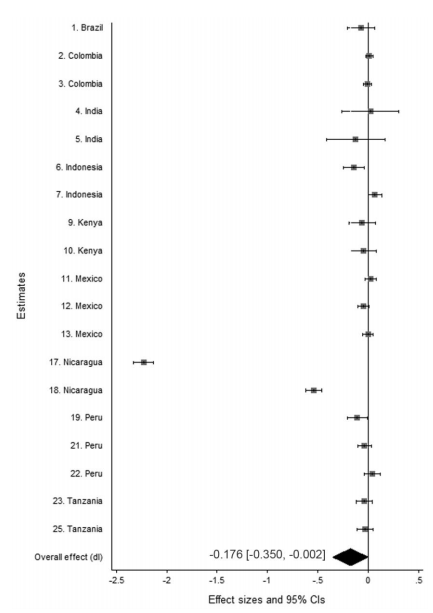
The findings of the published version do not vary from the working paper: Across continents, whether the programs have conditions or don’t, the result is the same. The poor don’t spend more on temptation goods. But for the published version, we complemented our vote count (where you sum up how many programs find a positive effect and how many find a negative effect) with a formal meta-analysis. You can see the forest plot below. (The results are not substantively different from the “vote count” review that we did in the working paper and maintain in the published version as a complement to the meta-analysis.)

meta-analysis

As you can see, while there are only two big negative effects, both from Nicaragua, most of the effects are slightly negative, and none of them are strongly positive. We do various checks to make sure that we’re not just picking up people telling surveyors what they want to hear, and we’re confident that cannot explain the consistent lack of impact across venues.

Why might there be a negative effect? After all, if people like alcohol, we might expect them to spend more on it when they have more money. We can’t say definitively, but even unconditional transfer programs almost always come with strong messaging: Recipients hear, again and again, that this money is for their family, that this money is to make their lives better, and so on and so on. We know from others areas of economics that labeling money has an effect (called the flypaper effect).

So you can be for cash transfers or against cash transfers, but don’t be against them because you think the poor will use the money on temptation goods. They won’t. To quote the last line of our paper, “We do have estimates from Peru that beneficiaries are more likely to purchase a roasted chicken at a restaurant or some chocolates soon after receiving their transfer (Dasso and Fernandez 2013), but hopefully even the most puritanical policy maker would not begrudge the poor a piece of chocolate.”

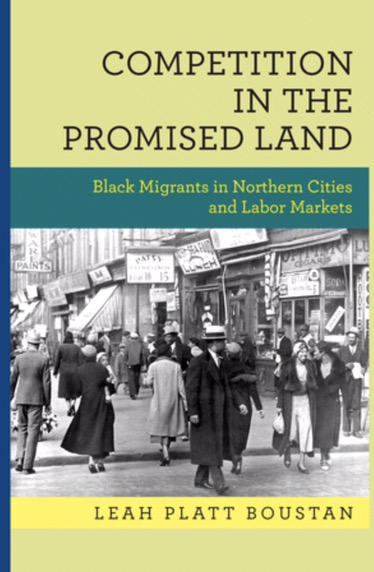
Over the last 100 years, most US blacks migrated from the South to the North. Did they find what they sought?

Yes and no. Better income and better social conditions, but also a black-white pay gap that changed little over time. Why?

Leah Platt Boustan, UCLA economist (and my friend), just wrote a book on it, Competition in the Promised Land: Black Migrants in Northern Cities and Labor Markets.

This is from James Ryerson’s New York Times review

In her rich and technical account, the economist Leah Platt Boustan employs the tools of her trade — resourceful matching of data sets, rigorous modeling of labor phenomena, sweeping use of census figures — to analyze the demographics and economics of the Great Migration as a whole… Her investigation both deepens our understanding of what we think we know and adds new complexities and wrinkles.

I expect it’s excellent.

Has the war over RCTs been won?

Esther Duflo and Abhijit Banerjee of MIT and JPAL weigh in during an interview in Tim Ogden’s forthcoming book, Experimental Conversations, which I am enjoying thoroughly:

Esther: “I think it’s been completely won in that I think it’s just happening. A lot of people are doing it without us. It’s being used. I think it is now understood to be one of the tools. The argument within the economics profession [over the value of RCTs] had two main consequences, both good. First, it raised the profile. If something was debated, people began to believe it must be significant. Second, it did force us to answer the challenges. There were a lot of valid points that were raised and it forced us to react. We’ve become more intelligent as a result.”

Abhijit: “I am less certain that it has been won. The acid test of whether an idea has come to stay is that it becomes something that no one needs to justify using. … RCTs aren’t there yet: it is true almost everyone is doing them, but many of them are taking the trouble to explain that what they do is better than a ‘mere RCT.’ We need to get to the point where people take RCTs to be the obvious tool to use when possible to answer a particular class of empirical questions.”

Beyond incentives: The economist as plumber

Earlier this month, Esther Duflo of MIT gave a talk at the IMF, and the slides are available here. I found the framing insightful.


She goes on to give three examples from impact evaluations in India that seek to improve “the rules of the game,” creating systems for better governance: (1) “fixing the pipes” — eplatform for workfare payments, (2) “changing the faucet” — biometric identification for welfare payments, and (3) “replacing the meter” — inspections on polluting compliance.

Michael Kremer on how RCTs lead to innovation

The modern movement for RCTs in development economics…is about innovation, as well as evaluation. It’s a dynamic process of learning about a context through painstaking on-the-ground work, trying out different approaches, collecting good data with good causal identification, finding out that results do not fit pre-conceived theoretical ideas, working on a better theoretical understanding that fits the facts on the ground, and developing new ideas and approaches based on theory and then testing the new approaches.

This is from an insightful interview with Michael Kremer, Harvard economics professor “generally given credit for launching the RCT movement in development economics with two experiments he led in Kenya in the early 1990s,” and my graduate school advisor.

The interview is in Tim Ogden’s book Experimental Conversations: Perspectives on Randomized Trials in Development Economics.


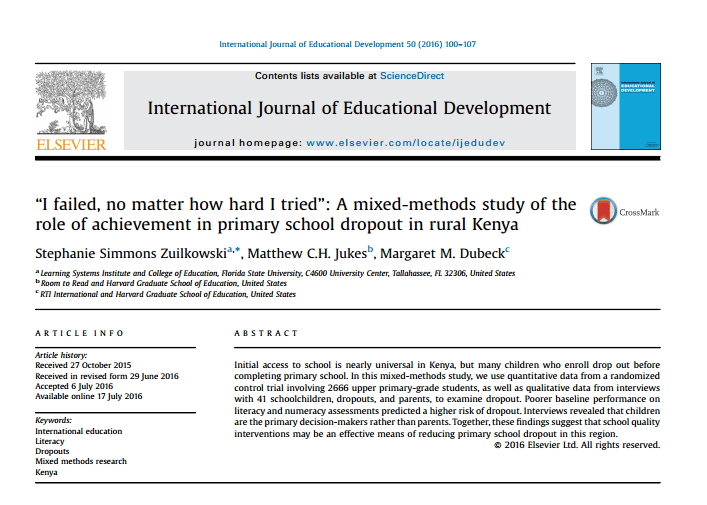
Quick take: “I failed, no matter how hard I tried”: A mixed-methods study of the role of achievement in primary school dropout in rural Kenya, by Zuilkowski et al.

In Kenya, virtually every child enrolls in primary school, but many don’t complete it. Stephanie Simmons Zuilkowski, Matthew Jukes, and Peggy Dubeck use mixed methods to explore why.

Three findings stood out to me:

  1. In interviews with both youth and with parents, the youth (age 14-15, mostly, but some older) were “universally” characterized as the main education decision makers. In many cases, parents encouraged them to stay in school but the youth opted to drop out.
  2. Lower performing youth were more likely to drop out of school. This isn’t surprising but it’s useful to see it quantified. It comes out in both the quantitative and the qualitative work here.
  3. Free primary school isn’t free (and I’m not even talking about pure opportunity cost; I’m talking about simple out-of-pocket costs).

Okay, to the study! They point out why cross-sectional studies may miss the point in understanding dropout rates:

A cross-sectional study may identify proximal factors affecting dropout risk—perhaps pregnancy or the need to work for pay (Ball 2012)—but not the earlier factors that put the child on the trajectory toward dropout. In interviews with parents and teachers, proximal reasons for dropout may become the post-hoc rationale for a child’s dropout obscuring the underlying trigger factors.

Finding 1: Who decides on dropouts?  Admittedly, it’s a small sample for this part: They spoke with 21 youth and 20 parents. In most cases, the interviews were conducted separately. Of the youth, half had dropped out. Here is the key finding: “In our interviews with the dropouts in this sample, the youth were described universally as the principal educational decision-makers, both by the parents and by the youth themselves.” Notably, both youth and parents talked about the importance of education. “The stories of all 11 children who dropped out began with some variation of: ‘I wasn’t doing well in school.’” Many of the quotes highlight relative performance and the inability to get extra help. To me, this points back to the importance of structuring education systems that help teachers to teach to the right level (see here and here for more on that). Many of these children simply weren’t getting instruction at their current level.

Finding 2: “A student with a literacy composite score one standard deviation above average would have fitted odds of dropout that are 40% lower than those of the average scorer. A student with a numeracy score one standard deviation above average would have fitted odds of dropout that are 17% lower than those of the average scorer.” N=2,500+

Finding 3: “Despite the official abolition of school fees, all 13 schools the sampled youth attended had charged fees for extra teachers, books, or materials. Nine of the 21 interviewees—five students and four dropouts—said they had been sent home to get money for fees or materials. Children who could not gather the required amounts were not generally allowed back in class.”

I recommend the paper.

Quick take: “Education Quality and Teaching Practices” in Chile

On this morning’s commute, I caught up on a new NBER Working Paper: “Education Quality and Teaching Practices,” by Marina Bassi, Costas Meghir, and Ana Reynoso.

Here is the abstract: “This paper uses a RCT to estimate the effectiveness of guided instruction methods as implemented in under-performing schools in Chile. The intervention improved performance substantially for the first cohort of students, but not the second. The effect is mainly accounted for by children from relatively higher income backgrounds. Based on the CLASS instrument we document that quality of teacher-student interactions is positively correlated with the performance of low income students; however, the intervention did not affect these interactions. Guided instruction can improve outcomes, but it is a challenge to sustain the impacts and to reach the most deprived children.”

Why no effect for lower-income students? To expand a bit on the abstract: “The most striking result from the table is the association between better student teacher interactions (reflected in a higher CLASS score) and the performance of low income students. In effect, one additional standard deviation in the principal component of CLASS scores is associated with a higher SIMCE test score for low income students of between 15% and 20% of sd units. These results are robust to adjustments in p-values to control for the FWE rate. For higher income students, effects are smaller and in some cases insignificant.”

So if the quality of interactions is particularly important for lower-income students, and the intervention isn’t affecting those interactions, then that could explain the differential effects. It’s an interesting hypothesis, and it points to the ongoing need to better understand what’s happening in the classroom.

Here’s a little more on the intervention: “The main intervention of the program was to support teachers through a modifed method of instruction by adopting a more prescriptive model. Teachers in treated schools received detailed classroom guides and scripted material to follow in their lectures.”

Everything you ever wanted to know about cotton, and maybe much, much more

Sven Beckert provides a history of the cotton industry from its earliest mentions in historical records to modern cultivation and processing. He shows both the shifts in the cotton industry across the world, from the American South to Pakistan, and how the industry has changed over time, from slavery through the modern labor movement.

Seeing these big trends was interesting, as how the American Civil War drove up cotton prices in Egypt, benefitting Egyptian farmers. Individual anecdotes were also interesting, as when German industrialists could not convince West African farmers to exclusively plant cotton because — shocker! — the farmers could saw that it was “much more labor intensive and not necessarily more profitable.” Likewise, I was intrigued by the fact that “although it is often imagined that the [West African] slave trade was animated by simple exchanges of guns and gewgaws for human export, slaves were more frequently traded for a far more banal commodity: cotton textiles.”

At the same time, I had two gripes with the book. First, it felt to me that Beckert was largely fighting against the straw man that capitalism works without any state intervention. The people naive enough to believe that probably aren’t going to wade through this tome. This leads to my second gripe, that at 400 pages of text, the book feels — as Adam Hochschild, author of the wonderful narrative history King Leopold’s Ghost, wrote in the New York Times — “crowded with many more details and statistics (a few of them repeated) than the nonspecialist needs.”

My take away? Interesting, not entirely convincing (on the capitalism narrative), but perhaps only the most committed will read to the very end.

Below are excerpts from a handful of professional reviews.

Highly Positive

Publishers Weekly: “a hefty, informative, and engaging study of cotton” … “Beckert’s narrative skills keep the story of capitalism fresh and interesting for all readers”

Daniel Walker Howe, Washington Post: “‘Empire of Cotton’ proves Sven Beckert one of the new elite of genuinely global historians. Too little present-day academic history is written for the general public. “Empire of Cotton” transcends this barrier and should be devoured eagerly, not only by scholars and students but also by the intelligent reading public. The book is rich and diverse in the treatment of its subject. The writing is elegant, and the use of both primary and secondary sources is impressive and varied. Overviews on international trends alternate with illuminating, memorable anecdotes.”

Karen Long, Newsday: “Be forewarned, as this momentous and brilliant book illustrates, those ubiquitous cotton fibers we take for granted are soaked in history, money and blood.” http://www.newsday.com/entertainment/books/empire-of-cotton-review-the-fiber-that-remade-history-1.9700322

V. Krishna Ananth, The Hindu: “Sven Beckert’s Empire of Cotton: A Global History is certainly a must-read for specialists as well as the lay reader. The lucid style and the wide canvas, both in time and space, make the book riveting.” http://m.thehindu.com/books/literary-review/drvkrishna-ananth-reviews-empire-of-cotton/article7485199.ece

Charles Post, The Journal of the Civil War Era: “His new book, Empire of Cotton, promises to be a classic.” https://muse.jhu.edu/article/601686

Wendy Smith, Boston Globe: “Beckert’s brilliant case study makes it clear how valuable this broader perspective is.” https://www.bostonglobe.com/arts/books/2014/12/18/book-review-empire-cotton-global-history-sven-beckert/ADRXIA2qU7DTFUqP7eA2uJ/story.html

Positive

Giorgio Riello, History Today: “an engrossing narrative” “Beckert is at his best when considering slavery and cotton plantations, places of violent domination where, even more than in the dark satanic mills of England, the rhythm of ceaseless exploitation was imposed by ruthless plantation owners.” “One might think that this is a narrative of unredeemed Eurocentric triumphalism, if it were not for the fact that Beckert shows the unbalances, weaknesses and utter failures of the cotton empire. … What once was the backbone of western capitalism is now a sclerotic sector whose survival, at least in the US, relies on state subsidies.”
 

The Economist: “Mr Beckert’s story is both inspirational and utterly depressing, a reflection of the white-knuckle ride that has been the characteristic of globalisation through the centuries.”

Andrew McKie, Wall Street Journal: “That this journey is seldom dull is to Mr. Beckert’s great credit. He is a deft and admirably clear writer with a story that is not only sweeping but, in the strict sense, terrific.” http://www.wsj.com/articles/book-review-empire-of-cotton-by-sven-beckert-1421443202

Eric Herschthal, Slate: “Beckert’s version will not be the final word in this new history of capitalism, but it is an exceptional start.” http://www.slate.com/articles/arts/books/2014/12/empire_of_cotton_a_global_history_by_sven_beckert_is_a_great_history_of.html

Mixed

Adam Hochschild, New York Times: “‘Empire of Cotton’ is not casual airplane reading. Heavy going at times, it is crowded with many more details and statistics (a few of them repeated) than the nonspecialist needs. But it is a major work of scholarship” … “Empire of Cotton” is laced with compassion for the millions of miserably treated slaves, sharecroppers and mill workers whose labors, over hundreds of years, have gone into the clothes we wear and the surprising variety of other products containing cotton, from coffee filters to gunpowder.” “This makes “Empire of Cotton” read a bit like two books combined [a history of cotton and a history of capitalism], with one of them [the latter] incomplete.”
From the Dominican Republic under Trujillo to Dungeons and Dragons in New Jersey and Back Again

Wow! This Putlizer prize winning novel by Junot Diaz is tough to characterize. The story alternates narrators and jumps through time, telling the stories of an American teenagers Oscar de León, his sister Lola, their mother Beli (who emigrated from the Dominican Republic), and their grandfather Abelard. Oscar is overweight, obsessed with science fiction and fantasy, and consequently has some trouble fitting in at school. Lola is rebellious against her not-so-affectionate mother. Although Oscar and Lola are American, the story keeps returning to the Dominican Republic, both in the present, as Oscar and Lola return to visit, and in the past, as we learn how the lives of Beli and Abelard were profoundly affected by the oppressive dictatorship of Trujillo. As one narrator puts it, “Trujillo was Mobutu before Mobutu was Mobutu.”

It took me a while to get into the book, but ultimately I couldn’t put it down. Oscar keeps wanting to be better, but — like so many of us — he “seem[s] to be allergic to diligence.” The language — quick moving and sharp — moves fluidly between English and Dominican (Spanish) slang, with more references to science fiction and fantasy literature peppered in than I could keep up with. Diaz twists familiar tropes in interesting ways, as in his characterization of “nerd heaven — where every nerd gets 58 virgins to role play with.” The allusions range from the explicit — “I’m going to be the Dominican Tolkien” — to the implicit but obvious — “”Hiding your doe-eyed, large-breasted daughter from Trujillo, however, was…like keeping the ring from Sauron” (Lord of the Rings) — to the deep dive — “Sucks to be left out of adolescence, sort of like getting locked in the closet on Venus when the sun appears for the first time in a hundred years” (which is an allusion to Ray Bradbury’s wonderful story, “All Summer in a Day“). When Diaz tells of a Dominican teenager who rides a motorcycle between movie theaters because they share the reels to a single film, I recalled a similar sequence in the Italian film Cinema Paradiso. One ambitious reader has compiled annotations on many of the allusions online.

I lived in the Dominican Republic for two years, and I’ve read and loved a couple of novels about the Trujillo dictatorship — Julia Alvarez’s In the Time of the Butterflies and Mario Vargas Llosa’s La Fiesta del Chivo (The Feast of the Goat). Diaz talks about both of those, as well as a number of historical accounts (like La era de Trujillo, by Galíndez), all seamlessly woven into the fictional narrative.

Lev Grossman, author of the Magicians series that I’ve enjoyed deeply, wrote in Time magazine that the novel is a “massive, heaving, sparking tragicomedy.”

I tried the audiobook but it didn’t engage me. I shifted to the printed version and enjoyed it much more. Note on content: The book is full of strong language, sexual references, and occasional beatings.

anything is better than nothing?

Zanelle is an American volunteer teaching school in Lesotho.  She is talking to Frank, a cynical doctor in South Africa.

‘And you? What are you doing there?’

‘I’m a teacher.  The only one in the village.  I teach children of all different ages – six to sixteen.’

‘What do you teach them?’

‘Different subjects.  Math, English.  Some history.’

‘Can’t be too effective.’

‘Why not?’

‘Well, I mean.  Different ages all together. Different levels. All those subjects.’

‘It’s not like the schools you probably went to,’ she said, a bit stiffly. ‘But it does have some effect.  These are very poor people.  Anything is better than nothing.’

‘Is it?’

‘Well, of course. Don’t you think so?’

‘It seems to me,’ I said, ‘that past a certain point, anything is exactly the same as nothing.’

I disagree with Frank in this case, but the question is an important one.  Anything is definitely not ALWAYS better than nothing in development efforts.

-from The Good Doctor, by Damon Galgut (p97)