How development economists think about development vs how other economists think about development?

In a recent EconTalk episode, Russ Roberts interviews Chris Blattman about his experiment with Stefan Dercon on sweatshops in Ethiopia. 

This exchange amused me.

BLATTMAN: Getting a bad shock when you’re poor means–

ROBERTS: Death.

BLATTMAN: –can mean really terrible things. For these guys, not death. If you have a Grade 8 education in Ethiopia and you have a family that can support you, they’re outside option in the end is living at home and not having anything to do and not being able to contribute to the family, not having any spending money, and maybe having a harder time finding a husband or a wife. Maybe also bad things happen in the household. Maybe you’re contributing to your younger brother going to private school. But these people are not on the margins of death. This isn’t who sweatshops are hiring, at least in this case.

This is NOT to critique the great work that Russ Roberts does on the EconTalk podcast.

But it’s a reminder that many choices in developing countries are not about life or death, but that doesn’t mean they don’t have major implications for human well-being.

Why every academic should have a Twitter profile

If you are interested in greater exposure for your research, I recommend that you create a Twitter account with a recognizable, professional picture and a link to the page where you list your research. You can just use the picture from your research page, if you have one there. (The picture isn’t even essential; your affiliation and the link to your research website will do.)

I recommend this even if you have no intention of using Twitter. I recommend this even if you think Twitter is a waste of time.

Here is why: People who want to popularize research are on Twitter. Other researchers are on Twitter. When someone mentions your research on Twitter, then they often will “tag” you IF you have a recognizable Twitter profile. That tag means that curious people can click over to your profile, then EASILY follow the link to your research page and learn about the rest of your research. 
There are good reasons not to be active on Twitter. I’m listening to Cal Newport’s book Deep Work, and he makes the case that social media gets an outsize influence because we don’t have good metrics of productive impact. So we spend time chasing short-run retweets and likes rather than serious impact from concentrated, uninterrupted work. All good.

But in this case, the cost is low and fixed, probably ten minutes of your time. Again, this isn’t an argument to be active on Twitter. Just make it easy for the people who ARE on Twitter to find your work.

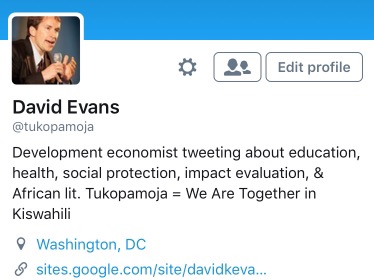
Here’s mine:

In January and February of this year, about 10,000 people have visited my profile page. Some (probably small) fraction of those clicked through to read more about my work.

What do you think? Why am I wrong?

Revenge is a dish best served cold. Twelve years cold. In a production of the Tempest. Performed by prison inmates.

A review of Margaret Atwood’s Hag-Seed

Felix Phillips is the artistic director of a theater festival. His style is avant-garde: “What was so bad about MacBeth done with chainsaws? Topical. Direct.” But he is pushed out by an underhanded business partner and goes off the grid for twelve years. He starts running a Shakespeare class for inmates at a local prison, and his plans for vengeance ensue. The whole novel is written with eager delight, pushing the plot forward. I couldn’t stop listening to it. 

Margaret Atwood has written an update to the Tempest in which the protagonist is fired during a production of the Tempest, enacts his vengeance during another production of the Tempest, all while his life adheres to the broad outlines of the Tempest. Despite some required suspension of disbelief, it’s an adventure.

You don’t need to be a Tempest expert to enjoy this, but I’d recommend skimming a plot summary of the Bard’s original, just to put Atwood in context.

Odds and ends

On paying taxes: “Such was the minimum price to be paid for the privilege of walking around on the earth’s crust and continuing to breathe, eat, and sh**, he thought sourly.”

On getting fired: “Felix climbed into his unsatisfactory car and drove out of the parking lot, into the rest of his life.”

On swearing: During the class, prisoners had a running competition. They could only use swear words found in the text of the play, and they lost points for any other swears.

Don’t believe me? Read other reviews.

POSITIVE

Viv Groskop, The Guardian: “This is written with such gusto and mischief that it feels so much like something Atwood would have written anyway. The joy and hilarity of it just sing off the page. It’s a magical eulogy to Shakespeare, leading the reader through a fantastical reworking of the original but infusing it with ironic nods to contemporary culture, thrilling to anyone who knows The Tempest intimately, but equally compelling to anyone not overly familiar with the work….It’s riotous, insanely readable and just the best fun.”

Rebecca Abrams, Financial Times: “Rap songs, Disney dolls, video montages and special effects spin her version off into a deliciously brave new world of its own….Hag-Seed is not only a fine example of the shape-shifting versatility of Shakespeare’s texts, but a successful novel in its own right….Hag-Seed displays Atwood’s inventiveness at its shining best, a novel that enchants on its own terms and returns you to the enchantments of the original.”

MIXED

Emily St. John Mandel, The New York Times: “The novel to this point is a marvel of gorgeous yet economical prose, in the service of a story that’s utterly heartbreaking yet pierced by humor, with a plot that retains considerable subtlety even as the original’s back story falls neatly into place. But the prison production of “The Tempest” leads to some of the book’s clunkiest elements.”

Books and authors mentioned in the book (read by the prisoners), besides Shakespeare:

  • Catcher in the Rye
  • Stephen King
  • Curious Incidence of the Dog in the Nighttime 

Chris Blattman on the incubation of ideas until opportunity strikes

Is a factory job better than a cash grant and some training? Chris Blattman and Stefan Dercon have a recent study in Ethiopia where they test these two options with a randomized-controlled trial. Back in December, Chris Blattman discussed with study with Russ Roberts on the EconTalk podcast.

In one interesting bit, Blattman highlights how holding onto an idea and repeatedly seeking an opportunity to implement it can ultimately bear fruit. I transcribed it (abridging a little for readability).

Since you have 300 people lining up for these jobs, instead of taking the first 50 in line who are qualified for the job and hiring them, why not see if we can find a factory owner who will find 150 who are qualified and instead of taking the first 50, we’ll flip a coin and we’ll take 50 out of those 150 qualified applicants as random and we’ll follow them over time and we’ll look at what happens to their incomes and their health and their career trajectories.

I had this idea as a graduate student 10 or 12 years ago, and I always thought, “Every time I meet a factory owner I’m going to feel him out. And I did. Once in a while I’d be on a plane to Uganda to work on one of my projects, usually related to poverty or conflict, and maybe I’d sit by a factory owner, and I’d say here’s this idea that I have, and they’d usually look at me kind of funny. They wouldn’t leap at the possibility. I was just this person they met on a plane, and I was a graduate student. I probably didn’t approach it well, and so it never really materialized.

So I was at a conference in London and there was an Ethiopian businessman who was sort of a real estate mogul. He was giving a talk to a group of development economics at the International Growth Centre, and I approached him afterwards and said, “That was terrific,” and I really enjoyed talking to him and we kept chatting and I said, “I had this idea. I think that your firms not only help achieve growth, but I think they might actually be tools of poverty alleviation. Here’s an easy way to answer that question.” And he said, “That sounds great. Let’s do it.” And so literally five or six weeks later we were on the ground in Ethiopia doing the first randomization.

I recommend the whole conversation.

Getting true voluntary consent for your field experiment may be harder than you think

Kim Dionne recently interviewed Melissa Graboyes on the excellent new Ufahamu Africa podcast. Graboyes wrote a history – The Experiment Must Continue: Medical Research and Ethics in East Africa, 1940-2014. I’m reading the book, and Graboyes provides a rich picture, filled with first-person reports from East African participants in research.

Dionne asked Graboyes for key takeaways. Here’s one on consent, which very much applies to social science research.

People regularly mistake the idea that they are participating in an experiment and it’s designed to benefit them personally, rather than the experiment is designed to generate data that can be used to answer important questions and hopefully get us closer to solving some important problems. This disconnect is really profound and it jeopardizes consent.

The basic components of consent laid in the Nuremburg code, laid out in European guidelines, laid out in U.S. national law, is that consent has to be informed, it has to have understanding, and it has to be voluntary. So we can inform people by giving them a consent form translated into Swahili. We can inform them by reading that consent form in Swahili. But if they don’t understand what we’re saying and can’t accurately describe back the kind of experiment they’re participating in with the commensurate risks and benefits that go with it, that’s not really voluntary consent, and it jeopardizes the idea that they are autonomously choosing to participate. I think that there’s a lot of research going on that is stumbling at that step, that we’re formally checking all the boxes we need to, but that we’re not adhering to the real meaning of what that rule is supposed to be about. [I’ve edited very slightly for readability.]

The interview has much more, and the podcast overall is a delight. I recommend it and Graboyes’ book.

Do markets change the goods for sale? Do they erode social norms?


If you’re going to read one review of Sandel’s book, read Deirdre McCloskey’s. If you have energy for one more, read mine.

Consider three true tales:

“Barbara Harris, the found of a North Carolina-based charity called Project Prevention, has a market-based solution [to the problem of babies being born to drug-addicted mothers]: offer drug-addicted women $300 cash if they will undergo sterilization or long-term birth control. More than three thousand women have taken her up on the offer since she launched the program in 1997.”

“It’s not easy to compose an elegant wedding speech, and many best men don’t feel up to the task. So some have resorted to buying wedding toasts online. ThePerfectToast.com is one of the leading websites offering ghostwritten wedding speeches…. You answer a questionnaire online…and within three business days you receive a professionally written custom toast of three to five minutes.”

“As a single mother of an eleven-year-old boy who was struggling in school, Kari Smith needed money for her son’s education. In an online auction in 2005, she offered to install a permanent tattoo advertisement on her forehead for a commercial sponsor willing to pay $10,000. An online casino met her price.”

What should be for sale? Reproductive rights? Tokens of friendship? Skin space? Health care? A love of learning? In this slim tome, Harvard professor and philosopher Michael Sandel explores the expansion of market-oriented thinking into a wide array of new areas, as the examples above demonstrate. Sandel offers about a hundred more: “The reach of markets, and market-oriented thinking, into aspects of life traditionally governed by nonmarket norms is one of the most significant developments of our time.” As he lays it out, markets do two potentially good things: First, markets tend to make the buyer and the seller better off. Otherwise they wouldn’t both be buying and selling. So if people are freely engaging in market behavior (even around things traditionally governed by norms), it is probably making them better off. (Sandel does point out that not all market behavior is “freely” engaged in, as one could argue with the drug addicts in the first example above.) Second, markets pass no judgment on transactions. If people want to buy or to sell their body space, why should a bystander be permitted to block that?

But his largest point against markets is that they may change the nature of the good being bought or sold (i.e., they may “corrupt” the item or the interaction). If selling fast passes at amusement parks and airports changes the nature of interactions in these spaces, then markets are changing the item. If trying to buy students’ motivation by paying them to read books crowds out their intrinsic interest in reading books, then the market behavior is changing the nature of the item for sale. (Sandel partially surveys the evidence on this: The effectiveness is mixed.) That doesn’t mean we shouldn’t ever do it:

“I do not claim that promoting virtuous attitudes toward the environment, or parenting, or education must always trump competing consideration…. If paying underachieving kids to read books brings a dramatic improvement in reading skills, we might decide to try it, hoping we can teach them to love learning later. But it is important to remember that it is bribery we are engaged in, a morally compromised practice that substitutes a lower norm (reading to make money) for a higher one (reading for the love of it).”

Indeed, we have some evidence from teacher incentives in the USA (Jinnai 2016) and from student incentives in India (Visaria et al. 2016) that suggests that after incentive programs are discontinued, some teachers or students perform worse than before the program was introduced. So these are not purely theoretical considerations.

Sandel doesn’t offer clear answers, but he poses important questions. As I listened to the audiobook, I alternated between thinking hard about markets in the fields I work in (education, health, social safety nets) and where we should think carefully about the erosion of norms, and being mildly annoyed at what I see as a pretty reductive view of economics (Freakonomics is quoted repeatedly in an effort to define modern economics).

I’m comfortable with far more markets than Sandel is, but maybe not all of them.

Reviews and reactions:
  • Dierdre McCloskey, personal website (economist): Sandel “does, to his credit, give many interesting examples of the moral dilemma in choosing money over status or queuing to allocate things, from selling kidneys to buying baseball players. Yet surprisingly for someone who has taught over the years 15,000 students in his famous course, Moral Reasoning 22, Sandel’s moral ideas in the book have no discernible connection to human moral thinking since Moses and Confucius and Socrates. The kids deserve better. His moral thoughts in fact are two only, and thin versions even of these: that equality is good; and that the sacred can be corrupted by the profane.”
  • Diane Coyle, Independent (economist): “This entertaining and provocative book is full of examples of vulgar commercialisation…. A lot of us will agree that there is far too much of this in modern life. However, there are examples in this book of the expansion of markets in ways that many people, especially economists, would mostly regard as beneficial, but the author argues are degrading…. What Money Can’t Buy will tap into a widespread unease about having to limit government and accept a larger private domain in this age of austerity; and about crass commercialisation when unemployment and inequality are too high. But it does not offer a clear guide to which markets are repugnant, and why.”
  • Philip Badger, Philosophy Now (philosopher): “His argument, which is difficult to resist in several respects, comes down to the point that the increasing commodification of our existence is a form of corruption which undermines both our relationships with each other and the relationship of the individual with society.”
  • John Lanchester, The Guardian (novelist & journalist): “Let’s hope that What Money Can’t Buy, by being so patient and so accumulative in its argument and its examples, marks a permanent shift in these debates. Markets are not morally neutral…. Anyone who is already in agreement with the ideas Sandel is advancing – a fairly numerous group of his readers, I’d have thought – may well want a more sweeping, angrier book, one that is more heated about the morally debased landscape brought to us by the ubiquity of market thinking.”
HT Mario Macis — who does great work on morally controversial transactions — for sharing the McCloskey review.
The respective value of theory and of field experiments

This is Antoinette Schoar of MIT.

On theory:

Theory is a way of organizing your thinking. In the end it’s setting up a hypothesis so that you have something to test. That’s why I also think that theory is most useful when it gives enough structure that it can actually allow you to refute hypotheses. The most frustrating theories are the ones that are so flexible that they fit any finding. This doesn’t help me to make better sense of the world. But it’s important to start from a theoretical framework rather than just a story because it forces you to be more precise. I think of myself primarily as an empiricist, so theory to me is very helpful when it helps me to unearth new empirical insights.

On field experiments:

What I really like about running field experiments is that even if you’re working with one bank or one NGO because you have to engage with the organization to implement something on the ground, if you want to do a good job, you have to get involved in the details. Which means that you get constant feedback on what is feasible and what is implementable or what is practical and what is just a pipe dream. What sounds great in an ivory tower may be impossible in the real world.

Of course, there are many more things in economics than theory and field experiments, but they are two important things.

From Tim Ogden’s Experimental Conversations: Perspectives on Randomized Trials in Development Economics 

Why don’t people take up savings products?

This is Xavier Giné at the World Bank

Part of the take-up problem, especially in the case of savings, is that some of these products are pretty crappy. If we see no demand for these products, maybe that’s a good thing actually. If you put money into one of these accounts, check the balance a few times, make a few withdrawals, half or all the money has been eaten up by fees. So the characteristics of the product are very important.

That’s from Tim Ogden’s Experimental Conversations: Perspectives on Randomized Trials in Development Economics.

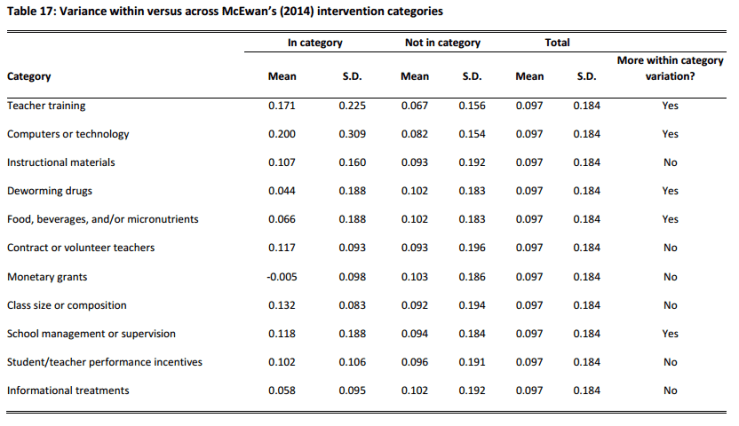
Beyond savings products, this is important because there is a temptation to lump interventions together (How effective are home-based child care visits? How effective is teacher training?) when in fact there is massive diversity in the particulars of the interventions. Sara Nadel and Lant Pritchett have referred to this as “high dimensional design space,” and Popova et al. document it in the case of teacher training interventions.

There is no reason to believe — ex ante — that all interventions in the same “category” will have the same effect. Indeed, in work Anna Popova and I did analyzing randomized controlled trials of education interventions, we found that in many cases, the variation in impact within categories exceeded the variation across categories, per the table below.

variation

So, as Giné says, “the characteristics of the product are very important.”

Lessons from a very productive economic historian: “Get it done and get it out”

I’m reading Greg Prince’s biography of economic historian Leonard Arrington. Early on, one of his mentees reports, “One of the lessons that Leonard taught me was to get it done and get it out.”

Arrington’s massive bibliography evidences that he followed his own advice. David Whittaker compiled the 35 page bibliography for the Journal of Mormon History, including 259 “articles in professional publications and chapters in books,” and more than 35 books, 68 articles in non-professional publications, and many reviews.*

Here’s a little sample:

bibliography

Arrington had amazing concentration: “When he got to the point that he was ready to write the article, he would go down into that office and stay there for 72 hours. His wife would bring him food.” Now, Arrington didn’t contribute equally to every one of these articles. “Not everyone agreed with the division of labor, with some feeling that Leonard’s name appeared at times when his contribution wasn’t sufficient to merit co-authorship…. ‘Of course, that wasn’t unusual for people who were the head of that kind of thing [the historical department he led].'”

But he got those papers out!

As Linda Ginzel at the University of Chicago writes, “If you don’t write it down, it doesn’t exist.” And as Raul Pachego-Vega writes for the Twitter crowd, #GetYourManuscriptOut.

I’d better get back to writing.

* For books, I took the “books, monographs, and pamphlets” section of his bibliography and counted everything over 100 pages.