Week 1 of reading The Wizard of the Crow, by Thiong’o

Shelfari is hosting an on-line book discussion of Kenyan writer Ngugi wa Thiong’o’s newest novel, The Wizard of the Crow. It begins this week with a mere ten pages a day, and I started this afternoon with some entertainingly extreme parody:

[Speaking of the fictional African nation’s ruler] It is said that when he was told that he could not be granted even a minute on the air [in the United States], he could hardly believe his ears or even understand what they were talking about, knowing that in his country he was always on TV; his ever moment – eating…, sneezing, or blowing his nose – captures on camera.

Oh wait, maybe that part isn’t so extreme…

reseña del libro: Fábulas de una abuela extraterrestre, por Daína Chaviano

I have to admit a fundamental problem with reading science fiction in a language other than my own: Science fiction has all these made-up words, and Spanish has a number of words I don’t know, so at a given point I’m not sure whether an unknown word is a science fiction word or just an uncommon Spanish word.  (It’s obvious when the word is Zaík-elo-Memj but not when it’s vartse.)  So that may have contributed to my non-enjoyment of this bit of Cuban sci-fi.  I will grant that it’s the first novel in which I’ve encountered the rare practice of polyandry; that’s something.  Seriously, I really loved another Chaviano book I read and will read more by her, but this one didn’t tickle me.  Mis pensamientos:

la premisa elevada encima de los personajes

Esta novela comienza de buen augurio: dentro de los primeros treinta páginas, Chaviano nos presenta con cuatro narrativos, todos relacionados:

En el primero, hay una criatura con tres ojos, tres bocas, y alas que le cuenta a su nieto dos historias, las del segundo y tercer narrativo. En el segundo, una muchacha humana corre de unos sacerdotes malvados dentro de un bosque oscuro. En el tercero, una muchacha en nuestro mundo escribe una novela contando el primer y el segundo narrativo. En el cuarto, un mago viejo mira por una bola de cristal y observa las chicas en el segundo y el tercer narrativo.

La estructura tan compleja me intrigó, pero desafortunadamente la dotada Chaviano no realiza nada de interés sobre esa fundación. Al contrario, resultan tantos protagonistas que ninguno queda bien desarrollado; ninguno evoca las emociones del lector. (La chica en el narrativo (3) se pregunta con exasperación «¿Cuántos protagonistas puede tener una novela?» Era el único momento en que sentí empatía por ella.)

La ciencia ficción se ha criticado porque «it inevitable proceeds from premise rather than character…and elevates scenario over sensibility» [1] [o sea, inevitablemente procede de la premisa y no de los personajes, y eleva el escenario encima de los sentimientos]. Esta novela es un ejemplo perfecto de esa crítica. Chaviano quiería establecer un libro de ideas: todos los personajes hablan de universos paralelos y alter-egos y la memoria genética y los viajes trans-dimensionales (¡hasta aparece una tabla ouija!). Hasta hay unas ideas interesantes sobre la distinción entre la magia y la ciencia (véase la página 223). Pero con tantas ideas extrañas me resultó imposible entender lo que pasaba ni mucho menos llegar a quererles a los personajes o a preocuparme por lo que les pasa.

Por el final, después de que un personaje da sus explicaciones raras por los acontecidos recientes, su amiga le responde «¿Te das cuenta de lo delirante que resulta todo? No puedo tomarlo en serio.» Tampoco yo lo puedo tomar en serio.

Hace poco que leí otro libro de Daína Chaviano que me encantaba, «El hombre, la hembra y el hambre», el cual tiene un poco de magia pero ni es la ciencia ficción ni el realismo mágico, sino un poco de magia introducido en la vida dura de la Cuba actual. Por allí sí se necesita más magia, pero por aquí menos.

[1] Sven Birkerts, “Present at the Re-Creation,” New York Times, 18 May 2003.
photos from the Gambian fishing community (& other recent photos from Sierra Leone & the Gambia)

I’ve uploaded the last batch of photos from my trip: several from the seashore, a few from a crocodile pool and a nature reserve I visited.  Here they are.

And in case you missed them but are interested, here are the other groups of photos from my recent trip (all previously posted):

ps All the photos are labeled, so if the labels don’t show up, click on the “options” button in the lower right corner of the slide show screen.

If you can’t get to Persepolis, go rent this awesome movie, The King of Kong: A Fistful of Quarters

Yesterday Chris Blattman posted a positive review of Persepolis with links to a trailer and interview with the author of the book the film was based on.  My wife and I saw the film today and I agree with Chris: this is a very well done girl’s coming-of-age story during Iran’s Islamic Revolution and its many years of war with Iraq.  But it’s a downer (with comic elements).  For people like me who know little about Iran’s history, it yields a peek.

Moving swiftly from the significant to the superfluous but awesome, this evening we finished watching the excellent and highly entertaining DVD (by my estimation as well as by that of the critics), The King of Kong: A Fistful of Quarters, about the ongoing battle for supremacy in … Donkey Kong: Yes, the video game that we played back in the 1980s.  This documentary is particularly skilled in that it gets the viewer to care deeply about a subject and characters that one normally would have no interest in.  I don’t care about video games, but I couldn’t resist rooting for the underdog in this saga.  The tension builds and builds until the credits roll.

In contrast to Spellbound, another extremely entertaining documentary, King of Kong has much less innate appeal.  Spellbound is about kids trying to achieve something great; King of Kong is about middle-aged men playing video games rather than spending time helping their kids with their spelling.  But this film delivers not only a great conflict (with the theme songs from both The Karate Kid and Rocky – Persepolis had Eye of the Tiger as well) but also a cast of characters more entertaining than any screenwriter could invent.

Even the DVD extras, with the brief history of Donkey Kong and the film festival appearances by Donkey Kong challenger Steve Wiebe, were entertaining.

Two favorite lines:

  1. [Walter Day, international referee for retro video games]  I wanted to be a hero. I wanted to be the center of attention. I wanted the glory, I wanted the fame. I wanted the pretty girls to come up and say, “Hi, I see that you’re good at Centipede.”
  2. [Steve Wiebe’s daughter, on the Guiness Book of World Records]  Some people sort of ruin their lives to be in there.

Run, don’t walk.  This is a great film.

the law of unintended consequences, manifest in potty training

In my economics work, I have often heard of the Law of Unintended Consequences,  defined by Tyler Cowen as follows:

When a simple system tries to regulate a complex system you often get unintended consequences.

A few weeks ago, my wife gave our three-year-old son an incentive: every time he poops in the potty, he gets to watch a few minutes of a dvd of his choice.  He really likes watching and we severely limit him, so this seemed like it might work.

The next morning, I get up early with him while my wife and the baby try to sleep a little longer.  Shortly thereafter I hear loud grunts and groans coming from the bathroom.  I rush in to find our son sitting on the toilet, trying to make poop out of nothing at all, just so he can watch a few choice scenes of Thomas the Tank Engine.

We have since revised the incentive scheme.  Some.

a funny thing happened on the way to the airport

Late Saturday afternoon I catch a taxi from Cape Point in the Gambia to the airport, about a half-hour trip.  We’re driving on a four-lane highway with a grassy divider down the middle.  The driver tells me he wants to stop for gas, crosses an opening in the divider, and is about to drive the wrong way down the highway for 150 meters when the car stops and won’t start.  I see a mass of cars coming from the other direction, but I figure this is probably standard fare: sure enough, they veer into the unblocked lane without so much as a honk.

The driver and I hop out and push the car down the highway to the gas station, fill up (or put in enough fumes to get a little further), and the car still won’t start.  The driver opens the hood and starts sucking gasoline out of some tube and spitting it out.  Try again, still won’t start.  More sucking, more spitting.  The car sputters to life and we make our way to the airport.  Glad I had plenty of time.

what i really do (photo)

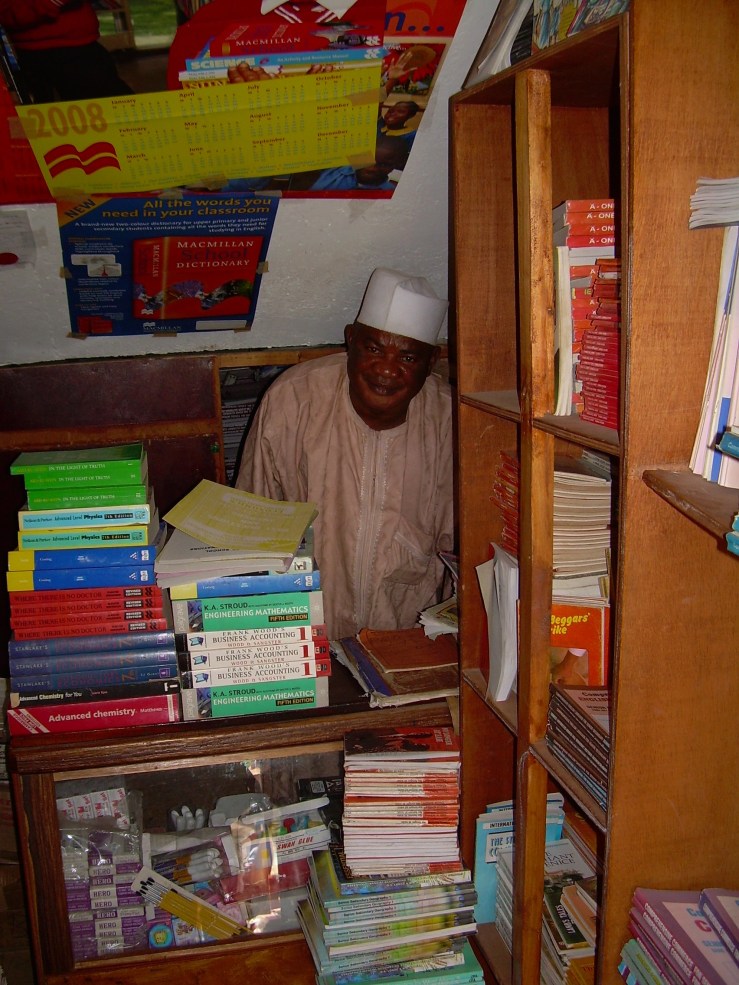
Sometimes people ask me what I really do while I’m in the Gambia or Sierra Leone or wherever, since I don’t post much about my work on my blog.

Here’s what I really do: scour tiny bookshops for African literature which is out of print in the West.  If you’re ever in Banjul, the Gambia, stop by the M&B Bookshop at 4 Clarkson St.  It’s the best bookshop in a broom closet I’ve ever seen.  What you can barely see in the photo is that Michael is emerging from a secret back room where he was looking for Gambian literature to satisfy my needs.

bookshop in banjul

Okay, I also have a job.  But more on that another day.