social sciences as sorcery

Stanlislav Andreski, in the delightfully understated foreward to Social Sciences as Sorcery, in which he argues that much of social science is worthless:

A renowned author would have to be a most extraordinary character…to be able to write prolifically in the full knowledge that his works are worthless and that he is a charlatan whose fame is entirely undeserved and based solely on the stupidity and gullibility of his admirers. Even if he had some doubts about the correctness of his approach at some stage of his career, success and adulation would soon persuade him of his own genius and the epoch-making value of his concoctions. When, in consequence of acquiring a controlling position in the distribution of funds, appointments and promotions, he becomes surrounded by sycophants courting his favours, he is most unlikely to see through their motivation; and, like wealthy and powerful people in other walks of life, will tend to take flattery at its face value, accepting it as a sincere appreciation (and therefore confirmation). p9

And one more bit

In any case, the most deadly agents of cultural infections are not the brazen cynics, but the sectarians prone to self-delusion and the timorous organization men anxious not to miss the band-waggon, who unquestioningly equate popularity and worldly success with intrinsic merit. p10

The take-away and the tossed bone:

I argue on the pages that follow that much of what passes as scientific study of human behavior boils down to an equivalent of sorcery, but fortunately there are other things as well. P10

Continue reading “social sciences as sorcery”

impact evaluation matters: how long do i have to wait to know if my program works?

King and Behrman have a paper on Timing and Duration of Exposure in Evaluations of Social Programs. The paper gives a useful (if not adrenaline-fueled – this is a review, after all) discussion of a host of issues to consider when deciding when to look for results of social programs. [For example, what if the program ends up rolling out at different times in different places? etc] They then give lots of examples of papers that have dealt with the issues (and how they’ve done it). Instructive stuff.

Summary: Impact evaluations aim to measure the outcomes that can be attributed to a specific policy or intervention. Although there have been excellent reviews of the different methods that an evaluator can choose in order to estimate impact, there has not been sufficient attention given to questions related to timing: How long after a program has begun should one wait before evaluating it? How long should treatment groups be exposed to a program before they can be expected to benefit from it? Are there important time patterns in a program’s impact? Many impact evaluations assume that interventions occur at specified launch dates and produce equal and constant changes in conditions among eligible beneficiary groups; but there are many reasons why this generally is not the case. This paper examines the evaluation issues related to timing and discusses the sources of variation in the duration of exposure within programs and their implications for impact estimates. It reviews the evidence from careful evaluations of programs (with a focus on developing countries) on the ways that duration affects impacts.

ARC book review: Emma’s War, by Deborah Scroggins

I read this because I came across the audiobook and essentially read every audiobook I encounter about Africa.  I enjoy these journalist and aid worker memoirs less and less relative to voices of actual African writers.  But, my thoughts…

a look at the West’s myriad and whimsical motives for interventions in Africa

Scroggins uses the life of aid worker cum rebel-wife Emma McCune to characterize the Sudanese north-south civil war. The author folds a series of stories into one volume: the life of McCune (from aristocratic British child with pony and all to adventurer to aid worker to wife of a Sudanese rebel leader), the experience of the Scroggins herself (who spent many years as a journalist in Africa), and the history of Sudan (from colonial times to the present).

[If you’re going to read one readable (i.e., not terribly dense) book about Sudan, I recommend Dave Eggers’ What Is the What, the fictionalized account of a Sudanese refugee boy in which Eggers discusses both the north-south civil war and the mass killings in Darfur.]

This book’s greatest value – and Scroggins recognizes this – is not so much in its insight into Sudan but rather in its insight into the West. We see Emma leaping into aid work as an escape from boredom, we see some aid workers water skiing back and forth in front of refugee camps while others work around the clock in feeding centers, and we see how Emma’s marriage to a Sudanese rebel affects the politics of local aid provision.** Scroggins also gives a larger history of Western intervention in Sudan. Her exploration of the manifold and whimsical motivations of Western involvement is insightful and worthwhile.

That said, I found the pre-Sudan life history of McCune (a chunk of the beginning of the book) tiresome, and occasionally Scroggins’ judgment jumps the gun on her analysis.* But in general she seeks to apply an even hand. Scroggins’ own observations from her time as a journalist provide a compelling illustration of the situation in southern Sudan (25 years ago, anyway). I also learned where anthropologists can get jobs (the UN, apparently).

I wouldn’t rush out to buy this book, but I’m not sorry I read it.

I listened to the unabridged audiobook read by Kate Reading (an appropriate name for a narrator), published by Blackstone Audio. It comes in a bit long at 12 CDs, but Reading gives a fine…well, Reading.

* For example, she comments that “the New World Order [i.e., peace in Africa] was desirable only if it could be achieved without cost to American lives” (326). Of course, this presumes that the West is capable of achieving this at some higher cost, which presumption is not obviously true.

** When I read of Emma going as an aid worker and marrying a local person, I was reminded of the wildly different story of Kenneth Goode, the anthropologist who married a Yanamamo woman.

The Band’s Visit: a funny, sweet film that you probably haven’t seen (but will enjoy)

An Egyptian police band flies to Israel to play a concert but takes the wrong bus and ends up stranded in a tiny Israeli hamlet.  They get to know a number of the locals, and the interactions run the gamut: painfully (hilariously) awkward, funny, sad. 


The interactions between locals are as likely to be awkward (and funny) as those between locals and the visitors, just in more familiar ways.  Maybe the film is about how emotions can cross cultures (even cultures known to have animosity), but I just found it funny and sweet and (sometimes) sad.  But it is very well done, and I recommend it.  (My wife and I both gave it an 8/10, which is strong praise.)


The film is in English, Hebrew, and (presumably) Egyptian Arabic.  We picked it up at our local Blockbuster.


The film is PG-13.  I remember one swear word and one split-second glimpse of a couple of arms and legs (which could be interpreted as sensuality).


Below is a glimpse of the funniest scene in the film, in which the band’s lothario coaches an Israeli on hitting it off with his date.

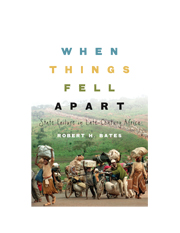
book review – When Things Fell Apart: State Failure in Late-Century Africa, by Robert Bates

I wasn’t a big fan.  For a more positive perspective (from someone who knows much more about African political economy than I do), see Mr Blattman’s comments.  Disagreement is – as always – welcome.

My thoughts:

an interesting model with a hodgepodge of evidence

In this short book (174 pages of text; 139 if you skip the quantitative appendix), Bates argues that state failure stems from predation on the part of the central government. His model, to put it briefly (and inadequately), is that governments can either take revenues from the people (1) in the form of taxes while providing services (such as security) or (2) in the form of predation. As long as the benefits of the former outweigh the latter (for example, when a government is assured of staying in power for a long time), the government will maintain security. However, if the long run is less certain, the government may sacrifice steady long-term gains in favor of larger short-term gains from predation.

Bates starts with an extended, insightful exposition of this metaphor (Chapter Two). Then he characterizes the conditions that prevailed prior to collapse in many African countries in chapters three (political trends), four (bad economic policies), and five (tensions between groups in the countries). In Chapter Six he describes the state failures. The conclusion sums it up, and the appendix gives some statistical evidence (the rest of the evidence is anecdotal or – Bates’s preferred term – narrative).

Overall I found the book slow reading (despite its brevity) and not as coherent as I’d have liked. The basic model is useful but I often found it unclear in the succeeding chapters how the many pieces of narrative evidence fit into the model. The clearest example of this was in Chapter Five, where three models of subnational tensions were presented followed by several examples that did not clearly fit the models.

Further, the form of narrative evidence (lots of different examples from various countries) felt less effective to me than either a detailed case study of one example or systematic statistical evidence. (If I had pre-existing intimate familiarity with the national histories, this would have been less of an issue) The statistical annex provides the latter but deserved more space: some integration of statistical findings with narrative evidence might have worked better. (As it was, the statistical annex left me with a number of clarifying questions.) Bates argues that he distinguishes himself from other work in the area by deriving his hypothesis from a theory rather than highlighting empirical “findings” (p8-9).* And yet Bates – in his empirical appendix – reports atheoretical findings such as the increasing likelihood of disorder over time (despite controlling for changes that should drive the changing likelihood) – p171-173. Finally, Bates doesn’t devote any time to states that didn’t experience state failure and why or how they differed, nor to rival theories and how they fare in light of the national narratives.

As a novice considering whether to read a book like this, the ideal would be to read at least two reviews: one from an expert (who can opine as to how this fits – or doesn’t – with existing knowledge) and one from a novice (who can tell how this may read to another novice). I fall in the latter category. In the former, Chris Blattman (an economics professor in Yale’s political science department) blogged, “It’s short, it’s readable, and it’s intelligent. Normally if I get just two of the three, I’m thrilled” [1]. A political scientist I know called it an “excellent primer.” And Nicholas Van De Walle (author of the highly esteemed African Economies and the Politics of Permanent Crisis, 1979-1999) wrote a brief review for Foreign Affairs, summarizing and concluding that “Bates paints in broad brushes and ignores the states in the region, such as Botswana, Cape Verde, and Mauritius, that have not followed this script but actually enjoyed stability, economic growth, and reasonably democratic politics” [2].

Perhaps this volume is most readable to the already initiated. But it is short and imparts a significant amount of valuable information; I recommend Chapters 2 and 6.

[1] Chris Blattman’s blog [easily searchable on-line], “When things fell apart,” 19 July 2008.

[2] Nicholas Van De Walle, “Africa,” Foreign Affairs, May/June 2008.

* I assume by this he means an explicit, chapter-long theory. Other work I’ve read in this area, by Collier or by Miguel, clearly has a theoretical basis even if not as formally stated as Bates’s.

To a Bed-Bug, by Sam Mbure

I wonder how long, you awful parasite,
Shall share with me this little bed,
And make me, from my sweet dreams be lost,
By sucking blood from my poor head.

I should but say man has much
Blood, which you and your families do feed
On; for supper, dinner, and lunch,
And besides, you do in my bed breed.

Clever thou art, tiny creature;
You attend me when I am deep asleep;
When thou art sure, I can’t you capture,
Just at the time I snore deep.

‘Tis so strange that before twilight,
The bed clear of you would seem;
For not one of you is in my sight;
As if your presence was in a dream

Sam Mbure is an active Kenyan writer; learn more about him here

Some months ago I posted my own poem about a cockroach I met in Sierra Leone.  If you read it and compare, it will be clear that Sam is a professional poet and I am an economist.  I am grateful to never have – to my knowledge – encountered Sam’s awful parasite.  Something to look forward to yet in life.  I read his poem in Wole Soyinka’s Poems of Black Africa.

a history of two African nations…through postage stamps

From Michael Kevane, an economist at Santa Clara University

An analysis of the imagery on postage stamps suggests that regimes in
Sudan and Burkina Faso have pursued very different strategies in
representing the nation. Sudan’s stamps focus on the political center and
dominant elite (current regime, Khartoum politicians, and Arab and Islamic
identity) while Burkina Faso’s stamps focus on society (artists, multiple
ethnic groups, and development). Sudan’s stamps build an image of the
nation as being about the northern-dominated regime in Khartoum (whether
military or parliamentary); Burkina Faso’s stamps project an image of the
nation as multi-ethnic and development-oriented.

He provides a history of each country through postage stamps.  See the whole
article here.

Here are a couple of sample stamps.

14 more reviews on the Africa Reading Challenge

Thanks to everyone for sharing!

  1. No Longer At East, by Chinua Achebe / Nigeria (elgoose)
  2. The Fate of Africa, by Martin Meredith (Hedgie)
  3. Measuring Time, by Helon Habila / Nigeria (Ugandan Insomniac)
  4. Mugabe: Power, Plunder, and the Struggle for Zimbabwe’s Future / Zimbabwe (Codrin)
  5. Things Fall Apart, by Chinua Achebe / Nigeria (Raider Girl)
  6. Road to Freedom, by Lucilda Hunter / Sierra Leone (Tristan)
  7. The Feud and Other Stories, by R. Sarif Easmon / Sierra Leone (Tristan)
  8. We Killed Mangy-Dog and Other Mozambique Stories, by Luis Bernardo Honwana / Mozambique (Heraclitean Fire)
  9. Mukiwa: A White Boy in Africa, by Peter Godwin / Zimbabwe (Ms. Four)
  10. A is for Africa, by Ifeoma Onyefulu (Callista)
  11. African Psycho, by Alain Mabancko / Congo-Brazzaville (Callista)
  12. Infidel, by Ayaan Hirsi Ali / Somalia, Ethiopia, Kenya (JMac)
  13. We Wish To Inform You That Tomorrow We Will Be Killed With Our Families, by Philip Gourevitch / Rwanda (Angela)
  14. What Is The What, by Dave Eggers / Sudan (Sarah)

does “rogue” sell books?

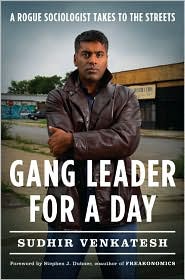
Of course we remember Freakonomics: A Rogue Economist Explores the Hidden Side of Everything.  And then Levitt’s sometime co-author writes Gang Leader for a Day: A Rogue Sociologist Takes to the Streets.  And just the other day I saw Rogue Economics: Capitalism’s New Reality.

Maybe rogue economics will become a new subfield for hopeful grad students.  Instead of being a labor and development economist, I could be a rogue economist (you know, I took the two-semester “rogue” sequence) taught by Levitt, Venkatesh, and – of course – Annja Creed, star of the Rogue Angel books, to add a bit of derring-do.

From wikipedia:

Rogue Angel is a paper back series of novels published bi-monthly since July 2006 by Harlequin Publishing’s Gold Eagle division. … The books deliver high-octane action, a basis in history with a twist on the fantastical, and more than a hint of derring-do.

And where are the rogue anthropologists?  I typed that into Amazon Books and got Where Bigfoot Walks, so maybe that’s a hint.