reseña del libro: Fábulas de una abuela extraterrestre, por Daína Chaviano

I have to admit a fundamental problem with reading science fiction in a language other than my own: Science fiction has all these made-up words, and Spanish has a number of words I don’t know, so at a given point I’m not sure whether an unknown word is a science fiction word or just an uncommon Spanish word.  (It’s obvious when the word is Zaík-elo-Memj but not when it’s vartse.)  So that may have contributed to my non-enjoyment of this bit of Cuban sci-fi.  I will grant that it’s the first novel in which I’ve encountered the rare practice of polyandry; that’s something.  Seriously, I really loved another Chaviano book I read and will read more by her, but this one didn’t tickle me.  Mis pensamientos:

la premisa elevada encima de los personajes

Esta novela comienza de buen augurio: dentro de los primeros treinta páginas, Chaviano nos presenta con cuatro narrativos, todos relacionados:

En el primero, hay una criatura con tres ojos, tres bocas, y alas que le cuenta a su nieto dos historias, las del segundo y tercer narrativo. En el segundo, una muchacha humana corre de unos sacerdotes malvados dentro de un bosque oscuro. En el tercero, una muchacha en nuestro mundo escribe una novela contando el primer y el segundo narrativo. En el cuarto, un mago viejo mira por una bola de cristal y observa las chicas en el segundo y el tercer narrativo.

La estructura tan compleja me intrigó, pero desafortunadamente la dotada Chaviano no realiza nada de interés sobre esa fundación. Al contrario, resultan tantos protagonistas que ninguno queda bien desarrollado; ninguno evoca las emociones del lector. (La chica en el narrativo (3) se pregunta con exasperación «¿Cuántos protagonistas puede tener una novela?» Era el único momento en que sentí empatía por ella.)

La ciencia ficción se ha criticado porque «it inevitable proceeds from premise rather than character…and elevates scenario over sensibility» [1] [o sea, inevitablemente procede de la premisa y no de los personajes, y eleva el escenario encima de los sentimientos]. Esta novela es un ejemplo perfecto de esa crítica. Chaviano quiería establecer un libro de ideas: todos los personajes hablan de universos paralelos y alter-egos y la memoria genética y los viajes trans-dimensionales (¡hasta aparece una tabla ouija!). Hasta hay unas ideas interesantes sobre la distinción entre la magia y la ciencia (véase la página 223). Pero con tantas ideas extrañas me resultó imposible entender lo que pasaba ni mucho menos llegar a quererles a los personajes o a preocuparme por lo que les pasa.

Por el final, después de que un personaje da sus explicaciones raras por los acontecidos recientes, su amiga le responde «¿Te das cuenta de lo delirante que resulta todo? No puedo tomarlo en serio.» Tampoco yo lo puedo tomar en serio.

Hace poco que leí otro libro de Daína Chaviano que me encantaba, «El hombre, la hembra y el hambre», el cual tiene un poco de magia pero ni es la ciencia ficción ni el realismo mágico, sino un poco de magia introducido en la vida dura de la Cuba actual. Por allí sí se necesita más magia, pero por aquí menos.

[1] Sven Birkerts, “Present at the Re-Creation,” New York Times, 18 May 2003.
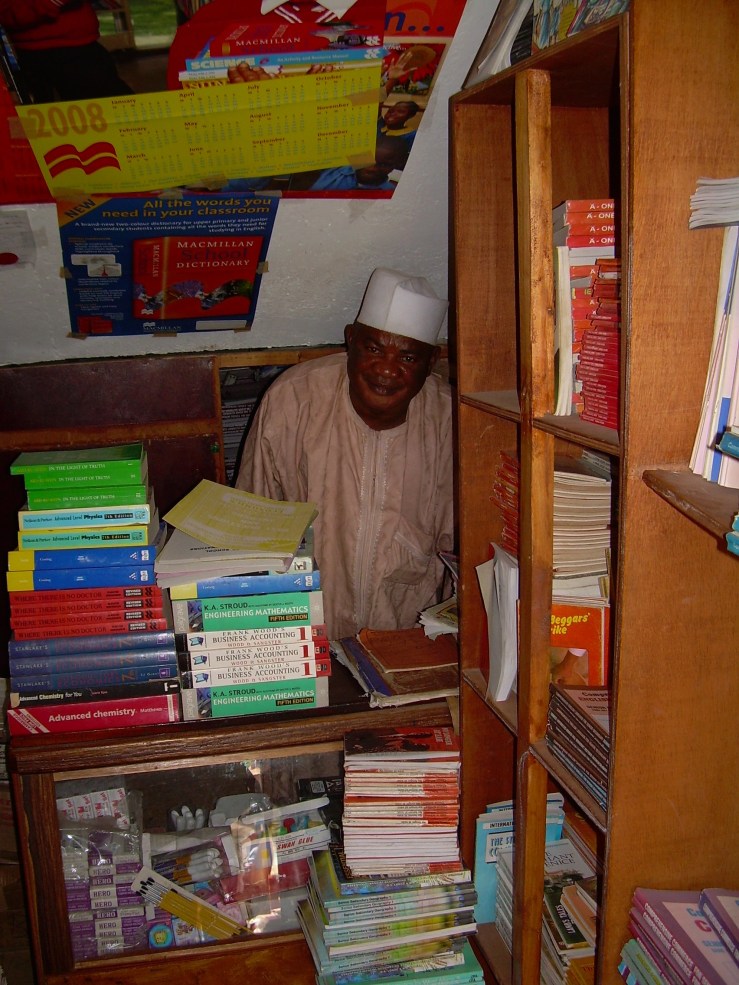
what i really do (photo)

Sometimes people ask me what I really do while I’m in the Gambia or Sierra Leone or wherever, since I don’t post much about my work on my blog.

Here’s what I really do: scour tiny bookshops for African literature which is out of print in the West.  If you’re ever in Banjul, the Gambia, stop by the M&B Bookshop at 4 Clarkson St.  It’s the best bookshop in a broom closet I’ve ever seen.  What you can barely see in the photo is that Michael is emerging from a secret back room where he was looking for Gambian literature to satisfy my needs.

bookshop in banjul

Okay, I also have a job.  But more on that another day.

on-line book schedule and discussion for Thiong’o’s The Wizard of the Crow, coming soon

Ngugi wa Thiong’o published this immense book in 2006, The Wizard of the Crow: almost 800 pages of political satire in a fictional African country.  Beachlover over at Shelfari has posted a reading schedule to help people get through it, and there will be an ongoing on-line discussion of the book there as well.  Read this bit from Aminatta Forna’s review of the book in the Washington Post:

Wizard of the Crow is first and foremost a great, spellbinding tale, probably the crowning glory of Ngugi’s life’s work. He has done for East Africa what Ahmadou Kourouma’s Waiting for the Wild Beasts to Vote did for West Africa: He has turned the power of storytelling into a weapon against totalitarianism.

Last year I read Thiong’o’s Petals of Blood and thought highly of it.  Some years ago I also read his The River Between and enjoyed it but not quite as much.  Time for the masterwork!

Wizard of the Crow

non-depressing development fiction: FOUND!

A month ago I posted a query about “upbeat” fiction that takes place in developing countries.  The reason is that my book club is tired of depressing fiction (after Purple Hibiscus and A Thousand Splendid Suns).  Some of the suggestions were odd.  For example, someone called The Poisonwood Bible upbeat; I wonder if they’ve read it.  (I liked it a lot but wouldn’t call it upbeat.)  Here are the suggestions I garnered which seemed like they might really be upbeat, the first two especially:

  1. Hullabaloo in the Guava Orchard, by Kiran Desai (Who knew she wrote a comedy before the devastating Inheritance of Loss?) – India
  2. Last Orders at Harrods, by Michael Holman – Kenya
  3. Red Earth and Pouring Rain, by Vikram Chandra – India
  4. Wizard of the Crow, by Ngugi wa Thiongo – Kenya
  5. The Whale Caller, by Zakes Mda – South Africa
  6. Dona Flor and Her Two Husbands, by Jorge Amado – Brazil
  7. Gabriela, Clove, and Cinnamon, by Jorge Amado – Brazil
  8. Spud, by John van de Ruit – South Africa

And here a few that might be upbeat (I wasn’t totally convinced by those who posted):

  1. Uhuru Street, by MG Vassanji – Kenya
  2. The Gunny Sack, by MG Vassanji – Kenya
  3. Measuring Time, by Helon Habila – Nigeria
  4. The Power of One, by Bryce Courtenay – South Africa

Expanding Horizons book review: Before we were free, by Julia Alvarez

Taking a brief break from Africana, part of what I did while my tv was in the closet in Freetown was listen to this excellent audiobook, which was part of my list for the Expanding Horizons reading challenge.  I really enjoyed this book (even though I’m not really the target demographic) and will surely give it as a gift when my nieces reach age 12 or so.  My thoughts:

poignant, compelling, revealing, excellent story of life under a dictatorship

Julia Alvarez tells the story of the end of the Trujillo dictatorship (1960s Dominican Republic). She cleverly tells the story from the perspective of a pre-teen girl (Anita) while weaving in major political players and events. She captures Anita’s loss of innocence as the oppressive political regime begins to impact her life first obliquely and then very directly. From the start, Alvarez engages us with her main character as she simultaneously paints on a much larger canvas. [As an adult male (without a pre-teen daughter), I found some of Anita’s talk about growing into a woman and being in love with the boy next door tiresome, but it all felt right for the character.]

Alvarez doesn’t shy away from the fiasco that took place after Trujillo’s assassination, but she does leave off just before the country’s first post-Trujillo elections (which were a farce, leaving a Trujillo crony in power for some thirty years). After you’ve finished the book, re-read the author’s note at the beginning: Realizing Alvarez’s intimate connection to the fictionalized events in the book is all the more poignant.

Note on content: Besides girlhood crushes, there is a brief, non-graphic mention of various forms of torture (ugly but important) and an allusion to Trujillo’s penchant for young mistresses.

For adult readers, this is a sweet complement to Alvarez’s wonderful earlier book, In the Time of the Butterflies, which tells the story of the Mirabal sisters, three key anti-Trujillo revolutionaries. While that book took us inside the resistance movement, having this book narrated by a child opens a window into how children are affected in times of oppression. For another perspective on the end of the Trujillo regime, read Mario Vargas Llosa’s excellent La Fiesta Del Chivo [The Feast of the Goat]; that book is not appropriate for child readers, with graphic portrayals of torture and of violence against a child (apparently accurate to the time and place).

Julia Alvarez reads the unabridged audiobook herself and is perfect for the role (all the more impressive as I’ve heard Alvarez speak in person, and she doesn’t really sound like a twelve-year-old girl).

Africa Reading Challenge: A Long Way Gone – Memoirs of a Boy Soldier, by Ishmael Beah

Last week, just before coming to Sierra Leone, I finished listening to Ishmael Beah’s memoir of his time running from and then participating in Sierra Leone’s civil war (excellently narrated by Dominic Hoffman).  This morning I visited two schools that served as rebel headquarters during the war; this book was very insightful into the impacts of the war here.  My thoughts:

skilled storytelling drives this tale of a boy who is both normal (for his time and place) and completely exceptional

Ishmael Beah tells of how his village was destroyed when he was just 11 years old, during Sierra Leone’s civil war of the 1990s. He and his friends wandered to escape the war for many months and then were forcibly enlisted in the military. After two years of fighting, UNICEF rescues him and other boys, and we learn how Ishmael is rehabilitated and reintegrated into civilian society.

Beah is a skilled storyteller, and he gives a compelling account of how the war affects children like him. The first half of the book is the wandering (which is similar to another excellent narrative of boy refugees, What Is the What by Dave Eggers), and the last third focuses on the rehabilitation and Beah’s life beyond. The relatively small middle portion deals with Beah’s time as a child soldier; I would have appreciated more information on that time, but Beah doesn’t need long to paint a clear picture. (I was surprised at the omission of any role of sexual violence, which was apparently significant in the Sierra Leone conflict.) I felt the eye-opening, unique contribution of this book was the story of the rehabilitation. This was in the early days of UNICEF’s and other organizations’ efforts to rehabilitate boy soldiers, and the challenges they faced are striking.

In some ways, Beah’s story feels like two stories. The first three-quarters are the normal: his experience seems to be similar to the experiences of other children in the period. The last quarter is the exceptional: Beah’s story diverges from that of the other boys as he comes to the USA as a UN representative for children affected by the war. Both are of interest, mostly due to Beah’s skills in narrating his tale.

It is natural to compare this to other books about young refugees and child soldiers in Africa. Beasts of No Nation and Moses, Citizen and Me are both novels about boy soldiers, the former focusing on the conflict and the latter on post-conflict re-entrance into the community. Beah’s account is more compelling than either of the novels, partly because it’s more likely to be fact and also simply because he’s a good writer with a powerful story to tell. Child soldiers play a small but crucial role in Adichie’s wonderful Half of a Yellow Sun. Interestingly, Moses, Citizen, and Me revolves around the boys putting on a performance of Shakespeare’s Julius Cesar, and that play also has a role in this memoir.

This book stands out from the others in its vivid and detailed description of the challenge of rehabilitating child soldiers as they withdraw from addictions to both cocaine and violence. A heartening supplement to Beah’s success story is the research of economist Chris Blattman, who finds positive outcomes for former child soldiers in terms of political participation elsewhere in Africa [1].

[1] Blattman, Christopher, “From violence to voting: War and political participation in Uganda,” Center for Global Development and Yale University, 2008.

is ishmael beah (former child soldier) right or wrong? OR does it matter how accurate a memoir is?

Ishmael Beah wrote a popular memoir of his time as a boy soldier in Sierra Leone. I’m just finishing the book, and Ishmael is an excellent storyteller who has been through harrowing times.  I remember when the memoir was published, not long after the James Frey memoir was found to be largely fabricated.  The publisher questioned Beah on the specificity of his memoir, and he reassured her that growing up in a culture rich with oral tradition had honed his memory. 

A few days ago, the newspaper The Australian quoted a couple who claim to have discovered that the events in Beah’s book occurred over one year, rather than the three years he claims in his book.  This would mean he was a soldier for a few months rather than two years.  Beah denies this. Whether Beah was a child soldier is not in question.

Whether Beah is right or wrong, this points me to the question of what I want to get out of a memoir. Whether a particular detail is right or wrong doesn’t matter to me: I’m seeking to gain an broad understanding of the challenges faced by child soldiers (both during and after the war).  If it turned out that Beah wasn’t a child soldier at all, that would affect my experience with the book. If he just got some dates wrong, that doesn’t affect much. Likewise with Rigoberta Menchu’s memoir recounting atrocities commited against Guatemala’s native peoples: even if it turned out to be a composite of many people’s experiences, no one denies that these atrocities took place.

Some memoirs, like Alexandra Fuller’s Don’t Let’s Go To the Dogs Tonight or Ruth Reichl’s Garlic and Sapphires, are just great stories, so whether they turn out to be perfectly factual or not is not terribly important. (Those elements of them that ring true are just as valuable as elements of novels that ring true: very valuable!)

With other memoirs, such as Gandhi’s or Nelson Mandela’s, much of what I’m seeking is to learn from the personal integrity and experience of this individual, so if I learned that these were consciously fabricated, I would be disappointed.

Ultimately, I believe all memoirs have an element of fiction, whether consciously constructed or not.  We humans just don’t remember that well, and our perceptions of what we experience involve so many assumptions that ultimately we’re each writing our own novel.  So maybe my novel can learn from someone else’s novel.

one of my new favorite writers: Daína Chaviano

Last month I finished the excellent Man, Woman, and Hunger (El hombre, la hembra, y el hambre).  Now I’m reading a very different book by her, Fables from an Extraterrestrial Grandmother.  I’ve been enjoying Chaviano so much (and having so much trouble placing her in a genre) that I was pleased to encounter this profile of her from a few years ago.

The Cuban exile’s books are best described as wild experiments in genre-busting. It’s as if Ray Bradbury married Michael Ende and frolicked occasionally with Anáis Nin.

She conceived of a series called Habana Oculta, or the Occult Side of Havana, that would take a realistic approach to describing the magical elements of the city she had left behind [Havana].

The most recent book in the Habana Oculta series, El hombre, la hembra, y el hambre (Man, Woman, and Hunger, Planeta, 1998) describes how four characters, including a prostitute turned Santería priestess and an economist turned butcher, struggle with their double lives and sense of lost identity in modern-day Cuba.

I recommend the whole article, as well as perusing the author’s site.

The book I’m reading by her now has one of the most fascinating narrative structures I’ve ever encountered: four simultaneous narratives, Narrative A has a novelist writing Narratives B and C, but Narrative B also has an ancient grandmother telling stories about Narratives A and C, and a sage in Narrative D can observe Narratives A and C in a crystal ball.  Mind exploding!

[Photo from Chaviano’s site]

Africa Reading Challenge review: Purple Hibiscus, by Chimamanda Ngozi Adichie

On Saturday I finished my first item of African literature for the year.  It was powerful and depressing; if you haven’t read anything by Adichie, read Half of a Yellow Sun first (I liked it better, more epic!).  But here’s what I thought of this one.

emotionally difficult bildungsroman against a backdrop of domestic abuse and military dictatorship

This is the story of wealthy Nigerian family with a deeply religious father who gives generously to family, the community, and other charitable causes; a loving mother; and two successful children (Kambili and her brother Jaja) who perform at the top of their classes in school. It also the story of a family wracked by domestic violence, a father with an uncontrollable temper, and two children who obey and perform through profound fear. Same family. Fifteen-year-old Kambili narrates the story as she and her brother go to visit their father’s free-thinking university professor sister, and attitudes begin to change.

The story is emotionally difficult (as it should be), and it never bores (although I occasionally became frustrated with Kamibili’s unrelenting shyness). Adichie – the author – effectively portrays the complex relationships between domestic abusers and their victims, the entwined fear and love and pride and anger. Adichie takes advantage of the father’s adoration of the West to get in a number of clever jabs at Western culture, and she uses the university professor aunt and her children to espouse a number of messages. (The aunt experiences – for example – the capricious nature of the process of applying for an American visa; for a much better characterization of that, however, read Kiran Desai’s The Inheritance of Loss.)

I can see why this was only shortlisted for the Orange Prize whereas Adichie’s more recent book, Half of a Yellow Sun, actually won the prize. Both books are emotionally effective, but Half feels more epic while it plays out on the backdrop of a major historical event (the Biafran War). Hibiscus is more of a domestic drama, although Adichie seeks to illustrate the challenges of life in Nigeria with a military coup, a significant amount of political intrigue, police oppression, and other dynamics.

One critique I had was with a subplot detailing Kambili’s first love interest, a priest. The future of the relationship was ambiguous enough to create real discomfort (she is fifteen and he is an adult, after all), and the reader experiences enough discomfort from the primary family relationship to satisfy all discomfort quotas for years to come.

I listened to the unabridged audiobook narrated by Lisette Lecat (published by Recorded Books, 10 CDs). Lecat is an excellent reader as always (she also narrated the excellent Don’t Let’s Go to the Dogs Tonight and The No.1 Ladies’ Detective Agency series), but I couldn’t help being bothered by the erroneous accent: Lecat is South African, and that accent is very distinct from the Nigerian accent.

Minor critiques aside, I highly recommend this fine example of modern Nigerian literature.

[Note on content: the book contains graphic (not gratuitous) domestic violence.]