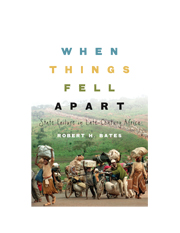
book review – When Things Fell Apart: State Failure in Late-Century Africa, by Robert Bates

I wasn’t a big fan.  For a more positive perspective (from someone who knows much more about African political economy than I do), see Mr Blattman’s comments.  Disagreement is – as always – welcome.

My thoughts:

an interesting model with a hodgepodge of evidence

In this short book (174 pages of text; 139 if you skip the quantitative appendix), Bates argues that state failure stems from predation on the part of the central government. His model, to put it briefly (and inadequately), is that governments can either take revenues from the people (1) in the form of taxes while providing services (such as security) or (2) in the form of predation. As long as the benefits of the former outweigh the latter (for example, when a government is assured of staying in power for a long time), the government will maintain security. However, if the long run is less certain, the government may sacrifice steady long-term gains in favor of larger short-term gains from predation.

Bates starts with an extended, insightful exposition of this metaphor (Chapter Two). Then he characterizes the conditions that prevailed prior to collapse in many African countries in chapters three (political trends), four (bad economic policies), and five (tensions between groups in the countries). In Chapter Six he describes the state failures. The conclusion sums it up, and the appendix gives some statistical evidence (the rest of the evidence is anecdotal or – Bates’s preferred term – narrative).

Overall I found the book slow reading (despite its brevity) and not as coherent as I’d have liked. The basic model is useful but I often found it unclear in the succeeding chapters how the many pieces of narrative evidence fit into the model. The clearest example of this was in Chapter Five, where three models of subnational tensions were presented followed by several examples that did not clearly fit the models.

Further, the form of narrative evidence (lots of different examples from various countries) felt less effective to me than either a detailed case study of one example or systematic statistical evidence. (If I had pre-existing intimate familiarity with the national histories, this would have been less of an issue) The statistical annex provides the latter but deserved more space: some integration of statistical findings with narrative evidence might have worked better. (As it was, the statistical annex left me with a number of clarifying questions.) Bates argues that he distinguishes himself from other work in the area by deriving his hypothesis from a theory rather than highlighting empirical “findings” (p8-9).* And yet Bates – in his empirical appendix – reports atheoretical findings such as the increasing likelihood of disorder over time (despite controlling for changes that should drive the changing likelihood) – p171-173. Finally, Bates doesn’t devote any time to states that didn’t experience state failure and why or how they differed, nor to rival theories and how they fare in light of the national narratives.

As a novice considering whether to read a book like this, the ideal would be to read at least two reviews: one from an expert (who can opine as to how this fits – or doesn’t – with existing knowledge) and one from a novice (who can tell how this may read to another novice). I fall in the latter category. In the former, Chris Blattman (an economics professor in Yale’s political science department) blogged, “It’s short, it’s readable, and it’s intelligent. Normally if I get just two of the three, I’m thrilled” [1]. A political scientist I know called it an “excellent primer.” And Nicholas Van De Walle (author of the highly esteemed African Economies and the Politics of Permanent Crisis, 1979-1999) wrote a brief review for Foreign Affairs, summarizing and concluding that “Bates paints in broad brushes and ignores the states in the region, such as Botswana, Cape Verde, and Mauritius, that have not followed this script but actually enjoyed stability, economic growth, and reasonably democratic politics” [2].

Perhaps this volume is most readable to the already initiated. But it is short and imparts a significant amount of valuable information; I recommend Chapters 2 and 6.

[1] Chris Blattman’s blog [easily searchable on-line], “When things fell apart,” 19 July 2008.

[2] Nicholas Van De Walle, “Africa,” Foreign Affairs, May/June 2008.

* I assume by this he means an explicit, chapter-long theory. Other work I’ve read in this area, by Collier or by Miguel, clearly has a theoretical basis even if not as formally stated as Bates’s.

To a Bed-Bug, by Sam Mbure

I wonder how long, you awful parasite,
Shall share with me this little bed,
And make me, from my sweet dreams be lost,
By sucking blood from my poor head.

I should but say man has much
Blood, which you and your families do feed
On; for supper, dinner, and lunch,
And besides, you do in my bed breed.

Clever thou art, tiny creature;
You attend me when I am deep asleep;
When thou art sure, I can’t you capture,
Just at the time I snore deep.

‘Tis so strange that before twilight,
The bed clear of you would seem;
For not one of you is in my sight;
As if your presence was in a dream

Sam Mbure is an active Kenyan writer; learn more about him here

Some months ago I posted my own poem about a cockroach I met in Sierra Leone.  If you read it and compare, it will be clear that Sam is a professional poet and I am an economist.  I am grateful to never have – to my knowledge – encountered Sam’s awful parasite.  Something to look forward to yet in life.  I read his poem in Wole Soyinka’s Poems of Black Africa.

14 more reviews on the Africa Reading Challenge

Thanks to everyone for sharing!

  1. No Longer At East, by Chinua Achebe / Nigeria (elgoose)
  2. The Fate of Africa, by Martin Meredith (Hedgie)
  3. Measuring Time, by Helon Habila / Nigeria (Ugandan Insomniac)
  4. Mugabe: Power, Plunder, and the Struggle for Zimbabwe’s Future / Zimbabwe (Codrin)
  5. Things Fall Apart, by Chinua Achebe / Nigeria (Raider Girl)
  6. Road to Freedom, by Lucilda Hunter / Sierra Leone (Tristan)
  7. The Feud and Other Stories, by R. Sarif Easmon / Sierra Leone (Tristan)
  8. We Killed Mangy-Dog and Other Mozambique Stories, by Luis Bernardo Honwana / Mozambique (Heraclitean Fire)
  9. Mukiwa: A White Boy in Africa, by Peter Godwin / Zimbabwe (Ms. Four)
  10. A is for Africa, by Ifeoma Onyefulu (Callista)
  11. African Psycho, by Alain Mabancko / Congo-Brazzaville (Callista)
  12. Infidel, by Ayaan Hirsi Ali / Somalia, Ethiopia, Kenya (JMac)
  13. We Wish To Inform You That Tomorrow We Will Be Killed With Our Families, by Philip Gourevitch / Rwanda (Angela)
  14. What Is The What, by Dave Eggers / Sudan (Sarah)

does “rogue” sell books?

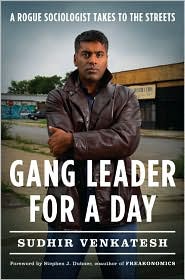
Of course we remember Freakonomics: A Rogue Economist Explores the Hidden Side of Everything.  And then Levitt’s sometime co-author writes Gang Leader for a Day: A Rogue Sociologist Takes to the Streets.  And just the other day I saw Rogue Economics: Capitalism’s New Reality.

Maybe rogue economics will become a new subfield for hopeful grad students.  Instead of being a labor and development economist, I could be a rogue economist (you know, I took the two-semester “rogue” sequence) taught by Levitt, Venkatesh, and – of course – Annja Creed, star of the Rogue Angel books, to add a bit of derring-do.

From wikipedia:

Rogue Angel is a paper back series of novels published bi-monthly since July 2006 by Harlequin Publishing’s Gold Eagle division. … The books deliver high-octane action, a basis in history with a twist on the fantastical, and more than a hint of derring-do.

And where are the rogue anthropologists?  I typed that into Amazon Books and got Where Bigfoot Walks, so maybe that’s a hint.

the original spider-man comics: awesome (review)

I recently got these from the library.  I read some to my 3-year-old, but then I couldn’t wait.  A rollicking good time.

first-class entertainment

This collection of the original 22 magazine appearances of Spider-Man* is awesome. I’m not an experienced Spider-Man fan; I mostly know him from the recent Tobey Maguire films (good, better, bad). Spider-Man is a great character: trying to do the right thing and beat criminals while struggling to make financial ends meet (at one point he tries to convince a sports card manufacturer to make Spider-Man trading cards – to no avail), trying not to lose his temper with kids at school (remember he’s just a teenager), and seeking to maintain a relationship while constantly disappearing (to turn into Spider-Man). His adolescent arrogance often gets the better of him and his luck turns sour as often as sweet (except in a fight, in which it turns sour less often 🙂 ).

The dialogue in these comics is hilarious, often because of its clunky exposition. I’d say “unintentionally,” but Stan Lee – the writer – seems savvy enough to see the joke. Here are a couple of lines I loved:

Dr Doom, in a thought bubble: “When one is a master of science, as I am, there is nothing which cannot be accomplished!”

Mysterio, in the midst of a battle with Spider-man: “I might as well tell you the whole story – for I shall see to it that you never tell anyone else!” [followed by the whole story**]

The book is full of visits from other superheroes: the Fantastic Four appear most prominently, but we also see the Hulk, and have cameos from the X-Men, Giant-Men, the Wasp, Dr Strange, Iron Man, and many more. The villains are endless and creative: my favorite is the oh-so-dated leopard skin pants-wearing Kraven the Hunter. And there isn’t a period in the whole book: all exclamation points and question marks.

This is first-class entertainment.

* Includes Amazing Fantasy #15, The Amazing Spider-Man #1 – 20, and The Amazing Spider-Man Annual #1.

** Reminiscent of that scene in The Great Muppet Caper when Miss Piggy asks her new employer why she just told her all about her personal life, to which the employer responds, Exposition!

book review: To Draw Closer To God, by Henry Eyring

My mother-in-law gave me this sweet book for my birthday.  I must have marked up two-thirds of the pages.  Highly recommended.  My thoughts:

exceptional collection of thought and counsel

In this selective collection of discourses, Brother Eyring teaches us how to hear the Lord, how to heed, and how to help others. In almost every chapter, I found myself making abundant marginal notes, sometimes to remind myself to implement a piece of counsel in my life, sometimes to emphasize how true a point felt, and other times to make sure that I remember a point for when the opportunity to apply to arises. The counsel I read in this book has affected how I read the scriptures, how I pray, how I listen to lessons and talks in church, and how I will approach friends struggling with their faith. These aren’t changes because of what seem like good ideas (although they are) but rather because the teachings feel true.

Perhaps this book is better than the average “Teachings” volume because of its selectiveness. With only 15 talks, each talk in this slim volume exhibits insights and inspiration.

I recommend this book highly, as one of the two most spiritual (non-scriptural) volumes I have ever read; the other is Yearning for the Living God: Reflections from the Life of F. Enzio Busche. I intend to gift this book liberally.

Many of the talks are also available on-line. I list the talks and where they were given, with an asterisk by those I found particularly helpful during this reading. I’m sure that next time I will be inspired by different passages. 
Continue reading “book review: To Draw Closer To God, by Henry Eyring”

Europe, by Mazisi Kunene

Europe, your foundations

Are laid on a rough stone.

Your heart is like cobwebs

That are dry in the desert.


Your children fill us with fear:

They are like the young of a puff adder

Who devour the flesh of their parent.


Once I believe the tales.

Once I believed you had breats

Over-flowing with milk.


I saw you rushing with books

From which the oracles derive their prophecies.

I heard you in the forest

Crying like wolves,

Breaking the bones of your clans.


Continue reading “Europe, by Mazisi Kunene”

my secret

I always keep a book to read at the office when I need a break.  Right now it’s Robert Bates’ new book, When Things Fell Apart: State Failure in Late-Century Africa.


BUT hidden under a pile of papers is the other book: Marvel Comics’ Essential Amazing Spider-Man, Volume 1.  The first Spider-Man comics ever, filled with nuclear radiation and sprinkled with Cold War terror.  Best line ever, from The Vulture:


Your flippancy is wasted on me, spider-man! you’re just whistling in the dark! i know an icy fear must be gripping your heart right now!

book review: Mr. Chickee’s Funny Money, by Christopher Paul Curtis (read by Joe Holt)

My wife has read most of Curtis’s other young adult fiction and enjoyed it, so we listened to this together. Quite a ride. My thoughts:totally absurd, totally funny

How can I not love a book with a sassy magical dictionary and a cuadrillion-dollar bill with the hardest working man in show business on the front?

In this wonderfully zany tale, nine-year-old Steven – living in Flint, Michigan – receives a strange piece of currency from an elderly neighbor. Steven, his friend Russell, and Russell’s giant dog (commonly mistaken for a bear) try to figure out whether the bill is real and end up eluding secret agents (you can tell because of the “Secret Agent” sign on the car), sparring with an ancient dictionary with customized rude messages written on the copyright page every time Steven opens it, and Much, Much More.

This is wacky fun; my wife and I had great time listening to it on a road trip. (We listened to the audiobook read by Joe Holt: just 3 discs long.)

There is a sequel (Mr Chickee’s Messy Mission) which I will definitely listen to (although not immediately: I don’t want the fun to wear off).

Note on content: There is at least one interjection which will strike most people as unexceptional but may offend those sensitive to use of God’s name. Not prevalent.