“the usual obscure nomenclature of the suburbs”

I know someone who lives on Nightmist Court, which you get to from Copper Sky Lane, but don’t turn on Enchanted Meadow Lane!  I’ve never seen any night mist, a copper sky, and certainly not an Enchanted Meadow.

Which I thought of as I read this passage

A few moments more saw us ascending the steps of The Laurels, as Mr Ingles’s residence was called.  Personally, I did not notice a laurel bush of any kind, so deduced that it had been named according to the usual obscure nomenclature of the suburbs.

from Agatha Christie’s The Big Four (I’m halfway through and it’s not that great), p19 of the Berkley Mystery edition.

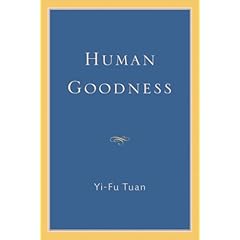
book review of a book i hope to return to often: Human Goodness, by Yi-Fu Tuan

I already posted at least one great vignette from this book.  Recommended.

a profound meditation on the meaning and experience of human goodness; it may even have left me with a bit more of that quality

I found this book thought provoking, inspiring, and behavior changing. I hope to return to it repeatedly.

Yi-Fu Tuan’s 200-page reflection has four parts:
(1) Vignettes from daily life illustrating the variety in manifestations of human goodness, demonstrating a range of what goodness might mean. For example, goodness may refer to producing “good” aesthetic (as in Mozart’s valuable service to the world), wholesomeness, good manners, indifference to self-image, etc.

(2) Vignettes illustrating the performance of good in the midst of great evil: Many of these stories are drawn from the Holocaust.

(3) Life stories from several people Tuan views as potentially “good”: the composer Mozart, the doctor Albert Schweitzer (who won the Nobel Peace Prize in the 1950s), the philosopher and social activist Simone Weil, and the poet John Keats.

(4) Tuan’s own reflections on goodness

Although I don’t know that the book holds together perfectly – several times I thought, This is a book one can publish at the END of one’s career – and although not all of Tuan’s observations are equally insightful, there is so much valuable content that these weaknesses are worth overlooking.

I found the profile of Albert Schweitzer particularly thought provoking, with his profound respect for all life – including animal and even plant life – and how he implemented that respect in life. In the admittedly short time since I finished the book, I have shifted how I think about animals and what our treatment of them implies not only for them but for our own spirituality.

Beyond that, the book is peppered with valuable insights. In the last section, Tuan explores the degree of violence we see in our lives, much of which is overlooked for its commonness. In the profile of Simone Weil, Tuan observes, “A test of sainthood is whether the person was widely and deeply loved. That seems to me even more convincing than an enumeration of good deeds, which can all be performed for mixed motives. … But perhaps the most convincing test of whether a person is truly good – a saint – is this. In his or her presence, does one feel oneself a better and more intelligent human being?” (180-1). And something from the vignettes: “By encouraging people to play at being good, manners may make people actually good; at least, such play, sincere or not, will make society itself more genial, more civilized” (18). From the preface: “Just think how the quality of our life will improve if we gossip, but gossip in the root meaning of that word, which is to relate `good tidings’ or `tidings close to God'” (xii).

I highly recommend the book. I will read more of Tuan (Escapism first), and I will likely pass copies of this book on to others.

book review: Poirot Investigates, by Agatha Christie

delightful travel reading, and the short story format makes it easier to take breaks along the way

I have been seeking to read Agatha Christie’s Hercule Poirot mysteries in publication order, and this is the third.* A collection of 14 short stories, this book obviously flows differently than the previous novels, but it was lovely travel reading. With short stories, I often enjoy a story but feel no particular compulsion to move on to the next. Not so here! I read the whole book in the course of a weeklong business trip to Brazil, winding down my evenings with the delightful company of Hercule Poirot and his partner, Captain Hastings.

Christie varies the nature of the crimes, including murders, robberies, kidnappings, and blackmail. She also experiments with the voice: Some have Hastings describing the events; others are narratives of past cases narrated to Hastings at the fireside; Poirot solves one mystery without ever leaving his apartment (on a bet with his friend Inspector Japp of Scotland Yard).

The final story (The Chocolate Box) is a special treat: the one time where Poirot actually got the answer wrong!**

For a work trip, in some ways this beats a novel since stopping between stories is a little bit easier. While the stories are not all equal, the book as a whole was a great ride.

Note on content: As usual, the characters are sexist (Hastings: “I am not a great admirer of the so-called New Woman myself, and, in spite of her good looks, I was not particularly prepossessed in her favor”) and racist (Poirot: “To the Oriental mind, it was infinitely simpler to kill [the victim]”), although the latter doesn’t come up much. And Poirot is arrogant, but charmingly so: “I, who have undoubtedly the finest brain in Europe at present, can afford to be magnanimous.”

* After Mysterious Affair at Styles and Murder on the Links.
** Although the critic Pierre Bayard argues Poirot got it wrong in the The Murder of Roger Ackroyd, as described in his book Who Killed Roger Ackroyd?: The Mystery Behind the Agatha Christie Mystery. (I haven’t read the book, I just saw the reference on Wikipedia under “The Murder of Roger Ackroyd.”)

if you loved The Shadow of the Wind…

…the English translation of the sequel, The Angel’s Game, comes out in June and is available for pre-order.  I read it in Spanish some months back (the review here) and enjoyed it quite a bit (despite a precipitated ending). 

It’s nowhere as good as Shadow of the Wind, but it’s fun and I will definitely read Zafón’s next book in the series.  (This book isn’t a sequel to Shadow, but it has some overlapping characters.)

children’s books in Spanish – libros en español para niños

Most days I read stories to my boys in Spanish.  Some are translations of English storybooks, others are originally in Spanish.  I’ve started keeping a record, ordered both by quality and by how recently I read them.  Updated on this page.

La mayoría de los días leo uno o más libros en español a mis hijos (de dos y cuatro años).  (El español no es nuestra lengua materna pero intentamos de todos modos.  Aquí pongo la lista de algunos de los libros, cómo me gustaron a mí, y cómo me gustaron a mis hijos.  Avísame si hay alguna manera en que puedo hacer que esto sea más útil o si tienes recomendaciones que te gustaría compartir.

Libros para niños, ordenados de mejor a peor

Libros para niños, ordenados de leído más reciente y más antes

reseña de (audio) libro: Sopita de Fideo, por Cristina Pacheco

This is the third book I’ve listened to by Mexican writer Cristina Pacheco recently (the first, the second).  Here is a more sophisticated characterization of her writing (compliments of Google Books): “Her short stories concentrate on the social, economic, and spiritual status of contemporary Mexico and especially, but not exclusively, on the poor in contemporary Mexico, the people ignored by the Mexican government and the advertising media.  Constructing a fictionalized social document, Pacheco depicts the daily life of millions in the Mexican metropolis” (María Elena de Valdés, The Shattered Mirror: Representations of Women in Mexican Literature, U of Texas Press, 1998, p144).


otra colección iluminante sobre el estrés continuo en la vida diaria de los pobres mexicanos


En este conjunto de cuentos (todos re-cortos), Pacheco ilumina la vida cotidiana y los desafíos de los pobres mexicanos, especialmente los que viven en la capital.  Escuchamos de mujeres abandonadas (con sus hijos), después tentadas a recibir sus esposos penitentes, de familias pasando hambre, de niños intentando gozar de la vida (como niños) pero obligados a llevar los cargos de adultos.  Aunque la mayoría de los cuentos no demuestran desastres ni tragedias, Pacheco eficazmente muestra el estrés diario de la vida de los pobres.


Este libro es parecido a los otros dos libros que he leído de recién (escritos más tardes): El corazón de la nocheEl oro del desierto.  Recomiendo los tres, pero mi preferido era El oro del desierto a causa del prólogo autobiográfico.

Escuché el audiolibro narrado por Mariana Carreño King, publicado por Recorded Books Audiolibros [3 discos].

reject luxury early? (and love math)

When she [Simone Weil], barely three years old, was given a large sparkling ring, she declared, “I do not like luxury!” (p159)

If that weren’t enough to make me think her awesome…

Both children [Simone and her brother] loved mathematics, at first no doubt as a mind-teasing game, then for its beauty, and finally, for Simone, as the language of truth, a hint of the divine. (p160)

from Yi-Fu Tuan’s ever thought-provoking Human Goodness

what i’m reading

  • Sopita de Fideo, by Cristina Pacheco – short stories about life for the poor in Mexico [audiobook]
  • Human Goodness, by Yi-Fu Tuan – meditations on what goodness really means; very insightful
  • Roads to Quoz: An American Mosey, by William Least Half-Moon – i’m not sure exactly what this is, but it has lots of Q words and is awesome [reading aloud with my lady]
  • History of the Church, by Joseph Smith (volume 1) – marvelous stories about a marvelous, difficult time
  • Conditional Cash Transfers: Reducing Present and Future Poverty, by Fiszbein et al – anti-poverty programs, and it’s actually readable
  • A more e a morte de Quincas Berro D’Agua, por Jorge Amado, a comic novel by the fabulous Brazilian writer [in my Portuguese class]

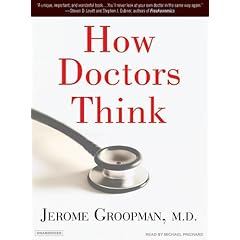
a book people who go to the doctor should read: How Doctors Think, by Jerome Groopman

My thoughts on Jerome Groopman’s How Doctors Think:

people who go to the doctor should read this book

Four years ago I went to my doctor in Massachusetts with a high fever and an earache. She diagnosed an ear infection and gave me antibiotics. Ten days later, I was in the hospital – in a room where they could turn on the negative air pressure at a moment’s notice – with malaria. If I read Groopman’s book before having that experience, I might have gotten the treatment I needed at a much earlier, safer stage.

Groopman’s book is all about why doctors get it wrong sometimes and what we can do – as patients and their loved ones – to help them get it right. Ultimately, doctors – like everyone else – are subject to a number of cognitive biases, such as availability (where they think you have whatever they’ve seen a lot of recently) or search success (where, as soon as they find a problem, they stop looking even though it could be something else). Groopman outlines these biases and illustrates each with multiple actual cases.* He then gives the reader practical advice about how to help doctors avoid these biases. For example

Patients can help the doctor think by asking questions. If he mentions a possible complication from surgery, they can ask how often it happens. If he talks about pain and lingering discomfort from a procedure, they can ask how the pain compares with having a tooth pulled under Novocain, or some other unpleasant event. If he recommends a procedure, patients can ask why, what might be found, with what probability, and, importantly, how much difference it will make to find it. (p175)

Here are a few of the other questions he recommends in the course of the book:

* What is the worst diagnosis that could explain these symptoms?
* What organs are near where I’m feeling discomfort?
* Is it possible that I have more than one problem?
* What else could it be?
* Is there anything that doesn’t fit?
* Is this treatment standard or do different specialists recommend different approaches? Why?
* How time tested is this treatment?

The book describes a litany of medical cases, each interestingly (like a good tv show – see below). Groopman also describes lots of research on medical decision making. I found it 96% interesting. But if you don’t find those elements interesting, the book may feel a little bit long.** In that case, I highly recommend reading at least the epilogue, which concentrates some – but not all – of what patients and families can ask to help doctors do a good job. I don’t agree with Groopman on everything; I have a little less faith than he does in doctors’ judgment and a little more in evidence-based medicine,*** where it can be appropriately applied. But those aren’t the things that matter in this book.

Take-away: Give the book a try; if it starts feeling long to you, at least carefully read the epilogue.

I listened to the unabridged audiobook read by Michael Prichard (9 CDs).  It was a solid reading.

* The first third of the book basically felt like watching a season of House M.D., a show in which a brilliant doctor is surrounded by a smart team, each member of which brings her or his biases to the case of the episode, leading to incorrect diagnoses, until the brilliant Dr House saves the day. Each of the biases and many of the diseases have come up on the show.

** If you do find reading this stuff interesting, one of my favorite books by a doctor is Arun Gawande’s recent Better: A Surgeon’s Notes on Performance.

*** Super Crunchers makes a strong case for evidence based medicine, written for the layperson.