even abject poverty is really relative (and contextual)

Students I took on a study abroad seminar spent several days with pavement dwellers in Bombay before coming to Soweto Township in Johannesburg. They were amazed at the good conditions of the apartheid-period workers’ housing – disappointing our hosts, who expected they would be appalled. Several men shared a room, and there was only one bathroom and one kitchen per floor, as compared to living on a sidewalk against a stone wall. In a parallel situation, when Brazilian youth from the favela were invited to stay in the South Bronx with the Ghetto Film School students, they thought they were living in luxury – until they were told they were in one of the worst "slums" in New York. (from Janice Perlman, Favela, p398)

plea to biographers: don’t put the chapter on ancestry at the beginning!

I read biographies on occasion, and often there is a chapter at the very beginning discussing how the individual’s ancestors came from who-knows-where and bought land in who-knows-where and then – in the next generation – they moved over to Here and bought a parcel at There, et cetera, et cetera. Unfortunately, this serves as little more than a right-of-passage to get into the actual biography, as it bears little apparent relation to the life story that follows.

I’m currently reading (er, listening to) The Immortal Life of Henrietta Lacks, by Rebecca Skloot, and in the course of the book, she gives just some of that family history. But here’s the key: she gives it about 40% into the book, now that I’m already invested in the characters and can think about how their ancestry might be relevant.

It’s parallel to advice I received from a graduate school advisor (in economics): Don’t write a stand-alone literature review; instead, write about the literature in the course of the paper, wherever it is most relevant.

impressive respondent tracking methods (or, why not to wait 30 years to try and find your people)

In the late 1960s, Janice Perlman interviewed 750 people in three favelas of Rio de Janeiro. Thirty years later, she decided to revisit the same people

"We used many approaches and kept following up on leads for the next two years. After securing permission to enter the communities, we began by putting up large colorful posters saying that we were eager to meet people who had participated in the 1968 study. The poster featured a photo of me … from that time and the cover of the Brazilian paperback edition of my book, which I had given to the study participants. Fortunately, due to a newspaper story about my return to Rio to follow up on my favela study, I was invited to be interviewed on the popular Brazilian television show Fantástico. That gave me the opportunity to reach a huge audience and appear to viewers to call in if they or someone they knew had been part of the original study. Likewise, I spoke on popular radio stations and community radio, and we posted ads in the most widely read newspapers in the communities. Then, for one Sunday afternoon in each place our team rented a van with a loudspeaker…and drove around each of the communities announcing a barbecue that afternoon and asking for help in our search for original study participants." (Favela, p49)

She also used more standard methods, using the old contact info, visiting the old neighborhoods: "This was complicated by the fact that many of the dwellings had no numbers or street name at all, and even when we had a partial address, the streets and numbering had long ago changed or been reconfigured, often several times over".

After all that and much more (for example, finding people with the right first name but who didn’t remember if they had participated), they found just 41% of the 750 study participants. This is extraordinary, and yet it seriously compromises the ability to draw inferences from the outcomes of these folks: Are these just the most successful (i.e., not homeless)? or the least successful (i.e., not moved on)?. Perlman recognizes this and tries to deal with it by tracing the overall composition of the favelas over time in addition to just the welfare of her found participants. I applaud Perlman and her efforts.

BUT, having worked with tracking surveys in a Kenya and Brazil and now starting some work in Mexico, the lesson is clear: Don’t wait 30 years to follow up on your people.

best movies & books of the year

My favorite non-scripture books (of the 43 read or listened to) of the year were Jonathan Lethem’s Motherless Brooklyn (loved it), Ian McEwan’s Atonement, and Willa Cather’s My Antonia.

I enjoyed lots of movies this year.  I really recommend – of the 91 watched – two Brazilian movies, one called Behind the Sun (available on Netflix) and another called A Dog’s Will (O Auto da Compadecida).  The latter is not available on Netflix but is watch-able on Youtube with English subtitles (see here).  I loved two children’s movies, How to train your dragon and Toy Story 3 (cried!).  I loved two classic comedies, Tootsie and Groundhog Day.  And I really, really enjoyed Crazy Heart.

what i’ve been reading and watching – July through December

Books for December
43. Mockingjay, by Suzanne Collins – Great conclusion to the Hunger Games trilogy. Good thoughts on government and what it really means to be good/bad.  8/10
42. The Good Doctor, by Damon Galgut – Two doctors, one idealistic, one cynical, clash in rural South Africa in the modern day.  Very good.  Insightful interview with the author is available at http://www.bbc.co.uk/programmes/p00c50nk .
41. Catching Fire, by Suzanne Collins – weakest of the three hunger games books, but I really liked the second half. 6/10

Movies for December
91. Scott Pilgrim vs the World (DVD) – Very creative, mash-up of video games and film.  Some dull moments but points for creativity. 8/10
90. Megamind (theater) – Will Ferrell is a super villain who learns to love.  I laughed a lot. 7/10
89. True Grit (theater) – Girl seeks justice for her father’s murder in the Old West.  Three leads all shine (Jeff Bridges, Matt Damon, and Hailee Steinfeld).  Very exciting.  7/10
88. Going the Distance (airplane version) – Romantic comedy with Drew Barrymore and Justin Long.  Fine.  6/10
Continue reading “what i’ve been reading and watching – July through December”

my favorite comedy of the year: A Dog’s Will (O Auto da Compadecida)

One of my favorite movies this year is the Brazilian comedy (family appropriate, although not a kid’s movie) A Dog’s Will, or O Auto da Compadecida.  It has my favorite comedy character of all time, João Grilo, or Jack the Cricket!

Unfortunately, this is not available via Netflix or Blockbuster.  I can’t even buy it with subtitles.

It is available via youtube with subtitles.  Here are the links:

Part 1
Part 2
Part 3
Part 4
Part 5
Part 6
Part 7
Part 8
Part 9
Part 10
Part 11

the case AGAINST investing in young children

I read a lot of evidence in favor of investing in young children.  For example, the following from Nobel laureate James Heckman and co-author Masterov:

We argue that, on productivity grounds, it makes sense to invest in young children from disadvantaged environments. Substantial evidence shows that these children are more likely to commit crime, have out-of-wedlock births and drop out of school. Early interventions that partially remediate the effects of adverse environments can reverse some of the harm of disadvantage and have a high economic return. They benefit not only the children themselves, but also their children, as well as society at large.

So I was refreshed today to finally see the other side of the coin.  I’d say, both by the gravitas of the author and the power of the argument, it pretty much balances out the argument:

My problem is the children themselves. They may be cute, but they are here to replace us. Need proof? Ever catch one walking around in your shoes? That’s a chilling moment, like finding an empty body snatcher pod in the basement.

“But children are our future!” Yes, but does that not also mean that we are their past? I don’t understand why we’re helping them. You don’t see union factory workers throwing a benefit for robots. (from I Am America, by Stephon Colbert, p10)

Quod Erat Demonstrandum

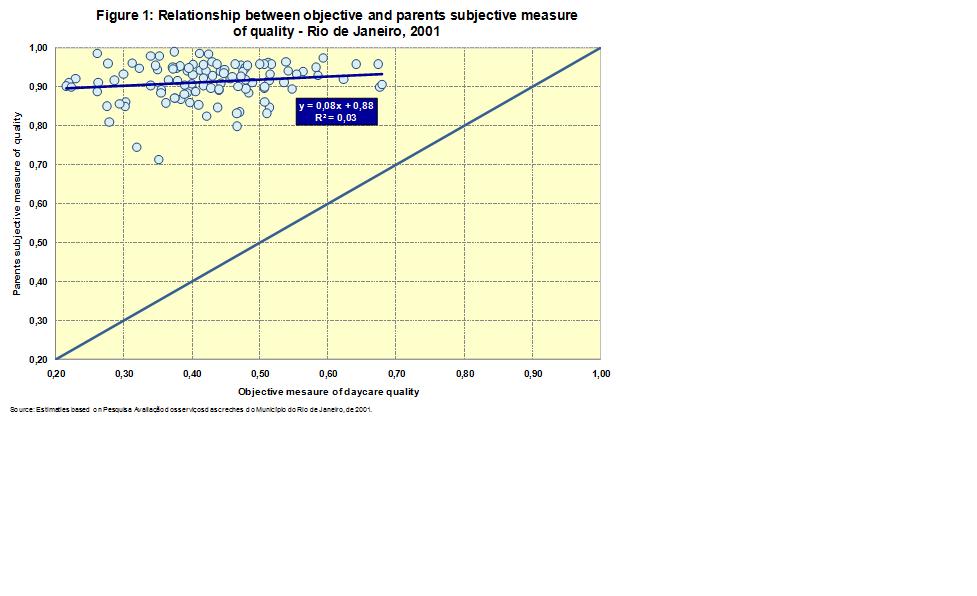
more evidence that parents have limited skill at judging quality of early child education centers

Earlier I highlighted a study that shows parents in Germany and the USA aren’t great at judging the quality of their early child education centers. 

Here is evidence showing the same for Rio de Janeiro.  The vertical axis shows parent evaluation, and the horizontal axis shows an objective measure.  As you can see, parents think all the daycare centers are about the same.

from Barros R, Carvalho M, Franco S, Mendonça R, Rosalém A. 2010. “A short-term cost-effectiveness evaluation of better quality daycare centers.” Working Paper.