junks make the man

The vast majority of people I’ve seen in Africa (in every country I’ve been to except perhaps South Africa) wear either African traditional dress or – less expensive – used American clothes.

I just listened to an interesting description of the process by which the clothes make it to Africa in Rivoli’s The Travels of a T-shirt in the Global Economy: people donate to the Salvation Army, they pick out what they can sell in their shops and sell the rest to US merchant, who sorts some to send abroad (the best) and the rest to go into mattress stuffing (and like products). A big African merchant buys a gigantic bundle of clothes, which he sells to the vendors I see in the African markets. (Rivoli argues convincingly that this is the only point at which textiles face a genuinely free market.)

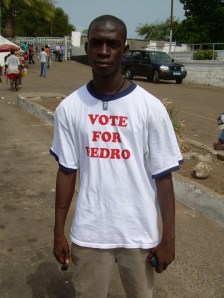
Different countries have different words for it: in Tanzania the used clothes are called mitumba (in Swahili), in Sierra Leone they are called junks (in Krio).

Below is a photo of one of my favorites, from the ferry stand in Freetown.  [I spoke with the gentleman: he’s never seen Napolean Dynamite, and I doubt he’s ever voted for Pedro.]

riding a wave of nostalgia to freetown and back

Sierra Leone’s international airport is not in Freetown. By land, it would take many hours to make the trip. Some months ago, there were four options for travel from the airport to Freetown:

1. UN Helicopter (for people with UN passports)
2. Commercial helicopter
3. Hovercraft
4. Ferry

However, in recent months the hovercraft caught fire and has been grounded since (no one was hurt, but luggage was lost). The commercial helicopter has been grounded (I’m not sure why, but I can guess). I don’t have a UN passport, so I take the ferry. (One can also take a tiny speedboat, but I haven’t figured out the logistics yet.)

The last couple of ferry rides, the first-class cabin (costs US$1.50) has been playing a slew of awesome 80s music videos, so awesome that I couldn’t help but sit and watch (rather than wander the deck):
• La Isla Bonita, by Madonna
• Sexual Healing, by Marvin Gaye (they just played the beginning of this non-sensual video – despite the title – and then skipped ahead)
• We Are the World, by everyone in American pop music in the 80s. A bunch of other people in the cabin – all Sierra Leoneans – knew the lyrics to this one and were mildly swaying and mouthing the words.  (You know I was, and people were loving the fact that I was loving We Are the World.)
• The Greatest Love of All, by Whitney Houston
• Sacrifice, by Elton John
• Everything (I Do), by Bryan Adams
• and then nothing less than a UB40 concert video

My 80s craving has been satisfied for at least two hours.

i’m sorry, there’s a problem with your visa…

…I don’t have a pen.  A week ago, I arrived at the Freetown airport in Sierra Leone and waited for the man at the desk to stamp and sign my visa, but he didn’t have a pen.  So I gave him my pen, which he held onto.

This afternoon, I arrived at the Gambia International Airport and waited while the woman at the desk looked, and looked, and then started waving my passport at a colleague in a nearby booth.  Oh, you need a pen?  Use mine, please.  I took it back afterward, but I wonder if perhaps we need a new NGO, making sure passport control agencies are fully stocked in pens.  Anyone looking for a niche?

book review: The Travels of a T-Shirt in the Global Economy: An Economist Examines the Markets, Power, and Politics of World Trade, by Pietra Rivoli

I took a few minutes this afternoon in the Freetown airport to pen some thoughts on this audiobook that I recently listened to.  (Note: you need either a short title or a short sub-title; you can’t have a long title AND a long sub-title.  No good.)  My thoughts:

a brief history of EVERYTHING about your t-shirt, from birth in a Texan cotton field to re-birth in a Tanzanian second-hand clothing market

Allow me to provide a more descriptive title for this volume: What I did last summer + a history of cotton growing in America + a history of cotton mills around the world + a brief history of Shanghai + a brief history of child labor + a brief history of labor activism + a brief history of workplace safety regulations + a not-at-all-brief history of US textile protectionism + a characterization of the international market for used clothes. Interesting? Often.

In the course of all these histories – occasionally interspersed with a reminder that we are following Rivoli’s t-shirt around the world – we jump from England to Japan to Texas to West Africa; we leap back and forth (and back and forth) from century to century. By the middle of the book, I had gotten dizzy and wished it had been a long magazine article.

But in fact, the second half is the most interesting. Rivoli gives a detailed history of textile protectionism in the United States, giving a peek into the dizzying, constantly morphing tariff and quota systems as well as the huge bureaucracy the system supports. And finally, she gives an illuminating description of what happens to the t-shirts after they get donated to the Salvation Army and how they make it to market stalls in East Africa.

Rivoli is an economist and so recognizes that her inherent leaning is toward free trade, but she argues for the value of both sides of the textile battle, both the free traders and the student demonstrators.

The first half of the book feels too long (even though it isn’t that long), and Rivoli’s strength is in illuminating description rather than careful analysis. But if you get bored, just skip ahead to the next chapter: There’s plenty to choose from!

[I listened to the unabridged audiobook narrated by Eliza Foss, published by Recorded Books. The reading is fine, but Foss’s voice is too syrupy sweet and storybookish for 8 CDs (think the voice-over narration from Desperate Housewives).]
sierra leonean roads: the people’s amusement park

This afternoon we were driving back from a rural school in Moyamba (Sierra Leone), and the road was so bad that at one point I said “Whoah!” as if riding a roller coaster.  I then explained to my colleagues what a roller coaster and an amusement park were, to which the driver commented, “In Sierra Leone it’s free!” and another colleague responded, “But for us it’s not an amusement.”  So true.

[In the course of the same ride, I saw 8 little piglets running off the road.  8 little piglets!]

the real racism test

Today I went to a neighborhood rated (apparently) as one of the worst in the entire world.  I believe it; even I found it kind of depressing, with heaps of trash and no sanitation plan (I saw all kinds of sanitation being emptied into the central canal…all kinds, real time).

So instead of dwelling on that, I’ll share a video clip from Extras which I find wildly funny.  People sometimes say we have subtle racism hidden in our subconscious: Ricky Gervais gives us the true test.

police corruption!

Greetings from Freetown, Sierra Leone.  Tonight my taxi driver (Capri) picked me up at 8:30 from the office, and soon after we were stopped by a traffic cop for a “routine inspection.”  He checked Capri’s license, inspected the headlights, called Capri out, then told us to go down to the police station.  Capri asked me to step out and look at the headlights: one was slightly dimmer than the other, but both were amply bright and this never would have warranted a citation in the United States.  This cop was looking for just one thing from the taxi with two Americans.

A bystander, a restaurant owner named Daouda [a variation of my own name], intervened and entreated the police officer until he relented and let us go.  Daouda then invited me to his restaurant, an invitation I will most definitely take him up on.

This wasn’t that unique; cops seek bribes all the time and in many countries, but tonight it struck me as particularly onerous, a stark sign of the subversion of the rule of law by money.  I can’t say I’ve never paid a bribe: Once I gave $20 to some Ugandan border guards after 45 minutes of interrogation and a threat of a jail.  But tonight I was prepared to go the mat.  [Of course, it’s easy to “be prepared” to go to the mat until one actually has to.  I had always imagined I’d be cool and collected if I were ever mugged, but the first time it happened – in Arusha, Tanzania, in 2000 – I was a disaster.]