the new Karate Kid movie

I am deeply attached to the old Karate Kid movie. I have watched it many times. I can recite non-pivotal scenes from memory. So that’s my starting point.

The new movie is … great! Better? I don’t know. The fighting at the tournament is MUCH better in the new movie. And the Mr Miyagi (old) / Mr Han (new) character is given a little more depth and flaws in this version, which makes him better. Jackie Chan also gets to show off his classic trick of fighting off baddies using unusual weapons (a windbreaker, in this case). Jaden Smith is less annoying and cuter than Ralph M. And there’s even a visual allusion to Back to the Future (tell me if you catch it).

I watched the old movie a few months ago, and I’m glad I did. There are subtle homages to it all through the new movie: a line here and there, either exactly the same or just tweaked a bit. And an occasional exact frame replica.

All in all, I had a great time.

books we haven’t read

Between a book we’ve read closely and a book we’ve never even heard of, there is a whole range of gradations that deserve our attention. In the case of books we have supposedly read, we must consider just what is meant by reading, a term that can refer to a variety of practices. Conversly, many books that by all appearances we haven’t read exert an influence on us nevertheless, as their reputations spread throughout society. … Non-reading…goes far beyond the act of leaving a book unopened. To varying degrees, books we’ve skimmed, books we’ve heard about, and books we have forgotten also fall into the rich category that is non-reading. -How to talk about books you haven’t read, by Pierre Bayard, p xviii-xix

As I read this, I thought about movies: I talk about a lot of movies that I haven’t seen, including those with the following characteristics

  1. Phrases which have become vernacular
  2. Trailers I have seen
  3. Reviews I have read
  4. Hype I’ve read in Entertainment Weekly
  5. Rotten Tomatoes summaries I have looked at
  6. Content summaries I have looked at (you know, these parental guides, like kids-in-mind.com or screenit.com)

And on and on. I appreciate Bayard’s distinguishing that that are a variety of ways to experience these media (books, movies, etc.), and that each may bring its own influence (and pleasure).

Finally, I can stop reading all those books…

better answers

Last week I was walking through Washington DC, and I noticed a shabbily dressed man as I walked down the street. A moment or two later, the man was walking next to me, saying, "I couldn’t help but notice you staring at me. Do you have a problem with the way I look?" I’m pretty sure I never stared at this guy, so I wittily retorted, "Excuse me?" He repeated, "I couldn’t help but notice you staring at me. Do you have a problem with the way I look?"

I answered, "I must have been thinking about something else. I don’t think I was staring at you." Which was true. But afterwards, I thought of several better answers:

1. Start singing Billy Joel’s "I love you just the way you are" and dancing around the guy
2. Say, "Why do you think I’m staring at you?! I want the $50,000 you owe me. I’ve been looking for you for months. Are you going to pay up or do I need to call the cops?"
3. Give the guy a big hug, saying, "I just need somebody to love" (a la Bill Murray with the insurance salesman in Groundhog Day)

Others?

reseña de La Traducción, por Pablo de Santis (narrado por Fernando Flores)

suspenso, fieldades inconsistentes, y muertes misteriosas en el mundo emocionante (en serio) de traductores profesionales

Miguel de Blast, traductor profesional, es uno de los invitados a un congreso sobre la traducción en un pueblo pequeño en la costa de la Argentina. Algunos de los invitados están muy interesados en la traducción de los idiomas perdidos, como el idioma del mundo antes de la torre de Babel. Una serie de muertes sigue. ¿Quién es responsable?

La novela es muy divertida. Logra mantener un sentimiento de suspenso a lo largo del libro y crea una serie de pedazos de un rompecabezas sin el lector saber cuáles son los pedazos, y mucho menos cómo se juntan. Vale la pena leer. El libro era finalista del Premio Planeta en 1997.

Escuché el audiolibro íntegro narrado por Fernando Flores, de cuatro discos. La narración fue buena.

Nota sobre el contenido: Ocurren algunas muertes, y se alude al sexo sin que el lector lo experimente de primera (o de segunda) mano.

Si quieres un resumen más detallado y más análisis, Diego Bagnera escribió una reseña interesante, que se puede encontrar con una búsqueda sencilla: Diego Bagnera, “Extrañas Muertes”, Clarin, 20 de setiembre de 1998.

massive expansion with minimal evidence: nutrition in India

“The Tamil Nadu Integrated Nutrition Project…is a growth monitoring, food supplementation, and intensive nutrition counseling programme. … In terms of the project’s impact, TINP was labeled a success by the World Bank. This followed the 1986 midterm evaluation, which found a reduction in rates of severe undernutrition. … The success of TINP was used as proof that a ‘silver bullet’ to address undernutrition existed. … The assessment at the end of [the second] phase was less glowing. The official TINP-I terminal evaluation showed a decline in the prevalence of severe undernutrition but an increase in mild and moderate undernutrition. … Interview with key Bank official revealed that there were major shortcomings with the baseline and midterm evaluations. … Other observers raised wider concerns…. The claims of successful growth monitoring…have been based on anecdotal and impressionistic evidence. … By 1999, the Bank had loaned over US$750 million to India despite the lack of substantive evidence that the design and implementation of TINP were effective. …

“Why does all this matter? … First, it matters for the potential beneficiaries of the nutrition program in question. Second… despite the lack of rigorous evaluation, TINP has come to represent the ultimate success story of the World Bank’s lending for stand-alone nutrition projects.” [Sridhar, The Battle Against Hunger, p2-5, 2008]

This isn’t a problem unique to the World Bank (but obviously the WB isn’t exempt). Billions go into programs about which all we know is “anecdotal and impressionistic.” Good evaluation is on the rise, though…

cheating on a social welfare program: it’s all in the histogram

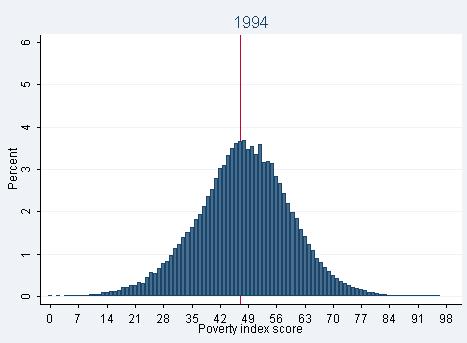
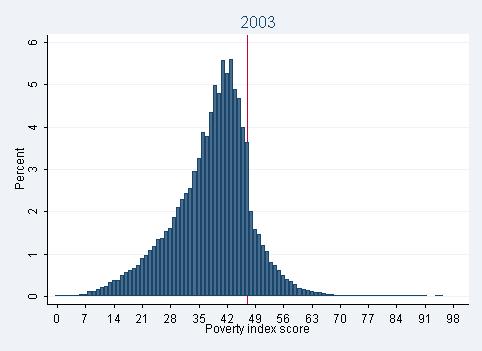
A Colombian welfare program made the formula used to assign benefits public to local officials in 1997.  Compare the distribution of households just below (left) and above (right) of the eligibility threshhold in 1994 and in 2003.  Seems an awful lot of households just barely qualify in 2003…

Kudos to Adriana Camacho and Emily Conover for the nice detective work in this paper: Manipulation of Social Program Eligibility: Detection, Explanations and Consequences for Empirical Research.

what makes a great teacher

The current issue of Atlantic Monthly has a great article on what makes a great teacher, which both gives results of quantitative analysis and impressive case studies. Highly recommended.

An excerpt:
"For years, the secrets to great teaching have seemed more like alchemy than science, a mix of motivational mumbo jumbo and misty-eyed tales of inspiration and dedication. But for more than a decade, one organization has been tracking hundreds of thousands of kids, and looking at why some teachers can move them three grade levels ahead in a year and others can’t. Now, as the Obama administration offers states more than $4 billion to identify and cultivate effective teachers, Teach for America is ready to release its data. …

Right away, certain patterns emerged. First, great teachers tended to set big goals for their students. They were also perpetually looking for ways to improve their effectiveness. For example, when Farr called up teachers who were making remarkable gains and asked to visit their classrooms, he noticed he’d get a similar response from all of them: “They’d say, ‘You’re welcome to come, but I have to warn you—I am in the middle of just blowing up my classroom structure and changing my reading workshop because I think it’s not working as well as it could.’ When you hear that over and over, and you don’t hear that from other teachers, you start to form a hypothesis.” Great teachers, he concluded, constantly reevaluate what they are doing.

Superstar teachers had four other tendencies in common: they avidly recruited students and their families into the process; they maintained focus, ensuring that everything they did contributed to student learning; they planned exhaustively and purposefully—for the next day or the year ahead—by working backward from the desired outcome; and they worked relentlessly, refusing to surrender to the combined menaces of poverty, bureaucracy, and budgetary shortfalls.

But when Farr took his findings to teachers, they wanted more. “They’d say, ‘Yeah, yeah. Give me the concrete actions. What does this mean for a lesson plan?’” [End of excerpt]

Amanda Ripley tells us. The full results of the Teach for America analysis are in Steven Farr’s book Teaching As Leadership: The Highly Effective Teacher’s Guide to Closing the Achievement Gap. Here is a partly worthy and partly less worthy critique of the article (her good point is that having uber-motivated teachers won’t fix structural problems in the system: true!).
book review: The Mystery of the Blue Train, by Agatha Christie

I just finished Agatha Christie’s sixth published Hercule Poirot book.  My thoughts:

not the best, certainly not the worst, but duly entertaining

I’ve been working my way through the Hercule Poirot books (in publication order), and one element that I appreciate is that Christie avoids a formulaic set-up. Sometimes Poirot is accompanied by his friend Hastings (Mysterious Affair at Styles), sometimes by a local person (The Murder of Roger Ackroyd), sometimes he solves the case from his armchair (one of the stories in Poirot Investigates), and sometimes he acts like 007 (the not-very-good The Big Four).

In this novel, Poirot doesn’t appear until the second third of the book. The first third lays out a variety of distinctive storylines that only come together on the titular Blue Train. Something bad happens. Poirot brings his A game. Red herrings abound. A great travel read. (I read it on a trip to Brazil: it got me through five days.)

Note on potentially offensive content: Murder as entertainment and vanity.