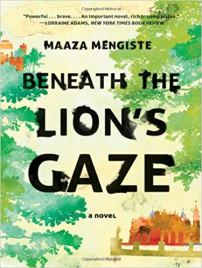
 Ethiopian-born writer Maaza Mengiste fled her country as a young girl around a period called the Ethiopian Red Terror, when between tens and hundreds of thousands of Ethiopians were killed by a communist military government called the Derg. In her first novel, Beneath the Lion’s Gaze, Mengiste uses one family to recount the end of Emperor Haile Selassie’s rule and the intimate horror of the Derg. The family’s patriarch, a surgeon, faces a terrible choice when the military brings him a victim of torture — at the brink of death — to revive, presumably for further interrogation. The surgeon’s two sons, his daughter-in-law, and their friends each confront the terror in their own way. Mengiste’s novel isn’t for the faint of heart: There is one scene of child torture and many other difficult images. But as Mengiste told NPR, “I am hoping that if we can understand the humanity of those who suffered through this, that we start to investigate beyond the pages of this book.”
I listened to the audiobook, well narrated by Steven Crossley. I had to jot down a few character names to keep track of everyone at the beginning, but it was well worth it.
Here are a few other reviews:
- Lorraine Adams, the New York Times: “For all its beginner’s flaws, ‘Beneath the Lion’s Gaze’ is an important novel, rich in compassion for its anguished characters.”
- Aida Edemariam, The Guardian: “Mengiste has clear metaphorical points to make: that this revolution was a family affair, turning children against parents, and against each other; that a country steeped in authoritarianism and religious fatalism … can suffer a terrible moral passivity at times of crisis… She is good on the resulting lostness, and on how everyone is compromised… Mengiste is good, too, on the pervading fear that anyone who lived there then remembers.”
- Kirkus Reviews: “An arresting, powerful novel that works on both personal and political levels.”
- The New Yorker: “The real marvel of this tender novel is its coiled plotting, in which coincidence manages to evoke the colossal emotional toll of the revolution: on a crowded street, soldiers force the doctor’s elder son to drag away a prisoner whom they shot, and who turns out to be a family servant’s long-lost child; the younger son becomes a legendary resistance fighter, killing soldiers and collecting civilian bodies for burial, while his fumbling childhood best friend thrives under a senior officer of the junta.”
This is book #27 in my effort to read a book by an author from every African country in 2019. I’m halfway there!

 Léopold Sédar Senghor
 The Old Drift
 “The reading of the last will and testament of Sr. Napumoceno da Silva Araújo ate up a whole afternoon. When he reached the one-hundred-and-fiftieth page, the notary admitted he was already tired and actually broke off to ask that someone bring him a glass of water.” So begins
 Teacher salaries are a point of contention in many countries. But a particular problem in low-income countries is that salary payments will sometimes be delayed for lengthy periods. Ba’bila Mutia’s exciting novel
 Norbert Zongo, an investigative journalist from Burkina Faso, published his novel
 A young woman living in the U.K. receives a letter informing her that her grandfather’s coffee plantation now belongs to her. The letter has no return address. “Knowingly, he had denied me the opportunity to write back with ready excuses, to enclose a cheque bloated with guilty zeroes.” When she returns to her unnamed West African home country (
 The late, great Dr. Wangarĩ Maathai has no shortage of accomplishments. Hailing from Kenya, she was the first East African woman to receive a PhD and the first African woman to receive the Nobel Peace Prize. She was a professor, a politician, and an activist. In 2009, just two years before her death, she published
 If you think that sprawling, multi-generational family sagas where characters have multiple names is the exclusive realm of Russian novelists, think again.
  David Evans' personal blog