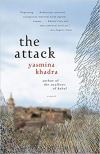

Dr. Amin Jaafari is a surgeon. He is an Arab and a naturalized Israeli citizen. He and his wife live a happy, secular life. One day, he finds out that his wife has blown herself and a fast food restaurant filled with schoolchildren up in a suicide bomb attack. In Yasmin Khadra’s The Attack, Dr. Jaafari seeks answers both within himself and from members of Arab community in Israel. In the process, Khadra — originally from Algeria — shines a light on the enduring Arab-Israeli conflict. I found this book illuminating and often engaging. The pacing slowed in the middle, and occasionally I wished for a little less thinking and a little more action. But ultimately, the insights and an occasionally lovely turn of phrase — I “stare unwaveringly at the opalescent streaks gently lifting the horizon’s coattails” at sunrise — won me over. I enjoyed John Cullen’s English translation and Stefan Rudnicki’s narration of the audiobook.
Here are some passages that stood out to me:
On violence: “The only battle I believe in is the battle the surgeon fights, which consists in recreating life in the place where death has chosen to conduct its manoeuvres.”
On the motivations of terrorists: “I think even the most seasoned terrorists really have no idea what has happened to them. And it can happen to anyone. Something clicks somewhere in their subconscious, and they’re off. Their motives aren’t all equally solid, but generally, whatever it is, it comes over them like that… Either it falls on your head like a roof tile or it attaches itself to your insides like a tapeworm. Afterward, you no longer see the world the same way. You’ve got only one thing on your mind: the thing that has taken you over, body and soul.”
On God: “I couldn’t bring myself to accept the notion that God could incite his subjects to take up arms against one another and reduce the exercise of faith to an absurd and frightening question of power relationships.”
On dreams: “He who dreams too much forgets to live.”
Here are some other reviews:
The Complete Review: “The final truth, and all the consequences are fairly well handled, and the novel packs a decent punch by the end.” (The Complete Review also excerpts a number of other reviews.)
James Buchan, The Guardian: “With the exception of Dr Yehuda, Moulessehoul’s Jews are louts. His Arabs strike heroic poses. There is none of that peculiarity of place, person and history that you find in an Israeli Arab writer such as the late Emile Habiby.”
Janet Maslin, New York Times: “painfully acute observations of Arab-Israeli strife… This book is also gripping and dynamic in ways that rivet the reader even when the thinking is didactic and the prose takes a purplish turn.”
Publishers Weekly: “Khadra…turns his attention to the Israeli-Palestinian conflict in this moving novel unlikely to satisfy partisans on either side of the issue.”
The New Yorker: “Khadra’s writing has a tendency toward cliché, but the book’s dark vision of the conflict is powerful.”
This is book #11 in my effort to read a book by an author from every African country in 2019.
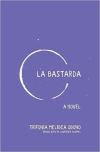
“Don’t forget that your mother is dead, your father is a scoundrel, and you’re a bastarda.” Trifonia Melibea Obono’s La Bastarda is the first novel by a woman from Equatorial Guinea to be translated into English. If that weren’t enough to get you to read it, how about knowing that it’s been banned in the author’s home country? And if you want more, how about that it’s good?! (And short, coming in at just over one hundred pages.)
Okomo’s mother died in childbirth, and she’s never met her father. This places her on the outskirts on her ethnic group, the Fang. Over the course of the book, she encounters other people at the margins, particularly the local, outcast gay community. When one character asks how she, as a lesbian, fits into Fang culture, an uncle tells her, “There isn’t a word for it. It’s like you don’t exist.” Okomo’s journey takes her far beyond the borders of her village and explores what it means to carve out a place for yourself as an orphan and as a gay person in one African society. The prose is simple, appropriate to the adolescent narrator, and Lawrence Schimel’s translation into English is clear. Historian Abosede George has a nice afterword, putting the book into context.
You can read more about the book here, and you can read about the author here. You can read an excerpt here, but come on, the book is just 100 pages: Go ahead and read it already.
This is book #10 in my effort to read a book by an author from every African country in 2019.
Here are some notable passages:
On early marriage: “Dina is on the brink of old age—she is eighteen years old and has no husband!”
On the universal truth of parties: “That’s when I discovered the worst part of parties: cleaning up.”
On non-sexual intimacy: “We spent some time in silence, letting our bodies talk.”
How not to open a letter asking your daughter for money: “Daughter, Your marriage is the biggest mistake you’ve made in your whole life.”
On a traditional healer: “After bankrupting her, the curandera sent her to the hospital.”
On youth: “Your opinion doesn’t count; your elders are always right.”
On the metal ceiling: In that makeshift town, I discovered that the better-paying jobs were all held by men. Women were limited to cleaning and cooking. And also: prostitution.”
Here is what other people thought of the book:
Publishers Weekly: “Slim yet undeniably potent… Obono’s voice is assured and vital, and her tale of queer rebellion in Fang society is an exceptional take on the coming-of-age novel.”
Karina Szczurek, Africa in Words: “Obono’s writing itself is an act of inspiration and should be celebrated as such. Her narrator tells the story in a fresh, mesmerising voice. Its haunting quality adds to the irresistibility of this slim book and its considerable impact.”
Silvia Cruz Lapeña, Altair: “Escuchar la voz de una ecuatoguineana lesbiana es el principal valor de La bastarda porque entre los suyos, los fang, entorno del que procede la autora, ni siquiera hay una palabra para referirse a ellas… Otra de las fuerzas de esta novela radica en que se carga en pocas páginas la imagen de mujer sumisa que se da de las africanas.”
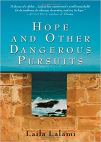
We open on an inflatable boat, making the dangerous crossing from Morocco to Spain. Dozens of migrants are aboard, but we are introduced to just four: Murad, a college graduate who majored in English, Faten, who flunked out of school; Aziz, a married man; and Halima, who has brought her two children. The boat capsizes and the passengers must swim to shore.
Laila Lalami’s collection — Hope and Other Dangerous Pursuits — then flashes back, with a chapter on what led each of these four to make the perilous journey; and then forward, with a chapter on what happened to each after the attempted migration. Some made it safely to Spain; some got sent back to Morocco. But in whichever locale, Lalami draws engaging, sympathetic characters and humanizes their motivations for migrating. Most central is the desire to work: “He knew, in his heart, that if only he could get a job, he would make it, he would be successful.” The fantasy isn’t just for money, but for purpose: “Aziz imagined that maybe one day he would be like them, have a car and a place to go to, instead of sitting idle at a coffee shop while his wife was at work.” I thoroughly enjoyed this collection. Highly recommended, particularly in this time when refugees and migrants are at the center of many nation’s policy debates.
Here are some lines that I enjoyed:
On patience: “Halima wondered whether all the Lord ever wanted from His people was patience. Hadn’t she suffered long enough? She was sure that the Lord also wanted His people to be happy, but she couldn’t come up with a stock expression as a retort, the way her mother always did.”
On having a child veer toward fundamentalism: “What if he lost her to this … this blindness that she thought was sight?”
On economics: “What happened to your plans to study economics? … Look, you’ll be of more help [to your country] as an economist than as a schoolteacher.”
On the uncertain returns to adult literacy classes: “So far, the only use she had gotten out of the classes was that she could now read the rolling credits at the end of the soap operas she watched every night.”
On loving Western culture: “We’re so blinded by our love for the West that we’re willing to give them our brightest instead of keeping them here where we need them.”
On money: “That was the thing with money. It gave you choices.”
Here are some other reviews:
Joey Rubin, Bookslut: “Hope is not a tale of desperate immigration, nor of destructive encroachment. It is a tale of human potential; a story about the desire for improvement, and the difficulties inherent in the pursuit of such a dream — whether that dream be American, Moroccan, or just plain human. However, we are lucky in this case it is Moroccan; it is a landscape Lalami knows quite well.”
Publishers Weekly: “Less a novel than a set of finely detailed portraits, this book gives outsiders a glimpse of some of Moroccan society’s strata and the desperation that underlies many ordinary lives.“
Kirkus Reviews: “As her characters debate hot-button issues—How much Western culture is too much? Should women wear headscarves?—their individual points of view are presented so evenhandedly that readers are left to wonder which of these opinions are actually held by the Moroccan-born writer, who now lives in Oregon.”
Alan Cheuse, NPR: “This all works because the force of the subject matter carries the day.”
This is book #9 in my effort to read a book by an author from every African country in 2019.
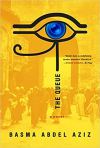
Welcome to a totalitarian regime with a byzantine bureaucracy that centers on one very long queue. Basma Abdel Aziz’s beautiful and maddening tale features Yehya, a man who was shot during a series of unnamed “disgraceful events.” In order to get surgery to remove the bullet — or to obtain any of a mass of services — he and thousands of others have to go and wait in line (the queue). People sleep in the queue. “Everyone expected the queue to move at any minute, and they wanted to be ready.” Yehya’s friends try to circumvent the bureaucracy, but the results are frustrating at best and violent at worst.
In the midst of all this, certain “riffraff” begin agitating for change, but most of those in the queue wish they would go away. “Life in the queue had been relatively orderly and stable before the Riffraff’s arrival; there were recognized rules and limits, which everyone accepted and everyone followed.” Better the gridlock you know than the upheaval you don’t?
Elisabeth Jaquette translated the book into English, and Mark Bramhall narrates the competent audiobook.
Highly recommended.
Here are a couple of other bits:
On official government statistics: “Those conducting the poll had therefore decided not to conduct one again. To simplify matters, they would announce the previous poll’s results on a set yearly date.”
On obtaining documents from the government: “Obtaining any document from that place was like plucking a piece of meat from the mouth of a hungry lion.”
On addressing symptoms rather than causes of problems: “Officials were investigating the possibility of placing parasols near places of heavy traffic, to calm citizens’ nerves and reduce their irritability.”
If I haven’t convinced you, check out what these other reviewers have to say:
Carmen Maria Machado, NPR: “The Queue is the newest in this genre of totalitarian absurdity: helpless citizens — some hopeful, some hopeless — struggling against an opaque, sinister government, whose decrees, laws, propaganda, and red tape would be comical if they weren’t so deadly serious.”
Pasha Malla, Globe and Mail: “Basma Abdel Aziz’s novel is not simply an exegesis on the state of her homeland, but a much more universal evocation of the relationships between hegemonic power and grassroots dissent. It feels both fitting and faintly tragic that she had to resort to the literature of dark fantasy to convey it.”
Publishers Weekly: “At its best, the novel captures a sense of futility and meaninglessness, but its impersonal tone and uneventful middle contribute, at times, to a lack of urgency.”
Time traveling serial killer! In South African writer Lauren Beukes’s thriller, a drifter from 1930s Chicago discovers a house with a murderous agenda. (That aspect reminded me of David Mitchell’s Slade House.) Beukes takes us back and forth in time, narrating from the perspective of Harper, the killer, and his various victims. Some of them don’t go quietly. The ending includes delightful ambiguity. Along the way, we can see ourselves in the characters’ exchanges.
“I’m scared, Mom.”
“We all are,” Rachel says. … “Shhh. It’s okay, honey. It’s all right. That’s the big secret, don’t you know? Everyone is. All the time.”
This was a quick, exciting read, based on enormous research about the city of Chicago, as Beukes lays out in her note at the end.
Bits and pieces:
As another entry of economists in popular culture, one of the victims is studying economics as Northwestern University and police find “Fundamental Methods of Mathematical Economics” in her backpack. Remember that Rachel Chu of Crazy Rich Asians also studied economics at Northwestern. I wonder if they knew each other?
“The problem with snapshots is that they replace actual memories. You lock down the moment and it becomes all there is of it.”
Here is what a few other reviewers had to say:
Alan Cheuse, NPR: “Beukes has done tremendous research about the long span of Chicago time in which her story occurs, and carefully constructed the eccentric and brilliant plot.”
Ben Hamilton, The Guardian: “The killing is so brutal and pitiless that it threatens to overwhelm the rest of the novel… This is an entertaining novel that will be read with keen attention, but the reader may end up slightly confused by the meaning of it all.”
Janet Maslin, New York Times (and this is a great review overall): “Once Ms. Beukes gets her chronological tricks working at full blast, Harper’s [the killer’s] methods become maddeningly effective.”
Publishers Weekly: “Beukes is particularly good at garnering sympathy for Harper’s female victims, creating deep characterizations in only a few pages, so that they come across as more than just fodder for a psychopath’s mission.”
This is book #7 in my effort to read a book by an author from every African country in 2019.
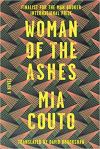
Mia Couto’s Woman of the Ashes — a historical novel — recounts a conflict in the closing days of a major African empire. In the late 19th century in what is now Mozambique, the empire (called the “state of Gaza”) resists the rule of the Portuguese. Imani, the novel’s protagonist, is a fifteen-year-old girl who acts as interpreter for the Portuguese military representative as conflict is imminent. Her family is torn, as one of her brothers fights for the Portuguese and the other for the African empire and as her . This is the first book in a trilogy: the second book is already out in Portuguese. David Brookshaw produced the English translation of Woman of the Ashes. I listened to the audiobook (narrated by Bahni Turpin and Joel Richards) and sometimes got a little lost in the plot, but the prose was gorgeous. Here are a few lines that stood out:
“Before long our nation will be a jumble of scars, a map forged by so many blows that we shall be more proud of the wounds than of the unblemished body we may yet save.”
“The difference between war and peace is as follows: in war, the poor are the first to be killed; in peace, the poor are the first to die. For us women, there’s another difference too: in war, we get raped by those we do not know.”
Men “are scared when women talk, and even more scared when women stay silent.”
“To describe the decrepit building as a ‘barracks’ can only stem from some huge distortion that fails to distinguish between fact and desire.”
“My father was a tuner of the infinite marimba that is the world.”
“Some of us humans share the same fate: we die inside, and are only held together by our similarity to the living we once were.”
“Wars never begin. When we awaken to them, we realize they started long ago.”
“War is a midwife: from the insides of the world, it causes another world to emerge.”
“Dark memories are like an abyss: no one should lean too far over them.”
Filipe Nyusi, current president of Mozambique, said this of the book: “It is better for us to awaken the ghosts than for the ghosts to awaken us.” (Actually, he said, “Mais vale sermos nós a despertarmos fantasmas que fantasmas a despertarem a nós.”)
Sheila Glaser, New York Times: “Couto conjures what he has described as the ‘many and small stories’ out of which history is made, offering a profound meditation on war, the fragility of empire and the ways in which language shapes us.”
Kirkus Review: “A rich historical tale thick with allegory and imagery that recalls Marquez and Achebe.”
Daniel Bokemper, World Literature Today: “A beautiful and grotesque force interweaving history with myth.”
Luísa Gadelha, Diario Centro do Mundo: “A leitura vale a pena tanto pelo prazer literário quanto pelo resgate histórico de Moçambique.”
Caíque Gomez, Poltrona Vip: “Mia Couto mistura história, mito e magia para narrar os horrores da guerra com uma linguagem muito poética, característica marcada do autor, como se ele quisesse nos reconfortar de alguma maneira, como se dentro desses horrores, ele nos devolvesse o humano.”
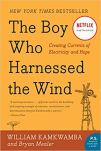
In this memoir, a young man in Malawi has to drop out of secondary school for lack of funds. But with his interest in electronics, access to a modest library, and incredible tenacity, he builds a windmill to generate electricity for his family. The story is inspiring, and it’s not surprising that a movie is coming out soon:
Over the course of the memoir, Kamkwamba gives insight to a range of issues that he and those he loves have faced: surviving a famine, adolescent marriage, getting sent away from school for not having a uniform, having to reduce meals in times of food insecurity, and the HIV crisis (documented in Kim Yi Dionne’s book Doomed Interventions).
I have a couple of quibbles with the book, which necessarily entail spoilers. So if you don’t want those, stop reading now! None of them mean that you shouldn’t read the book. But if you have read the book, I’d be interested in your take.
First, after Kamkwamba builds his windmill and continues to innovate, he ultimately gets “discovered,” first by local media and later by tech types from the U.S. These Westerners sponsor Kamkwamba so that he is able to provide a more stable life for his family and pay the school fees of several of his friends. Kamkwamba goes on to study at elite schools. I’m very happy for him, and I enjoyed hearing about his adventures. But I’m personally less interested in these tales that ultimately hinge on Western charity. (Again, this isn’t a critique of Kamkwamba’s story! It’s just a comment on the kinds of stories I’m most excited to read.)
Second, in the final pages of the book, Kamkwamba calls his fellow Africans to courage: “My fellow students and I talk about creating a new kind of Africa, a place of leaders instead of victims, a home of innovation rather than charity. I hope this story finds its way to our brothers and sisters out there who are trying to elevate themselves and their communities, but who may feel discouraged by their poor situation.” Kamkwamba showed amazing ingenuity and tenacity, but ultimately what pulled him out of poverty was charity. The Western donors weren’t investing in his windmill; they wanted to help out an inspiring kid. I’m glad they did! The story tells us a lot about hard work, but I’m not sure what it tells us about elevating oneself and “innovation rather than charity” (emphasis added).
The audiobook is well read by Chike Johnson. In the ebook — but not the audiobook — there’s a nice epilogue (“about the book”) in which Kamkwamba describes what has happened in his life since the book was published. It seems like he’s doing lots of great work in Malawi and beyond.
This is book #5 in my effort to read a book by an author from every African country in 2019.
Born, raised, and educated through university in Liberia, Jabbeh Wesley has lived in the U.S. for much of her adult life. In 2013, she returned to Liberia for four months, giving birth to much of her most recent poetry collection, When the Wanderers Come Home. With powerful imagery, she describes revisiting the land of her youth, now at peace but still struggling after years of civil war. (This was before the massive Ebola crisis made it to Liberia in 2014.)
In “So I Stand Here,” Jabbeh Wesley characterizes the foreignness of returning home:
I do not know these people
who have so sadly emerged out of the womb
of war after the termite’s feasting.
In “When Monrovia Rises,” she underlines the fear that pervades countries with recurring conflicts:
Everyone here barricades themselves behind steel
doors, steel bars, and those who can afford also
have walls this high. Here, we’re all afraid that one of us may light a match and start the fire again
Not all the poems are specific to post-war Liberia. In “I Need Two Bodies,” Jabbeh Wesley longs for one body to work and to fight through life, and another to rest and to sleep. In “July Rain,” she muses on the role of rain in justifying life choices: “If the rain would stop, we | would stop making babies, they say.” (Of course, as a microeconomist, I ask, Has anyone studied this? I’ve seen work on power outages and fertility and on television ownership and sexual activity, but not on rainfall.)
Here are what a couple of other critics have to say about the book:
Bidisha SK Mamata, Liberian Listener: “At heart When the Wanderers Come Home is a grieving love letter to Liberia, a country that contains her story just as she tries to contain all its stories… Despite the brokenness of what she describes, Wesley’s poetic form is smooth and steady, the neat stanzas and non-rhyming couplets capably containing the most shocking revelations.
Matthew Shenoda, World Literature Today: “In Wesley’s poetry we see the immense power of a poet working to express the human complexity and grief of a nation and her people often defined by war.”
This is book #4 in my effort to read a book by an author from every African country in 2019.
Lesley Nneka Arimah’s debut collection of short stories is a revelation. I first listened to the audiobook — beautifully narrated by Adjoa Andoh — a year ago, and I’ve just re-listened to it. The stories take place in Nigeria, in the U.S., in both. If I had to pick a theme, I’d pick loss, and Arimah explores every cave and crevice extending from that starting point.
Here are a few lines that struck me:
The U.S., a “country that rewards her brand of boldness, in her black of body, with an incredulous fascination that makes her put it away” (from the story “Light”).
A father and his daughter: “He does not yet wonder where she gets this, this streak of fire. He only knows that it keeps the wolves of the world at bay and he must never let it die out” (in “Light”).
“Joy had become a finite meal she begrudged seeing anyone but herself consume” (in “Glory”).
Turning 50, from the perspective of a child: “Mrs. Ajayi was very old, creeping on that age when life begins to lose all meaning, fifty, I think” (in “Redemption”).
A breathtaking collection of stories. The prose is beautiful; it made other books I read or listened to at the same time seem pedestrian. Some of the stories are realistic, others incorporate magical realism. Some take place in Nigeria, others in the U.S., other in both. I’d read a novel by Arimah on any of these stories. One woman observes about her boyfriend: “He didn’t seem to mind how joy had become a finite meal she begrudged seeing anyone but herself consume.” Or a father comments on his daughter: “He should chastise the girl, he knows that, but she is his brightest ember and he would not have her dimmed.” As Marina Warner wrote in the New York Times, “It would be wrong not to hail Arimah’s exhilarating originality: She is conducting adventures in narrative on her own terms, keeping her streak of light, that bright ember, burning fiercely, undimmed.”
At the time of this writing, the ebook on Kindle is available for US$1.99, which is wildly high literary value-for-money.
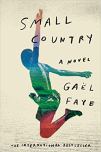
My second book in my effort to read a book by an author from every African country is Gaël Faye’s Small Country. Faye was born and raised in Burundi to a French father and a Rwandan refugee mother. At age 13, he fled to France. Small Country is an autobiographical novel, drawing on Gaye’s childhood experiences.
Here’s my quick take:
Rwanda’s neighbor to the south, Burundi, gets far less attention but also has a deeply troubled history. Faye, born and raised in Burundi to a French father and a Rwandan refugee mother, gives a glimpse at life over the course of coups, civil war, and stealing mangos with the neighborhood boys in this novel. Beautifully written and very evocative, Sarah Ardizzone delivers a lyrical translation into English.
Here are two passages that stood out to me. The first is on the morning of a coup.
I discovered that it was traditional to play classical music during a military coup. On November 28, 1966, for Michael Micombero’s coup, it was Schubert’s piano sonata No. 21; on November 9, 1976, for Jean-Baptiste Bagaza’s coup, it was Beethoven’s 7th symphony; and on September 3, 1987, for Pierre Buyoya’s coup, it was Chopin’s Bolero in C major. On this day, October 21, 1993, we were treated to Wagner’s Twilight of the Gods.
And the other is on genocide, recounted after his mother returns from trying to locate her loved ones after the Rwandan massacre.
Genocide is an oil slick: those who don’t drown in it are polluted for life.
Highly recommended. The audiobook is well narrated by Dominic Hoffman.