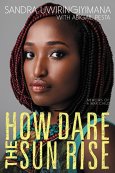
 At this point, there could be a whole genre of “memoirs by youth who fled war-torn African countries”: Earlier this year I read The Girl Who Smiled Beads: A Story of War and What Comes After — about Clemantine Wamariya’s flight from Rwanda at age five and subsequent time in a range of African countries before landing in the U.S. — and in years past I read Ishmael Beah’s memoir of his time as a child soldier in Sierra Leone, A Long Way Gone: Memoirs of a Boy Soldier.
To add to the list, I’ve just read How Dare the Sun Rise: Memoirs of a War Child, by Sandra Uwiringiyimana (written with Abigail Pesta). Uwiringiyimana fled the Democratic Republic of the Congo with her family when she was just ten years old. They moved to a refugee camp in Burundi, where she witnessed her mother and sister shot. (That’s the opening scene of the book.) The book is vivid and compelling in both its recounting of the challenges of day-to-day life as a refugee for a young child (as well as the horrors of the massacre in the Burundian camp) and the subsequent challenges that Uwiringiyimana faced when her family moved to Rochester, New York, as part of a refugee resettlement program. Life isn’t easy for refugees, especially those who’ve undergone profound trauma. Uwiringiyimana’s gradual healing and growth into an activist who speaks on behalf of her people is inspiring. Along the way, she chats with the Obamas, Oprah Winfrey, and others.
This memoir — targeted to young adults but insightful to not-so-young adults as well — moved me. And while I was grateful to learn from Uwiringiyimana’s story, it also left me thinking about the kinds of refugees who end up writing books and those who don’t, and how I look forward to finding even more stories in times to come. This story was a privilege to hear, but I don’t want to get caught in the danger of a single story.
Here are a few passages that impressed me:
-
On education: “My parents deeply valued education. They had big dreams for their kids, and they knew it all started with school.”
-
On getting to school in DRC: “The kids at my school all lived within walking distance. That was the only way for any of us to get to school: on our feet.”
-
On racism in DRC: “At school, the Congolese kids were not always so supportive. They would tease me, mainly because my nose was thinner than theirs, making me look different. Sometimes they would say I wasn’t truly Congolese. Other times they would call me Rwandan. It was meant to be an insult, making me into a foreigner, but I didn’t know what it meant. ‘I’m not Rwandan,’ I would say. ‘I’ve never been to Rwanda. I was born here.’”
-
On twerking: “Where I come from, twerking is not sexualized the way it is in America. The boys sometimes do it better than the girls. Everyone does it. It’s wild and fun and freeing,”
-
On camping as a former refugee: “One day, the youth group invited me along for an overnight party that sounded weird to me—a camping trip. I had never heard of camping. I imagined we would go to the woods and hike and swim, then go to sleep in a bed in a house. When I heard that we would be sleeping on the ground for three days, outside, under a tent, I thought that was insane. People did this on purpose? It sounded like a refugee camp. Goodness, I thought. Are these people so bored, so privileged, that they want to sleep outside on the ground instead of in their comfy beds?”
-
On images of Africa on American TV: “The images of Africa on American TV were all the same: There were the ads for charity groups showing a white lady holding a starving black child, flies landing all over the kid. Indeed, Africans might be poor, but we know how to swat flies.”
-
On the upside of Facebook: “As more survivors of our massacre made their way to America, we began to connect with one another on Facebook, as we were all scattered across the country. And we decided to meet up once a year for a reunion, on the anniversary of the attack in August.
Here is what a few other critics had to say:
-
Elizabeth Bush, Bulletin of the Center for Children’s Books: “Sandra’s account of her transition to America is fully as engrossing as her family’s escape from their war-torn homeland, and her memories of trying to navigate American culture as a twelve-year-old alien desperate to fit in will provoke consideration even with readers who look upon immigrant classmates and neighbors with indifference.”
-
Didier Gondola, Africa Access Review: “How Dare the Sun Rise is not without its flaws. Although her compelling story does elicit her readers’ sympathy for the plight of refugees, the author never really provides a context to help readers understand the history and events that transformed the Great Lakes Region into a cauldron of war. At times, the narrative verges on the trivial and the melodramatic.”
-
Zoe I, TeenReads.com: “HOW DARE THE SUN RISE is a deeply moving and powerful book about strength, resilience and the truth about the American Dream.”
-
Kirkus Reviews: “This hard-hitting autobiography will have readers reeling as it shows one young woman’s challenging path to healing.”
-
Publishers Weekly: “With compassion and perspicacity, Uwiringiyimana shares the journey through which she became a courageous advocate for her tribe and refugees everywhere.”
-
School Library Journal: “The title is a critical piece of literature, contributing to the larger refugee narrative in a way that is complex and nuanced but still accessible for a YA audience.
This is book #31 in my effort to read a book by an author from every African country in 2019.
 The opening story of Sandra Aikaruwa Mushi’s collection of poetry and short tales,
 An adult son has committed an unspeakable crime and narrates from his jail cell, “narrow as a tomb, and just as cold.” (The crime is so unspeakable, in fact, that it isn’t revealed until three-quarters of the way through the book.) A mother narrates from beyond the grave. In this dark novel with dual tellers, Tunisian writer Hassouna Mosbahi illustrates — in
 As Adele boards the bus to return to her boarding school for mixed-race students in Apartheid-era Swaziland (now eSwatini), she learns that a wealthier girl has taken her place in the clique of powerful, popular girls. She suddenly finds herself rooming with Lottie, a low-income student with little respect for social norms, in a room last used by a student who died. But over the course of a school year, a series of adventures and a shared copy of the novel Jane Eyre bring the girls together. In this sweet, engaging book, Swazi born and raised writer Malla Nunn draws on her own experiences (as she discusses
 Ethiopian-born writer
 Léopold Sédar Senghor
 The Old Drift
 “The reading of the last will and testament of Sr. Napumoceno da Silva Araújo ate up a whole afternoon. When he reached the one-hundred-and-fiftieth page, the notary admitted he was already tired and actually broke off to ask that someone bring him a glass of water.” So begins
 Teacher salaries are a point of contention in many countries. But a particular problem in low-income countries is that salary payments will sometimes be delayed for lengthy periods. Ba’bila Mutia’s exciting novel
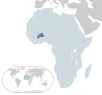 Norbert Zongo, an investigative journalist from Burkina Faso, published his novel
  David Evans' personal blog