junks make the man

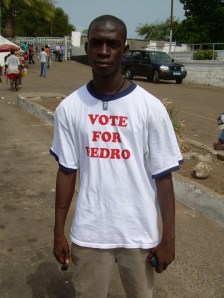
The vast majority of people I’ve seen in Africa (in every country I’ve been to except perhaps South Africa) wear either African traditional dress or – less expensive – used American clothes.

I just listened to an interesting description of the process by which the clothes make it to Africa in Rivoli’s The Travels of a T-shirt in the Global Economy: people donate to the Salvation Army, they pick out what they can sell in their shops and sell the rest to US merchant, who sorts some to send abroad (the best) and the rest to go into mattress stuffing (and like products). A big African merchant buys a gigantic bundle of clothes, which he sells to the vendors I see in the African markets. (Rivoli argues convincingly that this is the only point at which textiles face a genuinely free market.)

Different countries have different words for it: in Tanzania the used clothes are called mitumba (in Swahili), in Sierra Leone they are called junks (in Krio).

Below is a photo of one of my favorites, from the ferry stand in Freetown.  [I spoke with the gentleman: he’s never seen Napolean Dynamite, and I doubt he’s ever voted for Pedro.]
i’m sorry, there’s a problem with your visa…

…I don’t have a pen.  A week ago, I arrived at the Freetown airport in Sierra Leone and waited for the man at the desk to stamp and sign my visa, but he didn’t have a pen.  So I gave him my pen, which he held onto.

This afternoon, I arrived at the Gambia International Airport and waited while the woman at the desk looked, and looked, and then started waving my passport at a colleague in a nearby booth.  Oh, you need a pen?  Use mine, please.  I took it back afterward, but I wonder if perhaps we need a new NGO, making sure passport control agencies are fully stocked in pens.  Anyone looking for a niche?

police corruption!

Greetings from Freetown, Sierra Leone.  Tonight my taxi driver (Capri) picked me up at 8:30 from the office, and soon after we were stopped by a traffic cop for a “routine inspection.”  He checked Capri’s license, inspected the headlights, called Capri out, then told us to go down to the police station.  Capri asked me to step out and look at the headlights: one was slightly dimmer than the other, but both were amply bright and this never would have warranted a citation in the United States.  This cop was looking for just one thing from the taxi with two Americans.

A bystander, a restaurant owner named Daouda [a variation of my own name], intervened and entreated the police officer until he relented and let us go.  Daouda then invited me to his restaurant, an invitation I will most definitely take him up on.

This wasn’t that unique; cops seek bribes all the time and in many countries, but tonight it struck me as particularly onerous, a stark sign of the subversion of the rule of law by money.  I can’t say I’ve never paid a bribe: Once I gave $20 to some Ugandan border guards after 45 minutes of interrogation and a threat of a jail.  But tonight I was prepared to go the mat.  [Of course, it’s easy to “be prepared” to go to the mat until one actually has to.  I had always imagined I’d be cool and collected if I were ever mugged, but the first time it happened – in Arusha, Tanzania, in 2000 – I was a disaster.]

beggars: good or bad for tourism?

Within a couple of weeks, I encountered these portrayals of beggars and their interactions with Westerners in African literature.  First, in Senegalese writer Aminata Sow Fall’s The Beggars’ Strike (1979), a government minister explains his campaign to rid the city of beggars:

How can I explain… Well, you see, nowadays, people who live a long way away, in Europe and the United States of America, White people especially, are beginning to take an interest in the beauty of our country.  These people are called tourists.  You know, in the old days these White people came to rob and exploit us; now they visit our country for a rest and in search of happiness.  That is why we have built hotels and holiday villages and casinos to welcome them. … And when these tourists visit the city, they are accosted by the beggars and we run the risk of their never coming back here or putting out unfavourable propaganda to discourage others who might like to come. (p18)

A quarter century later, Kenyan writer Ngugi wa Thiong’o visits the issue in Wizard of the Crow (2006):

The government also had to be mindful not to upset tourism by sweeping too many beggars off the streets.  Pictures of beggars or wild animals were what many tourists sent back home as proof of having been in Africa.  In Aburiria, wild animals were becoming rare because of dwindling forests and poaching, and tourist pictures of beggars or children with kwashiorkor and flies massing around their runny noses and sore eyes were prized for their authenticity.  If there were not beggars in the streets, tourists might start doubting whether Aburiria was an authentic African country. (p35)

I suspect these are each true, depending on the traveller. 

Africa Reading Challenge: 25 participants + new recommendations

In December 2007 I posted the Africa Reading Challenge and have greatly enjoyed the response: 25 readers have posted reading lists and 14 reviews have been posted on books dealing with countries as diverse as Senegal, Sudan, Sierra Leone, and South Africa.  (The challenge goes throughout the year, so newcomers are welcome!)

Kathleen Sheldon, a researcher focusing on African women’s history, adds some nice suggestions I hadn’t encountered (for the most part), focusing on African authors:

My suggestions: Ousmane Sembene, God’s Bits of Wood (fantastic novel about a railway strike in Senegal); Ellen Kuzwayo, Call Me Woman (South African autobiography); Buchi Emecheta, The Joys of Motherhood (Nigerian novel, she has written several other novels as well) ; and Doreen Baingana, Tropical Fish:Tales from Entebbe (Ugandan stories). For some further ideas about novels, have a look at the book African Novels in the Classroom, edited by Margaret Jean Hay, which includes essays on 24 novels by African writers. Also, see the Feminist Press publications on Women Writing Africa – they now have three regional volumes (southern, east, and west Africa) – these are extensive compilations are probably too much to read for this challenge, but will introduce you to many wonderful women authors.

Also, if you want to read more analytical non-fiction on Africa, Chris Blattman has two lists (one and two).  [I try not to link to Chris’s site more than once a day, but it’s tough.]

obituary of a Ugandan spirit-channeller

As I read the obituary of The Creature from the Black Lagoon in this week’s Economist, I remembered one of that magazine’s most memorable obituaries from last year.  Here is an excerpt:

Alice Auma Lakwena, warrior and spirit-channeller, died on January 17th [2007], aged 50

If you had visited Wang Jok [northern Uganda] in May 1986 you might have seen, sitting beside the water, a young woman of 30 apparently talking to herself.

People from Opit, the railway town where she lived, knew her as Alice Auma. She sold fish and flour with another woman and had had two husbands, both of whom had deserted her because she was barren. But it was not Alice Auma who was sitting by the Nile. She was possessed by a spirit called Lakwena, and he was holding a consultation with all the animals of the park.

They swarmed round him in a huge bellowing crowd, elephants and hippopotami and crocodiles and giraffes, many of them holding up wounded limbs to be healed. Lakwena asked them who was responsible for the civil war in Uganda, in which the Acholi rebels of the north were fighting the troops of Yoweri Museveni’s National Resistance Army. They replied that “the people with two legs” were the violators of peace and Nature. A waterfall and a mountain were interrogated too. They gave back the same answer.

Lakwena and Alice went on to form their own army, the Holy Spirit Mobile Forces.  No weapons:

Each man had burned his witchcraft charms, and had appeased the spirit of anyone he had killed previously; and as the army marched into battle, singing Catholic hymns and with their bare torsos smothered in shea-nut oil, the bullets of the enemy would bounce right off them. Nature, too, was on their side. Water, if they were polite to it and “bought” each river they crossed with coins and shells, would block the enemy or drown him. Stones, if they threw them, would explode like grenades.

If you want to learn more about the trouble in northern Uganda, here is a reading list.

social norms vs market norms

Last week on NPR I enjoyed this interview with Dan Ariely [link to the audio at the top of the page] about his new book, Predictably Irrational.  At the NPR link above, there is an excerpt about social norms vs market norms: Ariely tells the story of an Israeli daycare center which struggled with people picking kids up late.  The center introduced a fine for lateness and found that tardiness actually increased, with the story being that people stopped feeling guilty about being late since they were paying for it.  Then, when the fine was removed, lateness did not fall to its earlier levels, suggesting that once you move from a social norm to a market norm, it’s very difficult to move back.  (Arieli gives other examples of this one-way street in an excerpt from his book.)

This reminds me of the debate in education on intrinsic (I teach because I care!) vs extrinsic (I teach because you pay me!) motivation.  Duflo, Hanna, and Ryan did a project paying teachers to show up to school in India (where teacher absenteeism is a major problem): they found that despite the introduction of extrinsic motivation (which substantially boosted teacher attendance), teachers worked about equally hard at school, suggesting that they didn’t lose their intrinsic motivation.  Unfortunately, this seems to be because the teachers in this sample spent very little time preparing for school, so perhaps they didn’t have much intrinsic motivation to lose.

cuban joke

“One Cuban young woman complains to another. ‘He lied to me! He told me that he was a luggage handler! It turns out, he’s nothing but a neurosurgeon!'”

This fits perfectly with the characterization of Cuba in Daína Chaviano’s excellent El hombre, la hembra, y el hambre [Man, Woman, and Hunger], in which an economics professor becomes a butcher (maybe we’d all be better off) and a literary translator becomes a prostitute, both in order to escape hunger.

The joke (and a detailed explanation) are here.  [HT: Marginal Revolution]