beggars: good or bad for tourism?

Within a couple of weeks, I encountered these portrayals of beggars and their interactions with Westerners in African literature.  First, in Senegalese writer Aminata Sow Fall’s The Beggars’ Strike (1979), a government minister explains his campaign to rid the city of beggars:

How can I explain… Well, you see, nowadays, people who live a long way away, in Europe and the United States of America, White people especially, are beginning to take an interest in the beauty of our country.  These people are called tourists.  You know, in the old days these White people came to rob and exploit us; now they visit our country for a rest and in search of happiness.  That is why we have built hotels and holiday villages and casinos to welcome them. … And when these tourists visit the city, they are accosted by the beggars and we run the risk of their never coming back here or putting out unfavourable propaganda to discourage others who might like to come. (p18)

A quarter century later, Kenyan writer Ngugi wa Thiong’o visits the issue in Wizard of the Crow (2006):

The government also had to be mindful not to upset tourism by sweeping too many beggars off the streets.  Pictures of beggars or wild animals were what many tourists sent back home as proof of having been in Africa.  In Aburiria, wild animals were becoming rare because of dwindling forests and poaching, and tourist pictures of beggars or children with kwashiorkor and flies massing around their runny noses and sore eyes were prized for their authenticity.  If there were not beggars in the streets, tourists might start doubting whether Aburiria was an authentic African country. (p35)

I suspect these are each true, depending on the traveller. 
Africa Reading Challenge: 25 participants + new recommendations

In December 2007 I posted the Africa Reading Challenge and have greatly enjoyed the response: 25 readers have posted reading lists and 14 reviews have been posted on books dealing with countries as diverse as Senegal, Sudan, Sierra Leone, and South Africa.  (The challenge goes throughout the year, so newcomers are welcome!)

Kathleen Sheldon, a researcher focusing on African women’s history, adds some nice suggestions I hadn’t encountered (for the most part), focusing on African authors:

My suggestions: Ousmane Sembene, God’s Bits of Wood (fantastic novel about a railway strike in Senegal); Ellen Kuzwayo, Call Me Woman (South African autobiography); Buchi Emecheta, The Joys of Motherhood (Nigerian novel, she has written several other novels as well) ; and Doreen Baingana, Tropical Fish:Tales from Entebbe (Ugandan stories). For some further ideas about novels, have a look at the book African Novels in the Classroom, edited by Margaret Jean Hay, which includes essays on 24 novels by African writers. Also, see the Feminist Press publications on Women Writing Africa – they now have three regional volumes (southern, east, and west Africa) – these are extensive compilations are probably too much to read for this challenge, but will introduce you to many wonderful women authors.

Also, if you want to read more analytical non-fiction on Africa, Chris Blattman has two lists (one and two).  [I try not to link to Chris’s site more than once a day, but it’s tough.]

obituary of a Ugandan spirit-channeller

As I read the obituary of The Creature from the Black Lagoon in this week’s Economist, I remembered one of that magazine’s most memorable obituaries from last year.  Here is an excerpt:

Alice Auma Lakwena, warrior and spirit-channeller, died on January 17th [2007], aged 50

If you had visited Wang Jok [northern Uganda] in May 1986 you might have seen, sitting beside the water, a young woman of 30 apparently talking to herself.

People from Opit, the railway town where she lived, knew her as Alice Auma. She sold fish and flour with another woman and had had two husbands, both of whom had deserted her because she was barren. But it was not Alice Auma who was sitting by the Nile. She was possessed by a spirit called Lakwena, and he was holding a consultation with all the animals of the park.

They swarmed round him in a huge bellowing crowd, elephants and hippopotami and crocodiles and giraffes, many of them holding up wounded limbs to be healed. Lakwena asked them who was responsible for the civil war in Uganda, in which the Acholi rebels of the north were fighting the troops of Yoweri Museveni’s National Resistance Army. They replied that “the people with two legs” were the violators of peace and Nature. A waterfall and a mountain were interrogated too. They gave back the same answer.

Lakwena and Alice went on to form their own army, the Holy Spirit Mobile Forces.  No weapons:

Each man had burned his witchcraft charms, and had appeased the spirit of anyone he had killed previously; and as the army marched into battle, singing Catholic hymns and with their bare torsos smothered in shea-nut oil, the bullets of the enemy would bounce right off them. Nature, too, was on their side. Water, if they were polite to it and “bought” each river they crossed with coins and shells, would block the enemy or drown him. Stones, if they threw them, would explode like grenades.

If you want to learn more about the trouble in northern Uganda, here is a reading list.

more on whether it matters if Ishmael Beah was telling the truth

A few weeks ago I blogged about whether it was important if Ishmael Beah’s account was not entirely accurate is his memoir A Long Way Gone: Memoirs of a Boy Soldier.  Chris Blattman has posted some thoughtful remarks on the topic.  I agree with his conclusion that it’s “better, I think, to take Dave Eggers’ approach, who penned a superb novel, What is the What, from the real experiences of a young refugee in southern Sudan.”

Still, I think we fool ourselves if we treat memoirs as less fictional than many other historical documents.  So while we wait for writers to admit to their novelization, I recommend a hearty helping of skepticism and a recognition of what we care about.  If Ishmael Beah has incorporated others’ stories within his, then his account still teaches me about the experiences of boy soldiers in Sierra Leone: That is what I was looking for anyway.  If, however, he has invented aspects of the tale, it’s more problematic.  I have no way of knowing, and so I enjoy the tale and assume it resembles the experience of boy soldiers.  Like any other non-fiction account would.

[Historian Aaron Sachs has a great piece on how a newspaper morphed his experience of encountering a dead body while out walking from fact to sort-of-fact.  Unfortunately, the piece is not available on-line so I can’t send you to it, but if you happen to be at Yale, check out “Cold, Hard, Facts,” Palimpsest, Vol. 1, No. 1 (May 2003).  The first page of Sachs’s piece is available as a sample.  What a tease!]

Africa Reading Challenge review: The Beggars’ Strike, by Aminata Sow Fall

While in the Gambia, I picked up several slim volumes of African literature; the first was The Beggars’ Strike, by Senegalese writer Aminata Sow Fall.  My thoughts:

light little satire of class dynamics and superstition

Mour Diaye, the Director of the Department of Public Health and Hygiene, clears the streets of his unnamed African capital of beggars. In return, he hopes to be promoted to vice-president of the nation. To ensure his appointment, he consults a marabout – a Muslim holy man (according to the book’s glossary) – who instructs him to offer a sacrifice to the beggars in their customary locations. But the beggars are all gone!

La Grève Des Bàttu was originally published in French in 1979. In this English translation (from Dorothy Blair) of the little novella, the author pokes fun at government bureaucrats, at superstition, and at hypocrisy of many sorts. The tone is playful and mocking; and the book is a fun, light read.

But the whole plot hangs on one magical assumption which never really worked for me: throughout, the beggars have significant leverage in that all kinds of powerful people are required by their marabouts to give sacrifices to beggars. So when the beggars go on strike, the people have to come and find them. Yet it doesn’t ring true, either in fact or as a plausible suspension of disbelief. While it is entertaining to see long lines of fancy cars pulling up to the home where the beggars have holed up, coughing up the wealthy to make their required offerings, the flight of fancy doesn’t feel quite airworthy.

If you come across this book and want to enjoy some mild satire, I recommend it: I encountered it in a little bookshop in Banjul, the Gambia, and at 99 pages, I figured I had little to lose. But I wouldn’t seek it out. It was made into a film (entitled Bàttu) in the year 2000 [amazingly not available at Blockbuster!], directed by Malian filmmaker Cheick Oumar Sissoko.

If you want satire, I’ve just started Ngugi wa Thiong’o’s Wizard of the Crow (2006): nothing mild there! And if you want another short but compelling example of Senegalese literature, I recently enjoyed Mariama Ba’s So Long a Letter (1981), which explores the travails of women in Senegal’s polygamous society.

how to extract money from foreigners: introductory session

Over the years, I have traveled extensively in environments with lots of poor people, and many such persons have sought to extract money from me in one way or another, many of them ineffectively and a few of them exceedingly effectively (the latter usually resulting in me being unconscious).In my (weak) efforts to make the world a better place, I am offering this free on-line course. In five short lessons (delivered over the coming weeks), you can extract with the best from the “bumsters” of Banjul to the soccer boys of Mombasa.

If you are a potential or an experienced extractor, sharing your own ideas and experience will help you to internalize these principles. If you are an experienced extractee (like myself), your own experiences can help numberless extractors in their efforts to provide for their own material needs as well as those of their families.

Course Outline
Lesson 1: Don’t bring up money with your foreigner on the first date. Or the second date. And don’t bring up an overseas trip or a bank account on the first love letter.

Lesson 2: Do pretend to work for the secret police.

Lesson 3: Don’t use the same pick-up lines as the other 200 would-be extractors.

Lesson 4: Do strangle or drug your foreigner. But don’t kill her.

Lesson 5: Win-win situations: The foreigner can pay you to be his guide, or pay you to leave him alone. You win in both situations.

Week 1 of reading The Wizard of the Crow, by Thiong’o

Shelfari is hosting an on-line book discussion of Kenyan writer Ngugi wa Thiong’o’s newest novel, The Wizard of the Crow. It begins this week with a mere ten pages a day, and I started this afternoon with some entertainingly extreme parody:

[Speaking of the fictional African nation’s ruler] It is said that when he was told that he could not be granted even a minute on the air [in the United States], he could hardly believe his ears or even understand what they were talking about, knowing that in his country he was always on TV; his ever moment – eating…, sneezing, or blowing his nose – captures on camera.

Oh wait, maybe that part isn’t so extreme…

photos from the Gambian fishing community (& other recent photos from Sierra Leone & the Gambia)

I’ve uploaded the last batch of photos from my trip: several from the seashore, a few from a crocodile pool and a nature reserve I visited.  Here they are.

And in case you missed them but are interested, here are the other groups of photos from my recent trip (all previously posted):

ps All the photos are labeled, so if the labels don’t show up, click on the “options” button in the lower right corner of the slide show screen.

a funny thing happened on the way to the airport

Late Saturday afternoon I catch a taxi from Cape Point in the Gambia to the airport, about a half-hour trip.  We’re driving on a four-lane highway with a grassy divider down the middle.  The driver tells me he wants to stop for gas, crosses an opening in the divider, and is about to drive the wrong way down the highway for 150 meters when the car stops and won’t start.  I see a mass of cars coming from the other direction, but I figure this is probably standard fare: sure enough, they veer into the unblocked lane without so much as a honk.

The driver and I hop out and push the car down the highway to the gas station, fill up (or put in enough fumes to get a little further), and the car still won’t start.  The driver opens the hood and starts sucking gasoline out of some tube and spitting it out.  Try again, still won’t start.  More sucking, more spitting.  The car sputters to life and we make our way to the airport.  Glad I had plenty of time.

what i really do (photo)

Sometimes people ask me what I really do while I’m in the Gambia or Sierra Leone or wherever, since I don’t post much about my work on my blog.

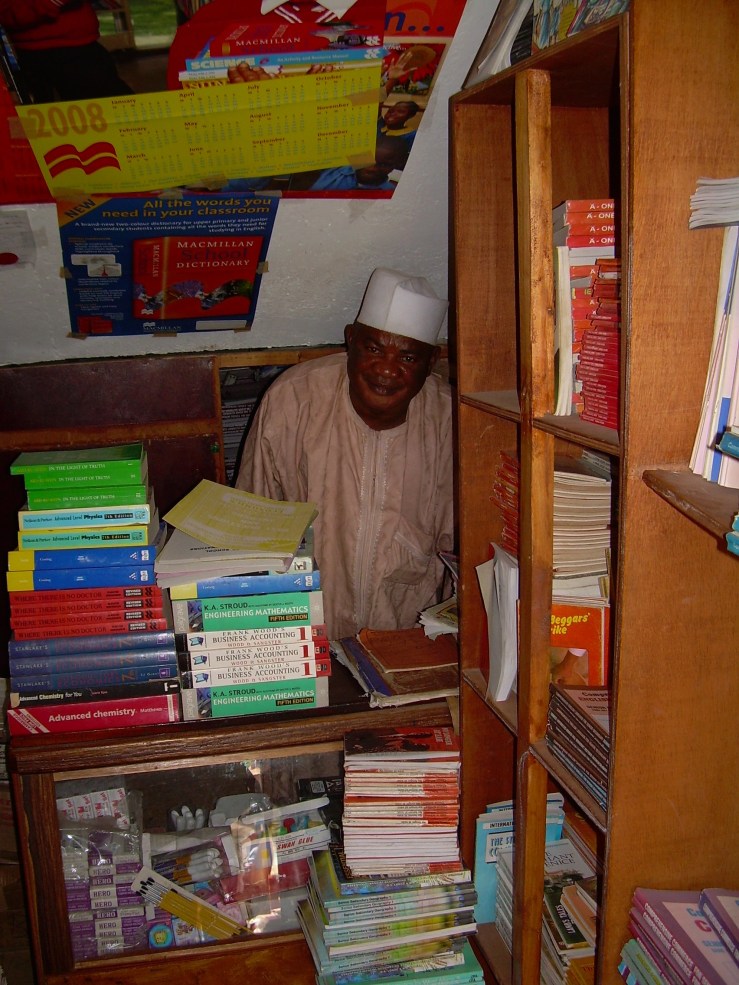
Here’s what I really do: scour tiny bookshops for African literature which is out of print in the West.  If you’re ever in Banjul, the Gambia, stop by the M&B Bookshop at 4 Clarkson St.  It’s the best bookshop in a broom closet I’ve ever seen.  What you can barely see in the photo is that Michael is emerging from a secret back room where he was looking for Gambian literature to satisfy my needs.

bookshop in banjul

Okay, I also have a job.  But more on that another day.