a fresh definition of multi-party democracy

I just finished Wizard of the Crow, a 765 page satire by Ngugi wa Thiongo.  The Ruler of the fictional Aburiria introduces his political philosophy of multiparty democracy:

There are no moral limits to the means that a ruler can use, from lies to lives, bribes to blows, in order to ensure that his state is stable and his power secure.  But if he could keep the state stable through sacrificing truth rather than lives, bending rather than breaking the law, sealing the lips of the oustpoken with endless trickeries rather than tearing them with barbed-wire and hot wax, if he could buy peace through a grand deception rather than a vast display of armored behicles in the streets, which often gave his enemies material for propaganda, it would be the sweetest of victories. (p703)
Herbst’s States & Power in Africa – the heavily abridged version for the concentration-challenged

Jeffrey Herbst’s States and Power in Africa has been recommended to me by various sources, not least of which is Chris Blattman’s recommended reading in Africa list.  But while everyone tells me it’s excellent, I haven’t made much progress.  It’s too dense for my pleasure reading (hello Wizard of the Crow, which I’m still reading), and too off the topics of my own research to read for work.

So today I was pleased (more than pleased: almost giddy) to encounter Harvard professor James Robinson’s ten-page review of Herbst from the Journal of Economic Literature.  Better yet, this ten-page review has a two-page summary of the book in the middle (as well as some interesting analysis).  If you’re not sure you want to invest in Herbst (or if you’re just lazy like me), I highly recommend the Robinson article.  I reproduce an abridged and highlighted version of the two-page summary here:

The starting point of Herbst’s analysis is that Africa is plagued by “state failure.” A state is meant to provide certain public goods in society, such as law and order, defense, contract enforcement,
and infrastructure. Yet in Africa most states provide very few of these.  They are unable to exercise control over much of their territory; they do not provide order or public goods. The literature talks dramatically about state “failure,” even “collapse.” What then is different about African states that leads them to diverge so radically from our ideal?

Continue reading “Herbst’s States & Power in Africa – the heavily abridged version for the concentration-challenged”

free copy of African Psycho for Africa Reading Challenge readers

I received this sweet offer in my in-box:

I just wanted to offer folks participating in the challenge a gratis copy of African Psycho, by Alain Mabanckou. I attach some of the reviews…Any blogger participating the challenge can email me for a gratis copy and they do not need to promise to review it, either!

Just email Richard at Richard AT softskull DOT com.

I took a look at some of the reviews and the book looks well-written, intriguing, and – well – not for everybody.  Here is the Amazon page.  I’m pasting a couple of quotes from professional reviews beneath the fold.

Continue reading “free copy of African Psycho for Africa Reading Challenge readers”

magic man to magic: “i felt like the ‘magic’ was getting between me and my fans

As I walk along the Gambian beaches, I am often approached by young men wanting to be my friend.  Usually on those walks, finding new friends isn’t one of my goals.  Everyone has the same conversation starteds: What’s your name?  Where are you from?  Some time ago, I wrote about adopting a stage name: Magic Man from Brigadoon.

Unfortunately, Magic Man created more questions than it answered, so I’ve shifted to Magic.  From Brigadoon.  Yes, that’s somewhere in Europe.

* The line in the title is from rapper P Diddy.

cab fight! cab fight!

I’m in the Gambia, and on Wednesday morning I needed to get from my hotel to my office early in the morning. None of the hotel-based cabs were around, so I walked out to the highway and got in a van. (“Vans” here are the same as matatus in Kenya and guaguas in the Dominican Republic, minivans that cram a bunch of people in and drive on a set route: basically an unsafe, unreliable bus.)  After a while I saw a taxi stand and got down.I walked up to the first taxi driver and asked for a price to my office; he quoted a reasonable price, so I moved to get in passenger seat of the taxi.  Suddenly a man jumps in front of me, blocking the door, shouting about how I can’t ride with this taxi driver because the driver owes this guy money for two weeks of work.

My initial response is that this particular dispute is not my concern, so I go around the protestor and get in the back seat of the taxi.  The driver gets in, and then the protestor leaps into the front seat of the taxi, puts his hand over the key in the ignition, and begins shouting and arguing with the driver in a language I don’t understand.

I decided to wait ten seconds for the situation to resolve. I counted slowly to ten in my head, got out of the taxi, went to another taxi 30 feet away, and got to work.

the most dangerous country in the world!

A friend asked me if Sierra Leone is the most dangerous country in the world.  Forbes magazine puts out a list of the world’s most dangerous destinations.  And the winners (?) for 2007 were

  • Somalia
  • Iraq
  • Afghanistan
  • Democratic Republic of Congo
  • Cote d’Ivoire
  • Pakistan
  • Burundi
  • Sri Lanka
  • Haiti
  • Chad
  • Lebanon
  • Liberia

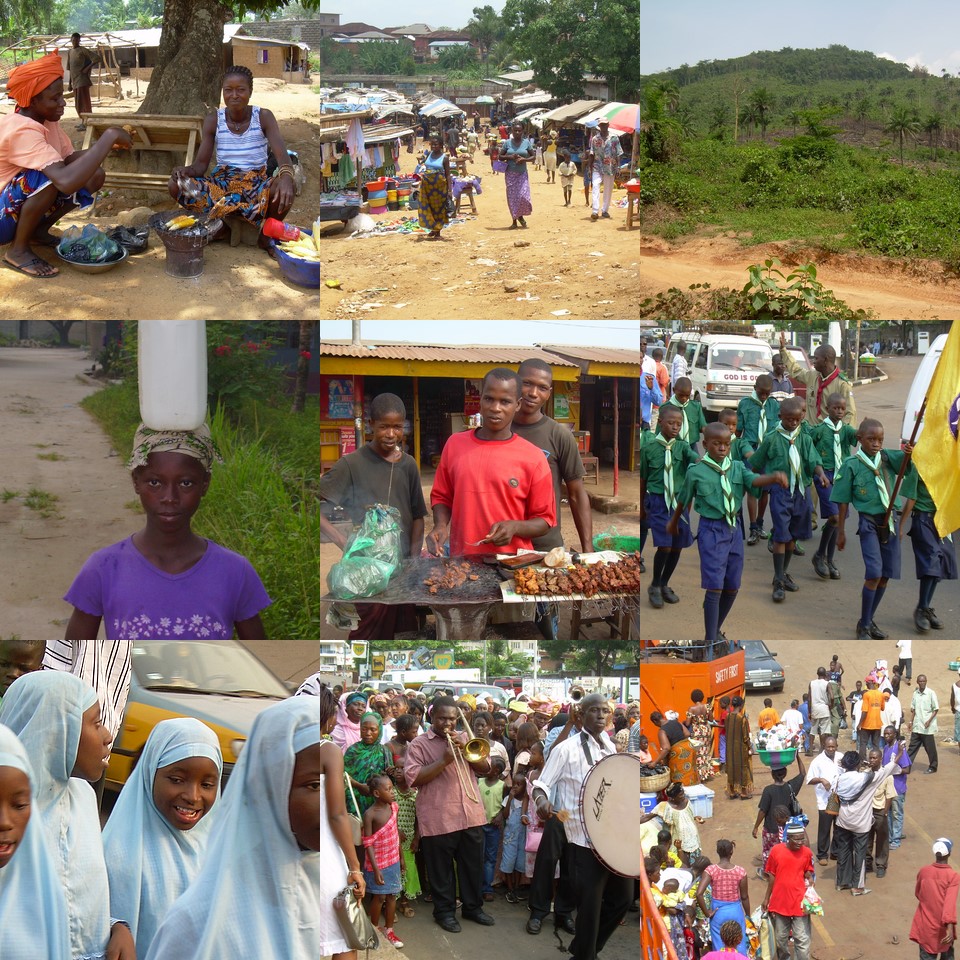
Not even in the top 12!  Sierra Leone was very dangerous when it was in the midst of civil war, but that ended in 2002.  Now, I certainly feel safer in Freetown than in Nairobi (perhaps simply due to the fact that I haven’t yet been mugged in Freetown).

Following the footsteps of Sudhir Venkatesh, I managed to infiltrate one of Freetown’s most insidious street gangs a few days ago.  Luckily, I escaped with my life and this photo.