My brother is working in Lesotho, southern Africa, with the Clinton Foundation for the coming months; he is posting about his experiences over at the Daniel in Africa blog.
a link i enjoyed on taxes
Steve Landsburg (author of The Armchair Economist): Huckabee’s tax plan is brilliant: so why is it getting trashed? I don’t support much of anything about Huckabee (especially that he pointed out that running for president is unlike playing bean bag: how wrong you are, Mr Huckabee!), but his tax plan appealed to me for the reasons Landsburg explains.
Thanks to Greg Mankiw for the pointer.
criticism i’d most like to receive from my boss
“Dave, you’re using too many literary allusions in your casual speech, and people are complaining.”
True criticism to a guy named Dave working for a greeting card company, recounted in my favorite podcast du jour, This American Life (Episode 326, Round 2).
gambian research round-up
Yesterday I flew to Banjul, the Gambia, where I’m working on an impact evaluation of an education project. In economics, it’s tempting to examine the research on the topic and to neglect the place, de-emphasizing context. To add to the education reading I’ve done, I took a look around to see what other recent research has been done in the Gambia. For being continental Africa’s smallest country, there is a lot.
Some of it is far from my subject, like the paper on agriculture-related injuries and rural nursing service. But other research, despite no blatant connection, has the potential to yield real insights into the context of my work. A study on childhood vaccination practices uses qualitative methods to explore why some people are more likely to complete their children’s vaccination schedules, and those reasons could inform my hypotheses as to why some parents are much less active than others in the school management community. Some of the methods used to produce a locally accessible film about tuberculosis could be tentatively applied to make education more accessible.
In searching specifically for papers on the Gambia, I also found education papers that would never have turned up in a general education search but which provide invaluable background. One paper assesses the returns to education in the Gambia; another explores the relationships between democracy and the structure of the Gambian education system. I’m learning my lesson: Read spatial, not just topical.
sierra leonean schools
Last Friday I visited five primary schools, some rural and some urban. Two were right at the heart of what was rebel headquarters during the war. Maybe one of the schools had a decent number of textbooks: all the rest had been robbed at some point. One head teacher showed me the former lock to her office, mangled and broken. Another emptied a box of broken padlocks onto her desk, explaining why the textbooks were being stored in a teacher’s home. Here are some snapshots.
flying on a non-existent airline
This morning I stopped by a local travel agency to confirm my flight for tomorrow from Freetown (Sierra Leone) to Banjul (The Gambia) on Slok Air International.
Travel agent: “That airline isn’t flying.”
Me: “What?”
“They haven’t flown since November.”
“But I just bought this ticket ten days ago.”
Shrug. “You would have to fly Gambia International Airways on Wednesday. Can I book you the ticket?”
Lesson: Always confirm your ticket. In case the airline is still selling tickets but not actually flying anywhere.
commitment devices and my television problem
Commitment devices are important. A friend of mine met a woman in Kenya who planted her sweet potatoes so that they would be ready to harvest just when she needed to pay school fees for her children: that way she wouldn’t be tempted the money from selling the vegetables on other things. In a project in Tanzania providing cash subsidies to poor families, women asked for the cash subsidies to be conditional on keeping their children in school as a commitment device to use the money well.
When I travel, I’m not very good with television. I get tired of the silence in the hotel room and end up turning on the tv to have some sound but end up watching more than is optimal. So I was pleased to see, in my Freetown hotel, that my tv was on a stand with wheels. A perfect opportunity for a commitment device! I asked the staff member who brought me to my room if the tv could be removed. The woman politely explained to me that if I don’t want to watch tv, I can just not turn it on. I said, I know, but I’d love to just not have it in the room. I explained my commitment problem; why not? Can you remove it? We went and asked the manager, who said, “This is very strange. I have never had a guest request this before. If you don’t want to watch the tv, then just don’t turn it on.” The staff woman explained my commitment challenge to the manager. He sent another staff member with me to the room to help me.
When we arrived, the man said, “But it’s already off!” He had been under the impression that the tv was on and I couldn’t figure out how to turn it off. “But if you don’t want to watch…” Yes, I know. “The people with the key to the store[room] come tomorrow, so we can do it tomorrow.” Fine. I unplugged the tv and rolled it into the closet: out of sight, out of mind. That seemed to largely alleviate my commitment problem, so I didn’t follow up.
A couple of days later, I told the manager that I had resolved my problem. He answered, “Oh yes, I spoke with the proprietor. She said, ‘If he doesn’t want to watch tv, he should just leave it off.'” Oh. Now I get it.
Africa Reading Challenge: A Long Way Gone – Memoirs of a Boy Soldier, by Ishmael Beah
Last week, just before coming to Sierra Leone, I finished listening to Ishmael Beah’s memoir of his time running from and then participating in Sierra Leone’s civil war (excellently narrated by Dominic Hoffman). This morning I visited two schools that served as rebel headquarters during the war; this book was very insightful into the impacts of the war here. My thoughts:
skilled storytelling drives this tale of a boy who is both normal (for his time and place) and completely exceptional
Ishmael Beah tells of how his village was destroyed when he was just 11 years old, during Sierra Leone’s civil war of the 1990s. He and his friends wandered to escape the war for many months and then were forcibly enlisted in the military. After two years of fighting, UNICEF rescues him and other boys, and we learn how Ishmael is rehabilitated and reintegrated into civilian society.
Beah is a skilled storyteller, and he gives a compelling account of how the war affects children like him. The first half of the book is the wandering (which is similar to another excellent narrative of boy refugees, What Is the What by Dave Eggers), and the last third focuses on the rehabilitation and Beah’s life beyond. The relatively small middle portion deals with Beah’s time as a child soldier; I would have appreciated more information on that time, but Beah doesn’t need long to paint a clear picture. (I was surprised at the omission of any role of sexual violence, which was apparently significant in the Sierra Leone conflict.) I felt the eye-opening, unique contribution of this book was the story of the rehabilitation. This was in the early days of UNICEF’s and other organizations’ efforts to rehabilitate boy soldiers, and the challenges they faced are striking.
In some ways, Beah’s story feels like two stories. The first three-quarters are the normal: his experience seems to be similar to the experiences of other children in the period. The last quarter is the exceptional: Beah’s story diverges from that of the other boys as he comes to the USA as a UN representative for children affected by the war. Both are of interest, mostly due to Beah’s skills in narrating his tale.
It is natural to compare this to other books about young refugees and child soldiers in Africa. Beasts of No Nation and Moses, Citizen and Me are both novels about boy soldiers, the former focusing on the conflict and the latter on post-conflict re-entrance into the community. Beah’s account is more compelling than either of the novels, partly because it’s more likely to be fact and also simply because he’s a good writer with a powerful story to tell. Child soldiers play a small but crucial role in Adichie’s wonderful Half of a Yellow Sun. Interestingly, Moses, Citizen, and Me revolves around the boys putting on a performance of Shakespeare’s Julius Cesar, and that play also has a role in this memoir.
This book stands out from the others in its vivid and detailed description of the challenge of rehabilitating child soldiers as they withdraw from addictions to both cocaine and violence. A heartening supplement to Beah’s success story is the research of economist Chris Blattman, who finds positive outcomes for former child soldiers in terms of political participation elsewhere in Africa [1].
[1] Blattman, Christopher, “From violence to voting: War and political participation in Uganda,” Center for Global Development and Yale University, 2008.
pictures from the Congo Valley Red Pump
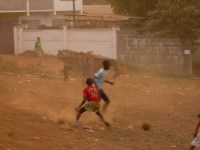
Here are some pictures from my first few days in Freetown. As a teaser, below is one of my favorites, of little boys playing soccer in the shadow of a wrecked car. (For more and in higher quality, follow the link above.)
jogging buffoon, dirty water, & racing from the naked boys
This evening I went for a run. My hotel is near a stream, and I love being near running water. I ran on the road for a while, then starting jogging by the stream, sometimes on a path and sometimes leaping from rock to rock.
I of course have no idea where I’m going, so I repeatedly run into dead ends. There are many people around – homes are built on all sides of the valley surrounding the stream (the Congo Valley Red Pump is the full name) – and every time I run into a dead end and have to backtrack, people laugh good-naturedly. The only way to respond to this is to embrace it: I raise my arms in victory at every dead end and turn around to re-try my luck. It’s my one chance to get laughs, since my irony tends not to fly here.
Jogging along the stream is eye-opening: trash is scattered around every bend, yet people are washing their clothes, bathing, fetching water (I imagine for cooking, but maybe just for washing), and yes, even defacating (i just saw a couple of kids doing this, like peeing in the pool). This may be the only source of water around.
People are in every state of dress and undress, but no one exhibits inhibitions as I go charging past, waving and saying hello or how di bodi in Krio when I’m feeling brave. (I don’t know what anyone’s feeling, obviously.)
At one point, a group of naked six-year-old boys started chasing me up the river. I ran faster.
 David Evans' personal blog