I’m writing from a little guest house in Pretoria, South Africa. I’m here for a week, then on to the Gambia and Sierra Leone.


I’m writing from a little guest house in Pretoria, South Africa. I’m here for a week, then on to the Gambia and Sierra Leone.
“Dave, you’re using too many literary allusions in your casual speech, and people are complaining.”
True criticism to a guy named Dave working for a greeting card company, recounted in my favorite podcast du jour, This American Life (Episode 326, Round 2).
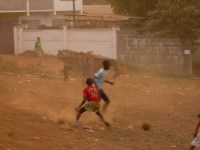
Here are some pictures from my first few days in Freetown. As a teaser, below is one of my favorites, of little boys playing soccer in the shadow of a wrecked car. (For more and in higher quality, follow the link above.)
This evening I went for a run. My hotel is near a stream, and I love being near running water. I ran on the road for a while, then starting jogging by the stream, sometimes on a path and sometimes leaping from rock to rock.
I of course have no idea where I’m going, so I repeatedly run into dead ends. There are many people around – homes are built on all sides of the valley surrounding the stream (the Congo Valley Red Pump is the full name) – and every time I run into a dead end and have to backtrack, people laugh good-naturedly. The only way to respond to this is to embrace it: I raise my arms in victory at every dead end and turn around to re-try my luck. It’s my one chance to get laughs, since my irony tends not to fly here.
Jogging along the stream is eye-opening: trash is scattered around every bend, yet people are washing their clothes, bathing, fetching water (I imagine for cooking, but maybe just for washing), and yes, even defacating (i just saw a couple of kids doing this, like peeing in the pool). This may be the only source of water around.
People are in every state of dress and undress, but no one exhibits inhibitions as I go charging past, waving and saying hello or how di bodi in Krio when I’m feeling brave. (I don’t know what anyone’s feeling, obviously.)
At one point, a group of naked six-year-old boys started chasing me up the river. I ran faster.
“I am a Muslim, and I’m a Chelsea fan.” These were among the first pieces of information I garnered from my cab driver this evening in Freetown.
25 hours ago, I took a cab from my house to the airport in DC. Two long flights and one ferry ride later, here I am at my hotel in Freetown. It’s 1am but the staff party is tonight and the music is deafening (even in my room). I’ll probably go crash for a while (if you can’t beat ’em…).
I’ve got the literary preparation for the trip: yesterday I finished Ishmael Beah’s Memoirs of a Boy Soldier and this evening I started Aminata Forna’s memoir The Devil That Danced on the Water, both of which take place here during Sierra Leone’s long civil war.
I would write more, but the beat is pushing out any and all thought.
I’m off for another long trip, leaving tonight. I hope to keep you apprised of my experiences.
Chris Blattman highlights the after-effects of being a soldier (either child or adult); here is the gist:
In a recent paper I harness near-random variation in who was recruited and who was not to calculate the long term impact of armed conflict on youth.
The answer: former child and adult recruits are a fifth more likely to vote, are more than twice as likely to be community leaders, and are no more violent than their peers. The reason? Violence, it seems, activates and empowers youth as or more often than it defeats them.
Such findings are not limited to Uganda. John Bellows and Ted Miguel find that war deaths in the family lead to greater political interest and activity in Sierra Leone. Psychologists have also found that that exposure to war violence has led to increased political activism among Jewish Holocaust survivors and Palestinian victims of bombardment.
The Kenyan opposition party has said it is shifting tactics from street demonstrations to boycotts:
ODM [Orange Democratic Movement] spokesman Salim Lone told the BBC that from next week, the opposition would switch to other forms of action, such as boycotts of firms run by what he called the government hardliners.
This is good news, only 600 tragic deaths later.
I recommend this posting from Michael Clemens at the Center for Global Development. He explains why brain drain of medical professionals from Africa may not have the dire effects you expect and also how the media has twisted his research to their own ends.
[Thanks to Chris Blattman at one of my favorite blogs for the tip.]
 David Evans' personal blog