not knowing whether aid works vs knowing it doesn’t work

The research exploring the relationship between foreign aid and economic growth has shown a fragile relationship (when it has shown a relationship at all!).  I just enjoyed Aid Effectiveness – Opening the Black Box, by Bourguignon and Sundberg (2007), which gives a nice summary of why we shouldn’t assume that means that aid doesn’t work.  (Rather it means that either aid doesn’t work or we’re measuring aid wrong or we can’t capture how long aid should take right or …)

It is no surprise that reduced form analysis shows tenuous links between aid and development outcomes. Aid has often been for non-developmental objectives, such as disaster relief or for military and political ends. Much aid is lost due to instability and conflict: roughly half of aid to Sub-Saharan Africa has gone to countries facing civil war and/or frequent military coups (Fitzpatrick et al, 2007). Much (though not all) aid has also been wasted on poorly conceived and executed projects and programs, often fettered by debatable conditionality. And from a statistical point of view many technical problems arise: distinguishing short vs. long term impact, problems with endogeneity of the aid-growth relationship, difficulty determining the direction of causality or controlling for country-specific characteristics, etc, (Bourguignon and Leipziger, 2006).

Case studies do not avoid this due to the difficulty of establishing the counterfactual: Easterly (2006) argues that aid is not associated with growth in Africa, whereas Collier (2006) argues that in the absence of aid growth would have been far worse. Moreover, the multi-dimensionality of development objectives-mean income, poverty, literacy, access to sanitation, inoculations-further complicates empirical analysis.
Herbst’s States & Power in Africa – the heavily abridged version for the concentration-challenged

Jeffrey Herbst’s States and Power in Africa has been recommended to me by various sources, not least of which is Chris Blattman’s recommended reading in Africa list.  But while everyone tells me it’s excellent, I haven’t made much progress.  It’s too dense for my pleasure reading (hello Wizard of the Crow, which I’m still reading), and too off the topics of my own research to read for work.

So today I was pleased (more than pleased: almost giddy) to encounter Harvard professor James Robinson’s ten-page review of Herbst from the Journal of Economic Literature.  Better yet, this ten-page review has a two-page summary of the book in the middle (as well as some interesting analysis).  If you’re not sure you want to invest in Herbst (or if you’re just lazy like me), I highly recommend the Robinson article.  I reproduce an abridged and highlighted version of the two-page summary here:

The starting point of Herbst’s analysis is that Africa is plagued by “state failure.” A state is meant to provide certain public goods in society, such as law and order, defense, contract enforcement,
and infrastructure. Yet in Africa most states provide very few of these.  They are unable to exercise control over much of their territory; they do not provide order or public goods. The literature talks dramatically about state “failure,” even “collapse.” What then is different about African states that leads them to diverge so radically from our ideal?

Continue reading “Herbst’s States & Power in Africa – the heavily abridged version for the concentration-challenged”

the best elucidation of the credit crisis i’ve seen so far (and other great podcasts this week)

1. This week’s episode of This American Life has the clearest explanation of the credit crisis I’ve seen: they talk with people in each step of the chain, from homeowners who took mortgages they couldn’t afford, to mortgage brokers, to the banks that bought those mortgages, and on up the chain through Wall Street and to the pool of global savings (they don’t actually talk to someone in the pool of global savings, but they talk to someone at the IMF about the pool).And it’s all in English, not Economese.

The radio program can be listened to on-line here. It’s the best hour I’ve spent this week.

2. The NPR Movies podcast for May 7 has a physicist explaining exactly which suspensions of disbelief are required to accept Iron Man and other superheroes.  You can skip straight to the story here.

3. The Moth podcast for May 9 tells the story of a young African-American woman who goes to work as a health assistant for a terminally ill Klansman. [This one has a little bit of strong language, but not more than you’d hear around town.]

4. This week’s EconTalk has Chris Anderson discussing his next book, all about “the idea that many delightful things in the world are increasingly free–internet-based email with infinite storage, on-line encyclopedias and even podcasts, to name just a few.”  Anderson is the author of The Long Tail and the editor of Wired magazine.  Here is an article by Anderson discussing the major points.

A good week for podcasts.

junks make the man

The vast majority of people I’ve seen in Africa (in every country I’ve been to except perhaps South Africa) wear either African traditional dress or – less expensive – used American clothes.

I just listened to an interesting description of the process by which the clothes make it to Africa in Rivoli’s The Travels of a T-shirt in the Global Economy: people donate to the Salvation Army, they pick out what they can sell in their shops and sell the rest to US merchant, who sorts some to send abroad (the best) and the rest to go into mattress stuffing (and like products). A big African merchant buys a gigantic bundle of clothes, which he sells to the vendors I see in the African markets. (Rivoli argues convincingly that this is the only point at which textiles face a genuinely free market.)

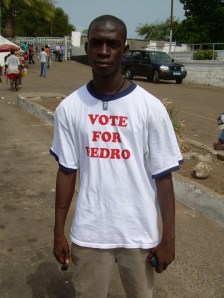
Different countries have different words for it: in Tanzania the used clothes are called mitumba (in Swahili), in Sierra Leone they are called junks (in Krio).

Below is a photo of one of my favorites, from the ferry stand in Freetown.  [I spoke with the gentleman: he’s never seen Napolean Dynamite, and I doubt he’s ever voted for Pedro.]

book review: The Travels of a T-Shirt in the Global Economy: An Economist Examines the Markets, Power, and Politics of World Trade, by Pietra Rivoli

I took a few minutes this afternoon in the Freetown airport to pen some thoughts on this audiobook that I recently listened to.  (Note: you need either a short title or a short sub-title; you can’t have a long title AND a long sub-title.  No good.)  My thoughts:

a brief history of EVERYTHING about your t-shirt, from birth in a Texan cotton field to re-birth in a Tanzanian second-hand clothing market

Allow me to provide a more descriptive title for this volume: What I did last summer + a history of cotton growing in America + a history of cotton mills around the world + a brief history of Shanghai + a brief history of child labor + a brief history of labor activism + a brief history of workplace safety regulations + a not-at-all-brief history of US textile protectionism + a characterization of the international market for used clothes. Interesting? Often.

In the course of all these histories – occasionally interspersed with a reminder that we are following Rivoli’s t-shirt around the world – we jump from England to Japan to Texas to West Africa; we leap back and forth (and back and forth) from century to century. By the middle of the book, I had gotten dizzy and wished it had been a long magazine article.

But in fact, the second half is the most interesting. Rivoli gives a detailed history of textile protectionism in the United States, giving a peek into the dizzying, constantly morphing tariff and quota systems as well as the huge bureaucracy the system supports. And finally, she gives an illuminating description of what happens to the t-shirts after they get donated to the Salvation Army and how they make it to market stalls in East Africa.

Rivoli is an economist and so recognizes that her inherent leaning is toward free trade, but she argues for the value of both sides of the textile battle, both the free traders and the student demonstrators.

The first half of the book feels too long (even though it isn’t that long), and Rivoli’s strength is in illuminating description rather than careful analysis. But if you get bored, just skip ahead to the next chapter: There’s plenty to choose from!

[I listened to the unabridged audiobook narrated by Eliza Foss, published by Recorded Books. The reading is fine, but Foss’s voice is too syrupy sweet and storybookish for 8 CDs (think the voice-over narration from Desperate Housewives).]

want an invention? have a contest!

England, the 1700s:

In traditional methods, the spinning of cotton was far more labor intensive than weaving, as it generally required between four and eight spinners to keep one weaver supplied with yarn.  In desperation, the British government began to sponsor competitions and award prizes to those offering solutions to the
spinning bottlenecks.

James Hargreaves rose to the challenge and patented his spinning jenny in 1770.*

A modern application of this approach to innovation is Advance Market
Commitments for vaccines, announced in today’s news:

Vaccines Deal To Help Poor States

“Six donors are close to approving a groundbreaking $1.5 billion mechanism designed to boost the development and affordable supply of new vaccines to the developing world.

The governments of Italy, the UK, Canada, Russia and Norway, as well as the Bill & Melinda Gates Foundation, will by June agree their support for final recommendations released today on a pilot Advance Market Commitment (AMC) to supply vaccines against pneumococcal disease, which kills 1.6 million people a year.

The AMC provides a guaranteed market for pneumococcal vaccines, underwritten by donors but with an agreement that recipient countries will assume an increasing share of the purchase cost over its lifetime until 2020. …

If judged successful, existing and new donors including Spain, Ireland and the US have already expressed interest in supporting up to two further proposed AMCs: one for malaria vaccines and one for tuberculosis. Initial estimates suggest malaria AMC would require $2.3 billion. …” [The Financial Times (UK)]

* from the painstaking The Travels of a T-Shirt in the Global Economy: An
Economist Examines the Markets, Power, and Politics of World Trade, p74-75.

stories vs statistics

Some of my research has related to the impact of losing a parent on a child’s education in various African contexts. In this work, I have been impressed by the disparity between the dire stories reported in the media and the more hopeful patterns revealed in my statistical analysis.My training is in statistical analysis, but I have been thinking about the value of stories recently. In a recent (excellent) edition of This American Life, I heard the tragic story of a young woman whose mother illegally brought her to the United States as an infant. Now this daughter is finishing college but cannot get a job because of a choice completely out of her hands. The story is sad and yet, without some relevant statistics (How many people are affected by this? to start).

That’s not to say that statistics are always convincing: often they are misleading, either by design or through ignorant misuse. Still, when handled right, they can elucidate the broad patterns in a population. Alternatively, statistics rarely reveal intimate dynamics. (This is not because they couldn’t in principle but because the right data is rarely gathered.) There, a story can illuminate.

Dani Rodrik enunciates a nice (if not earth-shattering) balance in his new book One Economics, Many Recipes:

I believe in the need for both cross-country regressions and detailed country studies. Any cross-country regression giving results that are not validated by case studies needs to be regarded with suspicion. But any policy conclusion that derives from a case study and flies in the face of cross-national evidence needs to be similarly scrutinized. Ultimately, we need both kinds of evidence to guide our views of how the world works. (p4)

the truth about economists?

A good friend of mine (who is not an economist but who has worked with her share) shared the following:

Scene: Our kitchen this afternoon. Ten-year-old fourth grader is eating his after-school snack.

Son: Here is my explanation of the economy: when people have money,
they buy things.
Mom: That’s how economists explain it too.
Son: But they do it in a more complicated and boring way, right?
Mom: Right.

!!!

the credit crisis made (relatively) easy

David Leonhardt of the NY Times makes an effort to explain the credit crisis to laypeople.  It helps.  My favorite line:

I spent a good part of the last few days calling people on Wall Street and in the government to ask one question, “Can you try to explain this to me?” When they finished, I often had a highly sophisticated follow-up question: “Can you try again?”

Update: I just read another version, how Steve Waldman would explain the credit crisis to a kindergartener. [HT: BW]