more on whether it matters if Ishmael Beah was telling the truth

A few weeks ago I blogged about whether it was important if Ishmael Beah’s account was not entirely accurate is his memoir A Long Way Gone: Memoirs of a Boy Soldier.  Chris Blattman has posted some thoughtful remarks on the topic.  I agree with his conclusion that it’s “better, I think, to take Dave Eggers’ approach, who penned a superb novel, What is the What, from the real experiences of a young refugee in southern Sudan.”

Still, I think we fool ourselves if we treat memoirs as less fictional than many other historical documents.  So while we wait for writers to admit to their novelization, I recommend a hearty helping of skepticism and a recognition of what we care about.  If Ishmael Beah has incorporated others’ stories within his, then his account still teaches me about the experiences of boy soldiers in Sierra Leone: That is what I was looking for anyway.  If, however, he has invented aspects of the tale, it’s more problematic.  I have no way of knowing, and so I enjoy the tale and assume it resembles the experience of boy soldiers.  Like any other non-fiction account would.

[Historian Aaron Sachs has a great piece on how a newspaper morphed his experience of encountering a dead body while out walking from fact to sort-of-fact.  Unfortunately, the piece is not available on-line so I can’t send you to it, but if you happen to be at Yale, check out “Cold, Hard, Facts,” Palimpsest, Vol. 1, No. 1 (May 2003).  The first page of Sachs’s piece is available as a sample.  What a tease!]
Africa Reading Challenge review: The Beggars’ Strike, by Aminata Sow Fall

While in the Gambia, I picked up several slim volumes of African literature; the first was The Beggars’ Strike, by Senegalese writer Aminata Sow Fall.  My thoughts:

light little satire of class dynamics and superstition

Mour Diaye, the Director of the Department of Public Health and Hygiene, clears the streets of his unnamed African capital of beggars. In return, he hopes to be promoted to vice-president of the nation. To ensure his appointment, he consults a marabout – a Muslim holy man (according to the book’s glossary) – who instructs him to offer a sacrifice to the beggars in their customary locations. But the beggars are all gone!

La Grève Des Bàttu was originally published in French in 1979. In this English translation (from Dorothy Blair) of the little novella, the author pokes fun at government bureaucrats, at superstition, and at hypocrisy of many sorts. The tone is playful and mocking; and the book is a fun, light read.

But the whole plot hangs on one magical assumption which never really worked for me: throughout, the beggars have significant leverage in that all kinds of powerful people are required by their marabouts to give sacrifices to beggars. So when the beggars go on strike, the people have to come and find them. Yet it doesn’t ring true, either in fact or as a plausible suspension of disbelief. While it is entertaining to see long lines of fancy cars pulling up to the home where the beggars have holed up, coughing up the wealthy to make their required offerings, the flight of fancy doesn’t feel quite airworthy.

If you come across this book and want to enjoy some mild satire, I recommend it: I encountered it in a little bookshop in Banjul, the Gambia, and at 99 pages, I figured I had little to lose. But I wouldn’t seek it out. It was made into a film (entitled Bàttu) in the year 2000 [amazingly not available at Blockbuster!], directed by Malian filmmaker Cheick Oumar Sissoko.

If you want satire, I’ve just started Ngugi wa Thiong’o’s Wizard of the Crow (2006): nothing mild there! And if you want another short but compelling example of Senegalese literature, I recently enjoyed Mariama Ba’s So Long a Letter (1981), which explores the travails of women in Senegal’s polygamous society.

photos from the Gambian fishing community (& other recent photos from Sierra Leone & the Gambia)

I’ve uploaded the last batch of photos from my trip: several from the seashore, a few from a crocodile pool and a nature reserve I visited.  Here they are.

And in case you missed them but are interested, here are the other groups of photos from my recent trip (all previously posted):

ps All the photos are labeled, so if the labels don’t show up, click on the “options” button in the lower right corner of the slide show screen.

a funny thing happened on the way to the airport

Late Saturday afternoon I catch a taxi from Cape Point in the Gambia to the airport, about a half-hour trip.  We’re driving on a four-lane highway with a grassy divider down the middle.  The driver tells me he wants to stop for gas, crosses an opening in the divider, and is about to drive the wrong way down the highway for 150 meters when the car stops and won’t start.  I see a mass of cars coming from the other direction, but I figure this is probably standard fare: sure enough, they veer into the unblocked lane without so much as a honk.

The driver and I hop out and push the car down the highway to the gas station, fill up (or put in enough fumes to get a little further), and the car still won’t start.  The driver opens the hood and starts sucking gasoline out of some tube and spitting it out.  Try again, still won’t start.  More sucking, more spitting.  The car sputters to life and we make our way to the airport.  Glad I had plenty of time.

what i really do (photo)

Sometimes people ask me what I really do while I’m in the Gambia or Sierra Leone or wherever, since I don’t post much about my work on my blog.

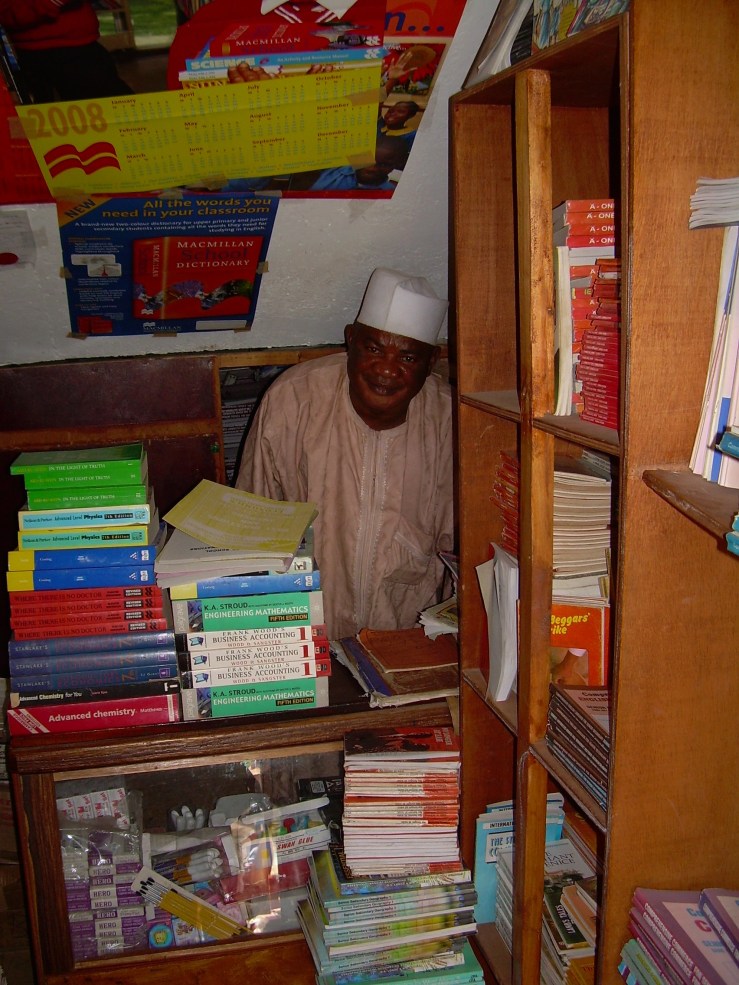
Here’s what I really do: scour tiny bookshops for African literature which is out of print in the West.  If you’re ever in Banjul, the Gambia, stop by the M&B Bookshop at 4 Clarkson St.  It’s the best bookshop in a broom closet I’ve ever seen.  What you can barely see in the photo is that Michael is emerging from a secret back room where he was looking for Gambian literature to satisfy my needs.

bookshop in banjul

Okay, I also have a job.  But more on that another day.

do’s and don’t’s of avoiding street and beach touts

Last time I was in the Gambia, I was constantly approached by touts on the beach, so much so that I adopted an alternative identity.  This visit, I’ve been experimenting with different ways of avoiding undue trouble with hustlers.

Don’t…

  • Pretend to be mute.  I tried this last week, and the beach hustler kept trying to communicate with me in sign language.  The guy would not give up.
  • Falter.  Last night, on my way home from a restaurant, I changed my course because I remembered I wanted to buy water and attracted significant attention.  Hustlers can smell uncertainty.

Do…

  • Walk purposefully.
  • Dress like a boring working person rather than a fun-loving tourist.
  • Mutter to yourself and occasionally start laughing, unprovoked by external stimuli.  (I wish I could claim this was a purposeful ruse, but, well…)

on-line book schedule and discussion for Thiong’o’s The Wizard of the Crow, coming soon

Ngugi wa Thiong’o published this immense book in 2006, The Wizard of the Crow: almost 800 pages of political satire in a fictional African country.  Beachlover over at Shelfari has posted a reading schedule to help people get through it, and there will be an ongoing on-line discussion of the book there as well.  Read this bit from Aminatta Forna’s review of the book in the Washington Post:

Wizard of the Crow is first and foremost a great, spellbinding tale, probably the crowning glory of Ngugi’s life’s work. He has done for East Africa what Ahmadou Kourouma’s Waiting for the Wild Beasts to Vote did for West Africa: He has turned the power of storytelling into a weapon against totalitarianism.

Last year I read Thiong’o’s Petals of Blood and thought highly of it.  Some years ago I also read his The River Between and enjoyed it but not quite as much.  Time for the masterwork!

Wizard of the Crow

non-depressing development fiction: FOUND!

A month ago I posted a query about “upbeat” fiction that takes place in developing countries.  The reason is that my book club is tired of depressing fiction (after Purple Hibiscus and A Thousand Splendid Suns).  Some of the suggestions were odd.  For example, someone called The Poisonwood Bible upbeat; I wonder if they’ve read it.  (I liked it a lot but wouldn’t call it upbeat.)  Here are the suggestions I garnered which seemed like they might really be upbeat, the first two especially:

  1. Hullabaloo in the Guava Orchard, by Kiran Desai (Who knew she wrote a comedy before the devastating Inheritance of Loss?) – India
  2. Last Orders at Harrods, by Michael Holman – Kenya
  3. Red Earth and Pouring Rain, by Vikram Chandra – India
  4. Wizard of the Crow, by Ngugi wa Thiongo – Kenya
  5. The Whale Caller, by Zakes Mda – South Africa
  6. Dona Flor and Her Two Husbands, by Jorge Amado – Brazil
  7. Gabriela, Clove, and Cinnamon, by Jorge Amado – Brazil
  8. Spud, by John van de Ruit – South Africa

And here a few that might be upbeat (I wasn’t totally convinced by those who posted):

  1. Uhuru Street, by MG Vassanji – Kenya
  2. The Gunny Sack, by MG Vassanji – Kenya
  3. Measuring Time, by Helon Habila – Nigeria
  4. The Power of One, by Bryce Courtenay – South Africa