junks make the man

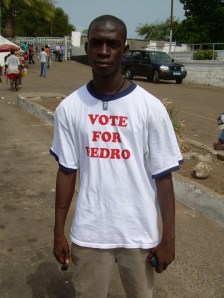
The vast majority of people I’ve seen in Africa (in every country I’ve been to except perhaps South Africa) wear either African traditional dress or – less expensive – used American clothes.

I just listened to an interesting description of the process by which the clothes make it to Africa in Rivoli’s The Travels of a T-shirt in the Global Economy: people donate to the Salvation Army, they pick out what they can sell in their shops and sell the rest to US merchant, who sorts some to send abroad (the best) and the rest to go into mattress stuffing (and like products). A big African merchant buys a gigantic bundle of clothes, which he sells to the vendors I see in the African markets. (Rivoli argues convincingly that this is the only point at which textiles face a genuinely free market.)

Different countries have different words for it: in Tanzania the used clothes are called mitumba (in Swahili), in Sierra Leone they are called junks (in Krio).

Below is a photo of one of my favorites, from the ferry stand in Freetown.  [I spoke with the gentleman: he’s never seen Napolean Dynamite, and I doubt he’s ever voted for Pedro.]
riding a wave of nostalgia to freetown and back

Sierra Leone’s international airport is not in Freetown. By land, it would take many hours to make the trip. Some months ago, there were four options for travel from the airport to Freetown:

1. UN Helicopter (for people with UN passports)
2. Commercial helicopter
3. Hovercraft
4. Ferry

However, in recent months the hovercraft caught fire and has been grounded since (no one was hurt, but luggage was lost). The commercial helicopter has been grounded (I’m not sure why, but I can guess). I don’t have a UN passport, so I take the ferry. (One can also take a tiny speedboat, but I haven’t figured out the logistics yet.)

The last couple of ferry rides, the first-class cabin (costs US$1.50) has been playing a slew of awesome 80s music videos, so awesome that I couldn’t help but sit and watch (rather than wander the deck):
• La Isla Bonita, by Madonna
• Sexual Healing, by Marvin Gaye (they just played the beginning of this non-sensual video – despite the title – and then skipped ahead)
• We Are the World, by everyone in American pop music in the 80s. A bunch of other people in the cabin – all Sierra Leoneans – knew the lyrics to this one and were mildly swaying and mouthing the words.  (You know I was, and people were loving the fact that I was loving We Are the World.)
• The Greatest Love of All, by Whitney Houston
• Sacrifice, by Elton John
• Everything (I Do), by Bryan Adams
• and then nothing less than a UB40 concert video

My 80s craving has been satisfied for at least two hours.

i’m sorry, there’s a problem with your visa…

…I don’t have a pen.  A week ago, I arrived at the Freetown airport in Sierra Leone and waited for the man at the desk to stamp and sign my visa, but he didn’t have a pen.  So I gave him my pen, which he held onto.

This afternoon, I arrived at the Gambia International Airport and waited while the woman at the desk looked, and looked, and then started waving my passport at a colleague in a nearby booth.  Oh, you need a pen?  Use mine, please.  I took it back afterward, but I wonder if perhaps we need a new NGO, making sure passport control agencies are fully stocked in pens.  Anyone looking for a niche?

sierra leonean roads: the people’s amusement park

This afternoon we were driving back from a rural school in Moyamba (Sierra Leone), and the road was so bad that at one point I said “Whoah!” as if riding a roller coaster.  I then explained to my colleagues what a roller coaster and an amusement park were, to which the driver commented, “In Sierra Leone it’s free!” and another colleague responded, “But for us it’s not an amusement.”  So true.

[In the course of the same ride, I saw 8 little piglets running off the road.  8 little piglets!]

police corruption!

Greetings from Freetown, Sierra Leone.  Tonight my taxi driver (Capri) picked me up at 8:30 from the office, and soon after we were stopped by a traffic cop for a “routine inspection.”  He checked Capri’s license, inspected the headlights, called Capri out, then told us to go down to the police station.  Capri asked me to step out and look at the headlights: one was slightly dimmer than the other, but both were amply bright and this never would have warranted a citation in the United States.  This cop was looking for just one thing from the taxi with two Americans.

A bystander, a restaurant owner named Daouda [a variation of my own name], intervened and entreated the police officer until he relented and let us go.  Daouda then invited me to his restaurant, an invitation I will most definitely take him up on.

This wasn’t that unique; cops seek bribes all the time and in many countries, but tonight it struck me as particularly onerous, a stark sign of the subversion of the rule of law by money.  I can’t say I’ve never paid a bribe: Once I gave $20 to some Ugandan border guards after 45 minutes of interrogation and a threat of a jail.  But tonight I was prepared to go the mat.  [Of course, it’s easy to “be prepared” to go to the mat until one actually has to.  I had always imagined I’d be cool and collected if I were ever mugged, but the first time it happened – in Arusha, Tanzania, in 2000 – I was a disaster.]

pronouncing vowels in kikuyu

I’m reading Wizard of the Crow, the longest book ever written in an African language. It was written in Kikuyu, one of Kenya’s main languages, and then translated into English. The author is Ngũgĩ wa Thiong’o. As you can see by his name, Kikuyu has some extra vowels. This afternoon I sat down with a Kikuyu colleague to figure out how to pronounce vowels in Kikuyu:

a as in car*
e as in egg
i as in me
o as in toe
u as in blue
ĩ as in day
ũ as in toe

You’ll note that I’ve given the same pronunciation for o and for ũ. She repeated the difference for me several times and I could finally hear it but the best I can characterize it is that the ũ sounds higher in tone whereas the o sounds lower. Very scientific, I know.

So Ngũgĩ is actually Go-gay: the n is at best very faint. One on-line writer suggests “place your tongue against the back of your front teeth and start to say ‘no.’ But instead of adding the ‘o,’ replace it instead with” go-gay.  But when my friend said it, I essentially couldn’t hear it.

*I’m (obviously) not a linguist; this is my best effort based on chatting with my friend.